
ASVAB · Line scores
Assembling Objects
Assembling Objects is the ASVAB subtest in which a drawing shows the pieces of a figure, or two shapes with a marked point on each, and you pick the drawing that joins them.
- Items
- 15
- Time
- 18 minutes
- Format
- Computer-adaptive
- Answer options
- 4
- Counts toward
- Line scores, not the AFQT
Screens of the trainer
The subtest
Measures
The subtest measures the ability to tell how an object will look once its parts are put together. It is the only spatial subtest of the ASVAB.
It does not count toward the AFQT. It counts toward the line scores the services use to qualify applicants for jobs.
Format
The subtest has 15 items in 18 minutes. It is computer-adaptive: each item is chosen from your earlier answers, and an answer cannot be changed once submitted.
Each item offers four drawings, and you pick one. On paper, the subtest has 25 items in 15 minutes.
Scoring
The subtest is reported as a standard score. Its items are scaled for difficulty, so the score is comparable between test-takers who saw different items.
Item types
Two kinds of item
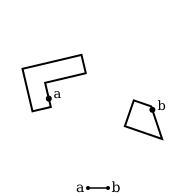
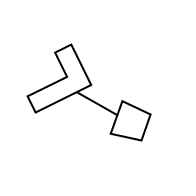
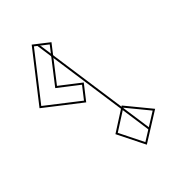
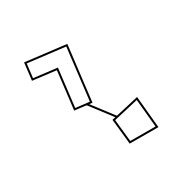
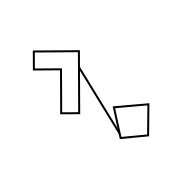
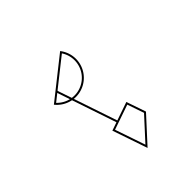
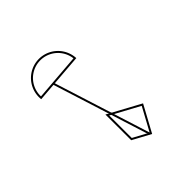
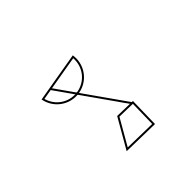
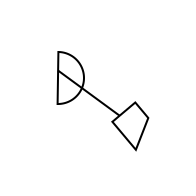
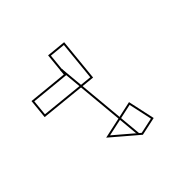
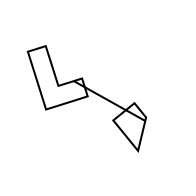
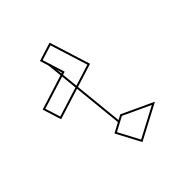
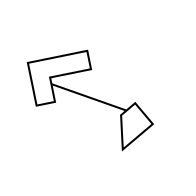
A connection item shows two shapes, with point a marked on one and point b marked on the other. Each of the four drawings joins the two shapes by a line, and you pick the one that joins them at those points.
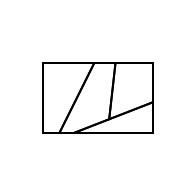
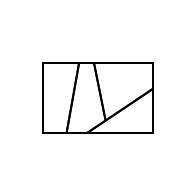
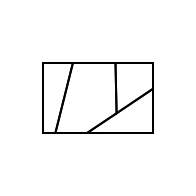
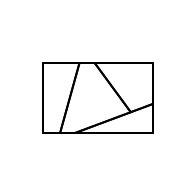
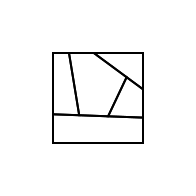
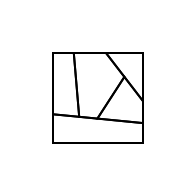
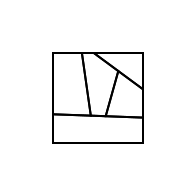
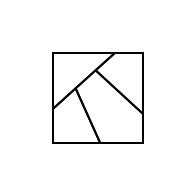
A puzzle item shows loose pieces, and you pick the drawing that shows them fitted together into one figure.
A piece may be turned but never flipped: a mirror image is never the correct answer.
Free practice test
Item 1 of 5
Select the drawing that joins the two objects at points a and b correctly.
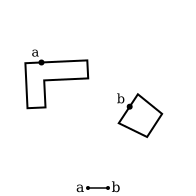
Show the answer
Answer: Drawing 1 of 4, item 1
Item 2 of 5
Select the drawing that shows how the parts above go together correctly.
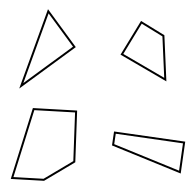
Show the answer
Answer: Drawing 3 of 4, item 2
Item 3 of 5
Select the drawing that joins the two objects at points a and b correctly.
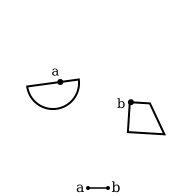
Show the answer
Answer: Drawing 2 of 4, item 3
Item 4 of 5
Select the drawing that shows how the parts above go together correctly.
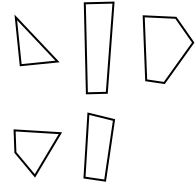
Show the answer
Answer: Drawing 2 of 4, item 4
Item 5 of 5
Select the drawing that joins the two objects at points a and b correctly.
Show the answer
Answer: Drawing 2 of 4, item 5
The Frontline Forge trainer
-
The correct drawing marked
Training runs on the same 18-minute clock as Test mode. After each pick, the correct drawing is marked on its tile and the clock stops until you press Next, and you can go back to the items you have answered.
-
15 items in 18 minutes, ranked
Test mode runs 15 items in 18 minutes, the count and time of the real subtest, with four drawings each. Every session draws 3 easy, 5 medium and 7 hard items from a pool of 3,000, 8 of one kind and 7 of the other.
-
Ranked against other test-takers
Each score is ranked against the scores of other test-takers. The Statistics page plots the ranking of every attempt, so you see whether you are beating more test-takers than before.