
ASVAB · Practice test
Free ASVAB practice test
135 questions: the ten subtests at their real question counts, the right answer after every question, with no account and no clock.
General Science
15 questions
Item 1 of 15
An animal that eats only plants is called a:
Show the answer
Answer: Herbivore
A herbivore eats only plants, the way deer, cows and rabbits feed on grass and leaves.
A carnivore eats other animals, and an omnivore eats both plants and animals.
A decomposer breaks down dead plants and animals instead of eating living plants.
Item 2 of 15
A "light-year" is a unit used to measure what?
Show the answer
Answer: Distance
A light-year is the distance light travels in one year, about 5.9 trillion miles.
Despite the word year in its name, it measures a distance, not a length of time.
Brightness and temperature have their own units, such as magnitude and the kelvin.
Item 3 of 15
What is the term for the force that opposes motion between two surfaces in contact?
Show the answer
Answer: Friction
Friction is the force between two surfaces in contact that resists their sliding past each other.
Inertia is an object's resistance to a change in its motion, and it is not a force.
Momentum is mass times velocity, and gravity pulls masses together whether or not they touch.
Item 4 of 15
A cloud forms mainly when:
Show the answer
Answer: Water vapor condenses into droplets
A cloud forms when rising air cools and its water vapor condenses into tiny droplets or ice crystals.
Sunlight heating the ground warms the air, but no cloud appears until the vapor condenses.
Air pressure never drops to zero in the lower atmosphere, and strong wind alone makes no cloud.
Item 5 of 15
In the visible light spectrum, which color has the longest wavelength?
Show the answer
Answer: Red
Red light has the longest wavelength in the visible spectrum, about 700 nanometers.
Violet has the shortest visible wavelength, about 400 nanometers, at the other end of the spectrum.
Blue and green fall between violet and red, so their wavelengths are shorter than red's.
Item 6 of 15
The asteroid belt is located mainly between which two planets?
Show the answer
Answer: Mars and Jupiter
The main asteroid belt lies between the orbits of Mars and Jupiter, the fourth and fifth planets.
Venus, Earth and Mars are neighboring rocky planets with no belt of asteroids between them.
Jupiter and Saturn are both gas giants, and the space between them holds no asteroid belt.
Item 7 of 15
What happens to the diaphragm when you exhale?
Show the answer
Answer: It relaxes and moves upward
When you exhale, the diaphragm relaxes and domes upward, shrinking the chest cavity and pushing air out.
It contracts and flattens when you inhale, which is the opposite movement.
It moves with every breath, and oxygen enters the blood through the lungs' air sacs, not the diaphragm.
Item 8 of 15
Which mineral property refers to the color of a mineral's powder when scraped across an unglazed surface?
Show the answer
Answer: Streak
Streak is the color of a mineral's powder, seen by rubbing it across an unglazed porcelain plate.
Hardness is resistance to scratching, and luster is how the mineral's surface reflects light.
Cleavage is the way a mineral splits cleanly along flat planes of weakness.
Item 9 of 15
An atom that has gained or lost one or more electrons, giving it an overall electric charge, is called what?
Show the answer
Answer: An ion
An ion is an atom that has gained or lost electrons, so it carries a net electric charge.
An isotope differs in its number of neutrons, which changes the mass but not the charge.
A molecule is two or more atoms bonded together, and a neutron is an uncharged particle.
Item 10 of 15
What do biologists call an alternate form of the same gene, such as one version coding for brown eyes and another for blue eyes?
Show the answer
Answer: An allele
An allele is one version of a gene, such as the brown and blue versions of an eye-color gene.
A codon is a three-letter unit of DNA or RNA that codes for one amino acid.
A chromosome is a long strand of DNA carrying many genes, and the genome is all of an organism's DNA.
Item 11 of 15
Why are noble gases such as helium, neon, and argon generally unreactive?
Show the answer
Answer: They have full outer electron shells
Noble gases have full outer electron shells, so they have little tendency to gain, lose or share electrons.
Helium has only two electrons but argon has eighteen, so having few electrons is not the reason.
Helium is the second-lightest element, so they are not the heaviest elements on the table.
Item 12 of 15
A keystone species is best described as a species that:
Show the answer
Answer: Has an outsized effect on its ecosystem
A keystone species has an effect on its ecosystem far larger than its numbers would suggest.
Keystone species include small animals and plants, not only top predators, and they live in many biomes.
A species that rarely interacts with others could not shape its ecosystem so strongly.
Item 13 of 15
Why are the oldest rocks on the ocean floor found far from mid-ocean ridges rather than right next to them?
Show the answer
Answer: New crust forms at the ridge and pushes older crust away
New ocean crust forms at a mid-ocean ridge and spreads outward, so the farther the rock, the older it is.
Old crust sinks back into the mantle at subduction zones far from the ridge, not beneath it.
Ridges add new crust continuously over geologic time, and ocean currents move sediment, not the solid rock of the seafloor.
Item 14 of 15
As more branches are added to a parallel circuit, the circuit's total resistance will:
Show the answer
Answer: Decrease with each added branch
Each added branch gives the current another path, so the total resistance of a parallel circuit decreases.
Resistance adds up only in a series circuit, where each new resistor increases the total.
The total always stays below the smallest branch resistance, so it never stays the same or becomes infinite.
Item 15 of 15
Why do mitochondria contain their own small set of DNA separate from the nucleus?
Show the answer
Answer: They likely evolved from bacteria engulfed by ancestral cells
Mitochondria likely descend from bacteria that ancestral cells engulfed, and they kept part of the bacteria's DNA.
Their DNA is separate from the nucleus and differs from it, so it is not a copy of nuclear DNA.
Plant and animal mitochondria both carry DNA for the same reason, and most other organelles carry none.
Arithmetic Reasoning
15 questions
Item 1 of 15
A square garden has sides of 12 feet. How many feet of fencing are needed to enclose it?
Show the answer
Answer: 48
A square has four equal sides, so the fencing measures 4 × 12 = 48 feet.
12 feet is one side only, 24 feet covers two sides, and 36 feet covers three.
Item 2 of 15
A parent is 4 times as old as a child, and the child is 8 years old. How old is the parent?
Show the answer
Answer: 32
The parent is 4 times the child's age, so the parent is 4 × 8 = 32 years old.
12 adds 4 to the child's age instead of multiplying, and 4 and 8 only repeat numbers from the problem.
Item 3 of 15
A map's scale reads 1 inch = 12 miles. Two cities are 3 inches apart on the map. How many miles apart are they in reality?
Show the answer
Answer: 36
Each inch on the map stands for 12 miles, so 3 inches stand for 3 × 12 = 36 miles.
9 subtracts 3 from 12, 15 adds them, and 4 divides 12 by 3 instead of multiplying.
Item 4 of 15
A pair of gloves marked $24 is discounted 25%. What is the sale price?
Show the answer
Answer: $18.00
25% of $24 is $6, so the sale price is $24 − $6 = $18.00.
$30.00 adds 25% instead of taking it off, and $19.20 takes off 20% instead of 25%.
$13.50 takes 25% off twice, but the discount is applied only once.
Item 5 of 15
A baker wants to make 8 loaves using a recipe that yields 5 loaves from 10 cups of flour. How much flour is needed?
Show the answer
Answer: 16.00
The recipe uses 10 ÷ 5 = 2 cups of flour per loaf, so 8 loaves need 8 × 2 = 16 cups.
6.25 cups inverts the ratio as 10 × 5 ÷ 8, and 13 cups just adds and subtracts: 10 + 8 − 5.
8 cups would make only 4 loaves, half of the 8 loaves the baker needs.
Item 6 of 15
A shop's monthly revenue over three months was $4,200.00, $4,500.00, and $4,800.00. What is the average monthly revenue?
Show the answer
Answer: $4,500.00
The average is the total divided by the count: $13,500 ÷ 3 = $4,500.00 a month.
$4,800.00 is the highest month, not the average, and $4,350.00 averages only the first two months.
$3,375.00 divides the total by 4 instead of by the 3 months given in the problem.
Item 7 of 15
A warehouse sells rice in a 12-pound sack for $9.00 or a 20-pound sack for $16.20. Per pound, what does the cheaper of the two sacks work out to?
Show the answer
Answer: $0.75
The 12-pound sack costs $9.00 ÷ 12 = $0.75 a pound, the cheaper of the two.
$0.81 is the 20-pound sack, $16.20 ÷ 20, so the larger sack is not the better deal here.
$0.06 is the difference between the two prices, and $0.90 matches neither sack's price per pound.
Item 8 of 15
A worker spends 2/5 of her paycheck and has $360 left. What was the full paycheck?
Show the answer
Answer: $600
Spending 2/5 leaves 3/5 of the paycheck, so each fifth is $360 ÷ 3 = $120 and the paycheck is $600.
$900 treats $360 as the 2/5 spent, and $504 adds 2/5 of $360 instead of solving for the whole.
$612 does not work: spending 2/5 of $612 leaves $367.20, not the $360 in the problem.
Item 9 of 15
A charity divides a $900 donation among three shelters in the ratio 4:3:2. How much does the shelter with the largest share receive?
Show the answer
Answer: $400
The ratio 4:3:2 has 4 + 3 + 2 = 9 parts, so each part is $900 ÷ 9 = $100.
The largest share is 4 parts, or $400, while $300 is the middle share of 3 parts.
$100 is a single part, and $225 divides $900 by 4 instead of by the 9 parts.
Item 10 of 15
A rectangular banner 4 feet by 6 feet is scaled up by a factor of 1.5 in both dimensions for a larger version. What is the area of the larger banner in square feet?
Show the answer
Answer: 54
Scaling 4 by 6 feet by 1.5 gives 6 by 9 feet, so the area is 6 × 9 = 54 square feet.
24 is the original area, and 81 is 9 × 9, as if the new banner were square.
72 triples the area, but scaling both sides by 1.5 multiplies the area by 1.5 × 1.5 = 2.25.
Item 11 of 15
A recycling program's weekly tonnage fell from 80 tons to 68 tons. What was the percent decrease?
Show the answer
Answer: 15.0%
The drop is 80 − 68 = 12 tons, and 12 ÷ 80 = 0.15, a 15.0% decrease.
17.6% divides the drop by the new value, 12 ÷ 68, but percent change uses the starting value.
1.5% of 80 tons is 1.2 tons and 8.1% is about 6.5 tons, both far short of the 12-ton drop.
Item 12 of 15
A batch of 240 bolts is inspected: 3/8 fail the first inspection. Of the bolts that pass, 1/6 fail a second inspection. How many bolts pass both inspections?
Show the answer
Answer: 125
3/8 of 240 is 90 bolts, so 240 − 90 = 150 bolts pass the first inspection.
1/6 of those 150 is 25 bolts, so 150 − 25 = 125 bolts pass both inspections.
150 passes only the first inspection, 90 counts the first round's failures, and 40 is 1/6 of 240.
Item 13 of 15
A cistern is filled by a pipe in 6 hours and emptied by an open valve in 8 hours. Starting from empty with both the pipe and the valve open, how many hours does the cistern take to fill?
Show the answer
Answer: 24
The pipe fills 1/6 of the cistern each hour while the valve drains 1/8 each hour.
The net gain is 1/6 − 1/8 = 4/24 − 3/24 = 1/24 per hour, so filling takes 24 hours.
14 adds the two times and 7 averages them, but opposing rates do not combine that way.
8 is the valve's emptying time, and with water draining, filling must take longer than the pipe's 6 hours.
Item 14 of 15
A worker earning $14 per hour, with time-and-a-half for hours beyond 40 in a week, receives $644 in gross pay for one week. How many hours did the worker work that week?
Show the answer
Answer: 44.00
The first 40 hours pay 40 × $14 = $560, leaving $644 − $560 = $84 of overtime pay.
Overtime pays 1.5 × $14 = $21 an hour, so $84 ÷ $21 = 4 extra hours, or 44 hours in all.
46.00 pays the extra hours at $14 instead of $21, and 30.67 divides all $644 by $21.
52.00 divides $84 by $7, the half-rate bonus alone, instead of by the full $21 overtime rate.
Item 15 of 15
After a 20% markup on cost and then a 25% discount on the selling price, an appliance sells for $216. What was the original cost?
Show the answer
Answer: $240.00
A 20% markup then a 25% discount gives 1.20 × 0.75 = 0.90, so the price is 90% of the cost.
The cost is $216 ÷ 0.90 = $240.00; check: $240 marked up 20% is $288, and 25% off leaves $216.
$288.00 is the marked-up price before the discount, and $180.00 only divides $216 by 1.20.
$227.37 nets the two changes to a 5% drop, but percentages of different bases do not simply add.
Word Knowledge
15 questions
Item 1 of 15
Blend most nearly means
Show the answer
Answer: mix
To blend is to combine things smoothly into one, so the closest word is mix.
Separate is the opposite action, pulling things apart instead of combining them.
Destroy means to ruin something, and examine means to look at it closely.
Item 2 of 15
The climbers began to ASCEND the steep rock face at dawn.
Show the answer
Answer: move upward
To ascend is to climb or rise, so the closest answer is move upward.
Move downward is the opposite direction, the meaning of descend rather than ascend.
Circle means to go around something and rest means to stop moving; neither is climbing.
Item 3 of 15
Hazardous most nearly means
Show the answer
Answer: dangerous
Hazardous means full of risk or danger, so the closest word is dangerous.
Safe is the opposite, describing something that carries no risk of harm.
Simple describes how easy something is, and costly describes how much it costs.
Item 4 of 15
Remedy most nearly means
Show the answer
Answer: solution
A remedy is something that cures an illness or corrects a problem, so the closest word is solution.
A problem is what a remedy fixes, so it names the other side of the situation.
Injury and mistake name kinds of harm or error, which a remedy would set right.
Item 5 of 15
The whole town shared in the family's GRIEF after the loss.
Show the answer
Answer: sorrow
Grief is deep sorrow, especially after a death, so the closest word is sorrow.
Joy is the opposite feeling, and comfort is what others offer to ease grief.
Curiosity is a wish to know or learn something, not a response to a loss.
Item 6 of 15
Mundane most nearly means
Show the answer
Answer: ordinary
Mundane describes something everyday and dull, so the closest word is ordinary.
Exciting is the opposite, describing something that stirs strong interest or feeling.
Dangerous and unpredictable describe risk and uncertainty, not how commonplace something is.
Item 7 of 15
Hamper most nearly means
Show the answer
Answer: hinder
To hamper is to get in the way of progress, so the closest word is hinder.
Help is the opposite, and finish means to bring something to an end.
Postpone means to reschedule for later, while hampering slows something down as it happens.
Item 8 of 15
Even after earning a large bonus, he remained FRUGAL, still clipping coupons and comparing prices before every purchase.
Show the answer
Answer: thrifty
Frugal means careful not to waste money, as clipping coupons shows, so the closest word is thrifty.
Wasteful is the opposite, describing someone who spends money freely and without care.
Curious and restless describe interest and impatience, which the coupons and price checks do not show.
Item 9 of 15
Anomaly most nearly means
Show the answer
Answer: irregularity
An anomaly is something that departs from what is normal or expected, so the closest word is irregularity.
Routine is the opposite, naming the normal pattern that an anomaly breaks from.
Certainty and agreement describe being sure and sharing an opinion, not something out of the ordinary.
Item 10 of 15
Relinquish most nearly means
Show the answer
Answer: give up
To relinquish is to willingly let go of a claim or of control, so the answer is give up.
Seize is the opposite, taking hold of something quickly or by force.
Suppress means to hold something down, and guard against harm means to protect, not to let go.
Item 11 of 15
As the storm began to ABATE, the sailors ventured back onto the deck.
Show the answer
Answer: subside
To abate is to become less intense, so a storm that abates is subsiding.
The sailors went back on deck because the storm was weakening, not lingering or coming back.
Expand is the opposite, growing larger or stronger instead of dying down.
Item 12 of 15
Laconic most nearly means
Show the answer
Answer: terse
Laconic describes someone who uses very few words, so the closest word is terse.
Verbose is the opposite, describing someone who uses more words than are needed.
Hesitant means slow to act or speak, and candid means frank, not brief.
Item 13 of 15
He seemed OBTUSE about the hints she was dropping.
Show the answer
Answer: slow to understand
Obtuse here means slow to understand, which is why he missed the hints she was dropping.
Quick to notice things and clever both describe the sharp mind he plainly lacked.
Brash means rudely bold or loud, which has nothing to do with missing a hint.
Item 14 of 15
Capitulate most nearly means
Show the answer
Answer: surrender
To capitulate is to stop resisting and give in, so the closest word is surrender.
Resist is the opposite, and negotiate means to bargain for terms instead of giving in.
Hesitate means to pause before acting, which delays a decision rather than yielding.
Item 15 of 15
Enervate most nearly means
Show the answer
Answer: weaken
To enervate is to drain of energy or strength, so the closest word is weaken.
Excite is a common trap: enervate sounds like energize but means nearly the opposite.
Distract means to draw attention away, and overwhelm means to defeat or swamp completely.
Paragraph Comprehension
10 questions
Item 1 of 10
An orchard in the Bellcrest region installed netting over its apple trees to keep hail from bruising the fruit before harvest. The netting reduced hail damage claims by roughly ninety percent compared to the previous three seasons. The orchard's manager noted that the netting also cut down on bird damage, though that was not the netting's original purpose.
According to the passage, what was the netting originally installed to prevent?
Show the answer
Answer: Hail damage
The passage says the orchard installed the netting to keep hail from bruising the fruit before harvest.
Less bird damage came as a side benefit, and the manager says it was not the original purpose.
Frost and insects never appear in the passage, so neither can be what the netting was meant to stop.
Item 2 of 10
Public transportation systems, including buses, subways, and light rail, aim to reduce road congestion and give residents an affordable alternative to owning a car. Cities that invest heavily in these networks often see lower rates of traffic accidents and reduced demand for downtown parking space. Riders also save money that would otherwise go toward fuel, insurance, and vehicle maintenance.
In this passage, the word 'congestion' most nearly means:
Show the answer
Answer: heavy crowding of traffic
Transit is offered as an alternative to driving, so reducing road congestion means easing heavy, crowded traffic.
Bus fares, fuel shortages and road repairs are not what fewer cars on the road would reduce.
Item 3 of 10
Farmers in the Kellwood Valley began using soil-moisture sensors buried at root depth to decide when to irrigate their corn fields. Before the sensors, many farmers watered on a fixed weekly schedule regardless of actual soil conditions. The sensors revealed that some fields needed water twice a week during dry spells and none at all after heavy rain. Water use in the valley fell by nearly a fifth within two growing seasons.
What is the main idea of this passage?
Show the answer
Answer: Soil-moisture sensors helped farmers save water
Sensors replaced a fixed weekly schedule, and water use in the valley fell by nearly a fifth.
The fixed schedule was a habit the sensors replaced, not a law, and nothing says corn needs irrigation to grow.
Heavy rain appears only as a time when some fields needed no water, not as damage to the crop.
Item 4 of 10
The trail guide pointed to a faint set of tracks pressed into the mud and told the hikers to follow them carefully, since they would lead directly to the overlook without the risk of getting lost among the unmarked side paths that branched off every quarter mile. She reminded the group to turn back before dusk regardless of how far along the tracks they had gone. The tracks looked fresh enough that the guide guessed another group had passed through only an hour earlier.
In the passage, what does the word 'them' refer to in the phrase 'follow them carefully'?
Show the answer
Answer: The tracks pressed into the mud
The guide points to the tracks in the mud, then tells the hikers to follow them to the overlook.
The hikers are the ones doing the following, so the pronoun cannot point back to them.
The side paths are what the tracks help the hikers avoid, and the overlook is where the tracks lead.
Item 5 of 10
Drought-tolerant wheat varieties are typically bred by crossing existing strains for traits like deeper roots, then testing the offspring under deliberately dry conditions over several growing seasons. Agricultural researchers at a test farm bred a new variety this way that survived a summer with barely half the normal rainfall, yielding nearly as much grain per acre as the standard variety grown under full irrigation nearby. The team credited the new variety's unusually deep root system for reaching moisture other wheat could not.
According to the passage, what did the researchers credit for the new wheat variety's drought survival?
Show the answer
Answer: An unusually deep root system
The team credited the new variety's unusually deep root system for reaching moisture other wheat could not.
Full irrigation watered the standard variety nearby; the new variety survived on barely half the normal rainfall.
The passage mentions neither a shorter growing season nor a special fertilizer applied in dry summers.
Item 6 of 10
Merchants and travelers moved silk, spices, and other goods along the Silk Road, a network of trade routes stretching from China to the Mediterranean for over a thousand years. Ideas, religions, and technologies spread along these routes just as readily as the goods themselves, connecting distant civilizations. Papermaking and gunpowder are both often cited as innovations that traveled westward this way.
What is the main idea of the passage?
Show the answer
Answer: The Silk Road did more than move goods; it linked civilizations through ideas
Ideas, religions and technologies traveled the routes as readily as goods, linking distant civilizations: that is the main point.
The routes ran for over a thousand years, carried spices too, and stretched from China to the Mediterranean.
Armies and military supplies never appear; the passage is about trade and the spread of ideas.
Item 7 of 10
The mural committee reviewed a dozen proposals before making its final selection this year. Its choice was a departure from its usual preference for realistic portraits, opting instead for an abstract design of overlapping shapes and color that several longtime residents found jarring at first. The artist held two public forums to explain the concept before painting began. Reaction has softened somewhat since the mural was completed.
In this passage, 'jarring' most nearly means:
Show the answer
Answer: Sharply disruptive to what one expects
The design broke with the committee's usual realistic portraits, so residents found it sharply disruptive at first.
A break from the usual style is the opposite of being identical to what came before.
Residents needed public forums and time to warm to it, so it was neither instantly pleasing nor forgettable.
Item 8 of 10
Deep knife grooves in a cutting board can trap bacteria that are hard to remove by washing alone, whatever the board is made of. Color-coded plastic boards address this differently: assigning a separate board to each type of food limits contact between raw meat and produce that is eaten uncooked. A restaurant switched from a single well-worn board to a color-coded plastic set after a health inspector's report flagged the deep grooves in the old board as a contamination risk. Six months later, the restaurant reported no cases of cross-contamination flagged during follow-up inspections, compared to two the previous year.
What can be inferred from the passage?
Show the answer
Answer: The color-coded boards likely helped cut cross-contamination
Flagged cross-contamination cases fell from two the previous year to none after the switch, so the boards likely helped.
The inspector's report on the old board's grooves came first and prompted the switch, not the other way around.
Two cases the previous year rule out a clean record before, and no national ban is ever mentioned.
Item 9 of 10
A safety officer at a chemical plant pushed for stricter glove requirements after two minor chemical burns occurred within the same month, both involving gloves that had visibly thinned from repeated use but had not yet been replaced. Some workers grumbled that the new inspection schedule slowed down their shifts. No further burns were reported in the six months after the new inspection schedule began.
What is the author's main purpose in this passage?
Show the answer
Answer: To explain the reasoning behind a new safety policy and workers' reaction to it
The passage gives the reason for stricter glove checks, two burns from worn gloves, and then the workers' reaction.
It reports no burns in the six months after the change, which hardly paints the policy as unnecessary.
Nothing says burns are rare in the industry, and the passage never describes how gloves are made.
Item 10 of 10
Evening filing hours, offered once a week at a small claims court, brought a rise in cases filed by tenants against landlords, a group that had previously been underrepresented among filers during weekday business hours. Court staff noted many of these tenants held jobs that made a weekday visit difficult. The court is now considering adding a second evening session after the first proved popular.
It can be inferred from the passage that weekday business hours most likely:
Show the answer
Answer: Made filing harder for some working tenants
Tenant filings rose once evening hours opened, and staff said many tenants' jobs made weekday visits difficult.
That rise shows the hours did shape who filed, so they had more than little bearing on it.
The passage describes one court only, and it never says weekday hours favored tenants over landlords.
Mathematics Knowledge
15 questions
Item 1 of 15
(−2)³ =
Show the answer
Answer: −8
(−2)³ = (−2) × (−2) × (−2) = −8: an odd power of a negative number stays negative.
8 drops the sign, as an even power would; 6 and −6 multiply the base by 3 instead of cubing it.
Item 2 of 15
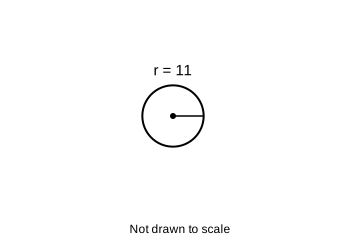
The area of the circle shown, in terms of π, is
Show the answer
Answer: 121π
The area of a circle is πr², and a radius of 11 gives π × 11² = 121π.
22π is the circumference, 2πr, and 11π uses the radius without squaring it.
30π fits no circle formula for this radius, neither the area nor the circumference.
Item 3 of 15
Which number is NOT a factor of 24?
Show the answer
Answer: 9
24 ÷ 9 = 2 with a remainder of 6, so 9 does not divide 24 evenly.
6 × 4, 8 × 3 and 12 × 2 all make 24, so 6, 8 and 12 are all factors.
Item 4 of 15
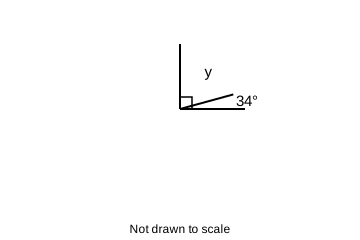
In the figure, the measure, in degrees, of angle y is
Show the answer
Answer: 56
The square mark makes the whole angle 90°, so y = 90° − 34° = 56°.
146 subtracts 34 from 180, which would hold only if the two angles formed a straight line.
22 and 40 do not add with 34 to make the 90° of the right angle.
Item 5 of 15
15% as a fraction in lowest terms is
Show the answer
Answer: 3/20
15% means 15/100, and dividing the top and bottom by 5 gives 3/20 in lowest terms.
3/10 equals 30%, 3/2 equals 150%, and 1/15 is about 6.7%, so none equals 15%.
Item 6 of 15
A standard six-sided die is rolled. What is the probability of rolling a number greater than 4?
Show the answer
Answer: 1/3
Only 5 and 6 are greater than 4: two outcomes out of six, so 2/6 = 1/3.
1/6 counts a single face, and 1/2 counts 4, 5 and 6, wrongly including the 4.
2/3 is the chance of rolling 4 or less, the opposite event.
Item 7 of 15
2 1/4 − 1 1/2 =
Show the answer
Answer: 3/4
In fourths, 2 1/4 − 1 2/4: borrow one whole to get 1 5/4 − 1 2/4 = 3/4.
As decimals the check is quick: 2.25 − 1.5 = 0.75, which is 3/4, not 7/8.
1 1/4 forgets to subtract the half, and 1/2 falls a full quarter short of the difference.
Item 8 of 15
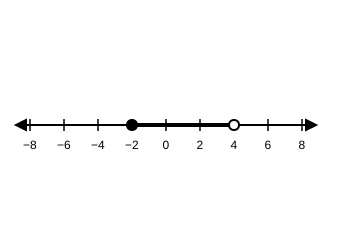
The inequality graphed on the number line shown is
Show the answer
Answer: −2 ≤ x < 4
The shading runs from −2 to 4: the filled dot includes −2, and the open dot leaves out 4.
−2 < x < 4 would need an open dot at −2, and x < −2 would shade to the left of −2.
−2 ≤ x ≤ 6 would run past 4 and end on a filled dot at 6.
Item 9 of 15
(2x²)³ =
Show the answer
Answer: 8x⁶
The power applies to both factors: 2³ = 8 and (x²)³ = x⁶, so the result is 8x⁶.
6x⁶ multiplies 2 by 3 instead of cubing it, and 2x⁶ leaves the 2 uncubed.
8x⁵ adds the exponents 2 and 3, but a power of a power multiplies them.
Item 10 of 15
In a mixture, water and concentrate are in a ratio of 5 : 1. In 18 quarts of mixture, the number of quarts of concentrate is
Show the answer
Answer: 3
5 parts water and 1 part concentrate make 6 parts, so each part is 18 ÷ 6 = 3 quarts.
Concentrate is one part, or 3 quarts; 5 is the water's share of the ratio, not a number of quarts.
6 counts the parts rather than the quarts, and 2 quarts would fit a mixture of only 12 quarts.
Item 11 of 15
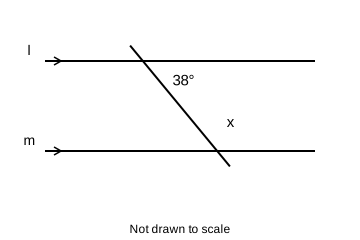
In the figure, lines l and m are parallel and cut by a transversal. The measure, in degrees, of angle x is
Show the answer
Answer: 142
x and the 38° angle sit between the parallels on the same side of the transversal, so x = 180° − 38° = 142°.
38 would be right for alternate interior angles, which lie on opposite sides of the transversal.
104 and 52 match no angle pair formed by a transversal crossing two parallel lines.
Item 12 of 15
√75 in simplest radical form is
Show the answer
Answer: 5√3
75 = 25 × 3, and 25 is a perfect square, so √75 = √25 × √3 = 5√3.
3√5 swaps the two numbers, and 25√3 forgets to take the square root of 25.
15√5 squared is 225 × 5 = 1,125, far more than 75.
Item 13 of 15
If 3 − 2x ≥ −5, then
Show the answer
Answer: x ≤ 4
Subtract 3 to get −2x ≥ −8, then divide by −2 and flip the inequality: x ≤ 4.
x ≥ 4 forgets to flip the inequality when dividing both sides by a negative number.
x ≤ −4 and x ≥ −4 lose the sign: −8 divided by −2 is positive 4.
Item 14 of 15
A fair coin is flipped 3 times. What is the probability of getting exactly 2 heads?
Show the answer
Answer: 3/8
Three flips give 8 equally likely outcomes; HHT, HTH and THH have exactly two heads, so 3/8.
1/8 counts only one order of the two heads, such as HHT.
1/4 is the chance of two heads in two flips, and 1/2 the chance of two heads or more in three.
Item 15 of 15
If 2x − 3y = 4 and x + 2y = 9, then y =
Show the answer
Answer: 2
From x + 2y = 9, x = 9 − 2y; then 2(9 − 2y) − 3y = 4 gives 18 − 7y = 4, so y = 2.
5 is the value of x, not y: x = 9 − 2 × 2 = 5.
y = 1 gives x = 7 and 2(7) − 3 = 11; y = 4 gives x = 1 and 2 − 12 = −10; neither makes 4.
Electronics Information
15 questions
Item 1 of 15
"Amperage" is another common name for which quantity?
Show the answer
Answer: Current
Amperage is the amount of current, measured in amperes, or amps, as on a fuse marked 15 A.
Voltage is measured in volts, power in watts and resistance in ohms, so none of them is amperage.
Item 2 of 15
Which common power source supplies alternating current in the United States?
Show the answer
Answer: A household wall outlet
US wall outlets supply alternating current, about 120 volts at 60 hertz, reversing direction many times each second.
A car battery, a rechargeable AA cell and a flashlight battery all supply direct current, which never reverses.
Item 3 of 15
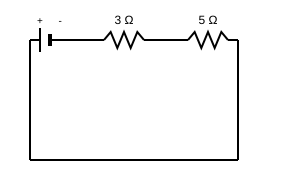
This diagram shows resistors connected in series. What is the total resistance?
Show the answer
Answer: 8 ohms
Resistors in series add directly: 3 ohms + 5 ohms = 8 ohms total.
15 ohms multiplies the two values, which no series or parallel rule does.
12 and 16 ohms do not come from adding the two resistors on the single loop.
Item 4 of 15
What is the main purpose of a capacitor in an electronic circuit?
Show the answer
Answer: To store electrical charge
A capacitor stores electrical charge on two plates separated by an insulator, then releases it when the circuit calls for it.
Limiting current is a resistor's job, and a resistor is also what turns electrical energy into heat.
A rotating magnetic field comes from the windings of a motor, not from a capacitor.
Item 5 of 15
In US household wiring, a black wire most commonly serves as the:
Show the answer
Answer: Hot (live) conductor
In US household wiring, black insulation marks the hot, or live, conductor carrying current from the panel.
White marks the neutral conductor, and green or bare copper marks the ground.
No wire in a circuit is decorative; the color code tells an electrician each wire's job.
Item 6 of 15
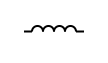
Which of these symbols represents a fixed capacitor?
Show the answer
Answer: Symbol 2 of 4
Two short parallel plates with a gap between them form the symbol for a fixed capacitor.
The stack of shrinking horizontal lines below a single lead is the ground connection symbol.
The row of rounded loops is a coil, or inductor, which builds a magnetic field.
The zigzag line is a resistor, the component that limits the current in a circuit.
Item 7 of 15
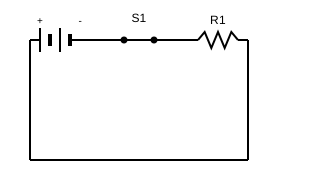
Switch S1 is closed. If it is then opened, what happens to resistor R1?
Show the answer
Answer: It loses power entirely
S1 and R1 sit on the same single loop, so opening S1 breaks the only path and R1 loses power.
It cannot keep operating normally, because no other path joins R1 to the battery once S1 opens.
It cannot burn out, since opening a switch stops current instead of sending more through the resistor.
It draws no current at all, not merely less, because an open switch leaves a gap in the loop.
Item 8 of 15
A tool uses 132 watts at 12 volts. What current does it draw?
Show the answer
Answer: 11 amps
Power equals voltage times current, so current is power divided by voltage: 132 ÷ 12 = 11 amps.
22 amps would draw 264 watts at 12 volts, twice the tool's rating.
16.5 amps would draw 198 watts, and 12 amps would draw 144 watts.
Item 9 of 15
In the American Wire Gauge (AWG) system, which statement about wire size and its gauge number is correct?
Show the answer
Answer: A smaller AWG number means a thicker wire
AWG numbers run backward: 10-gauge wire is thicker than 14-gauge, and 18-gauge is thinner still.
So a larger AWG number means a thinner wire, never a thicker one.
The gauge describes conductor thickness, insulated or bare, so it is tied directly to wire size.
Item 10 of 15
A blown fuse should always be replaced with a new one of:
Show the answer
Answer: The same amperage rating as the original
A fuse is sized to protect the wiring behind it, so its replacement must carry the same amperage rating.
A higher rating lets more current through than the wiring can safely carry, risking overheating or fire.
A lower rating blows under normal load, and fuses of different ratings are not interchangeable.
Item 11 of 15
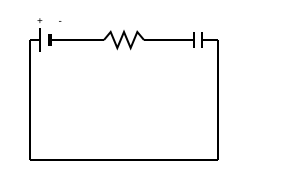
How is the resistor connected relative to the capacitor in this diagram?
Show the answer
Answer: They are connected in series
The resistor and the capacitor sit one after the other on a single path, so they are in series.
In parallel, each part would span the same two connection points on a separate branch of its own.
A series-parallel combination needs a branch somewhere in the circuit, and this loop has no branch at all.
They are connected: a capacitor blocks steady direct current, but a wire still joins it to the resistor.
Item 12 of 15
A typical silicon diode has an approximate forward voltage drop of about:
Show the answer
Answer: 0.7 volt
A forward-biased silicon diode drops about 0.7 volt, the usual rule of thumb for circuit work.
About 0.3 volt is typical of germanium diodes, not silicon ones.
0.1 volt is far too low for a silicon junction, and 1.5 volts is closer to a single battery cell.
Item 13 of 15
A series circuit has three resistors, 1 ohm, 2 ohms, and 7 ohms, with 30 volts applied. What is the voltage drop across the 1-ohm resistor?
Show the answer
Answer: 3 volts
Total resistance is 1 + 2 + 7 = 10 ohms, so the current is 30 ÷ 10 = 3 amps.
Across the 1-ohm resistor, V = I × R = 3 × 1 = 3 volts.
6 volts drops across the 2-ohm resistor; 15 volts would be half the source, and 30 volts all of it.
Item 14 of 15
A 3-ohm resistor is in series with a parallel combination of a 4-ohm and a 12-ohm resistor. What is the total resistance?
Show the answer
Answer: 6 ohms
4 and 12 ohms in parallel give 4 × 12 ÷ (4 + 12) = 48 ÷ 16 = 3 ohms; add the 3-ohm resistor for 6 ohms.
16 ohms adds 4 and 12 as if in series and leaves out the 3-ohm resistor.
7 ohms adds the 3-ohm resistor to the 4-ohm branch and ignores the 12-ohm branch.
11 ohms averages the pair instead of combining it, but parallel resistance is below the smallest branch.
Item 15 of 15
If one of the four diodes in a bridge rectifier fails open, the output becomes:
Show the answer
Answer: Half-wave rectified, with much more ripple
A bridge uses one diode pair on each half of the AC cycle, so one open diode loses one half-cycle.
The output is then half-wave rectified, with gaps between the pulses and much more ripple.
The other three diodes cannot cover the missing path, and the output neither doubles nor reverses polarity.


Auto Information
10 questions
Item 1 of 10
Which engine part turns the pistons' up-and-down motion into rotary motion?
Show the answer
Answer: The crankshaft
Connecting rods push on the crankshaft's offset journals, turning the pistons' up-and-down strokes into rotation.
The camshaft opens and closes the valves, and the timing belt keeps it in step with the crankshaft.
The flywheel bolts to the crankshaft and smooths its rotation, but it does not create it.
Item 2 of 10
In the tire size marking "205/55R16", what does the "205" refer to?
Show the answer
Answer: Tire width in mm
The first number in 205/55R16 is the section width, 205 millimeters from sidewall to sidewall.
The 55 is the sidewall height as a percentage of that width, not a measurement in millimeters.
R means radial construction, and 16 is the rim diameter in inches, not a radius or a rim width.
Item 3 of 10
Which component carries rotating power from the transmission to the rear axle in a rear-wheel-drive vehicle?
Show the answer
Answer: The drive shaft
The drive shaft runs under the car, carrying the transmission's rotation back to the differential and rear wheels.
The parking pawl locks the transmission in Park and carries no power while the car moves.
A tie rod links the steering to the front wheels, and a radiator hose carries coolant.
Item 4 of 10
What does a fuel filter do?
Show the answer
Answer: Removes fuel contaminants
The fuel filter traps dirt and rust particles in the fuel before they reach the pump and injectors.
The fuel pressure regulator holds pressure steady, and the fuel cap's relief valve vents the tank.
Transmission fluid has its own cooler, and the fuel filter never touches it.
Item 5 of 10
What is a likely effect of a loose serpentine (accessory) belt on a running engine?
Show the answer
Answer: A squealing belt noise
A loose belt slips on its pulleys, and the rubber squeals as it slides, often worst at startup.
Slipping also weakens the drive to the alternator, water pump and power steering pump.
A belt only stretches looser with wear, and it has no effect on tire wear or the fuel's octane needs.
Item 6 of 10
The engine won't crank, you hear a single loud click, and the headlights stay bright. What does this most likely point to?
Show the answer
Answer: A faulty starter or solenoid
Bright headlights show a charged battery; one loud click means the solenoid acts but the starter does not turn.
A weak ignition coil spoils the spark, so the engine would crank but fail to start.
The voltage regulator controls charging while the engine runs, and a blown ignition fuse would usually leave no click.
Item 7 of 10
What does slipping mean when applied to an automatic transmission?
Show the answer
Answer: The engine RPM rises without a matching speed gain
A slipping transmission lets engine speed climb while road speed lags, because power is not fully reaching the wheels.
Boiling fluid can cause trouble, but it is not what the word slipping describes.
Stalling at idle and a parking brake releasing by itself are different faults with other causes.
Item 8 of 10
In a compression test, one cylinder reads well below the rest, which are close together. This pattern points to:
Show the answer
Answer: A fault in that one cylinder
One low cylinder among even readings points to a problem in that cylinder, such as a valve or worn rings.
Even wear would lower all the readings together, not leave one far below the rest.
A weak battery slows cranking for every cylinder alike, and the coolant level does not change compression.
Item 9 of 10
What is "caster" in wheel alignment terms?
Show the answer
Answer: Steering axis tilt, side view
Caster is the forward or backward tilt of the steering axis, seen from the side of the vehicle.
That tilt helps the front wheels straighten after a turn and keeps the car stable at speed.
Tread width, lug nuts and tire pressure are tire and wheel details, not alignment angles.
Item 10 of 10
After a brake job, one front wheel drags slightly and gets noticeably hotter than the others after a short drive. This most strongly points to:
Show the answer
Answer: A sticking caliper
A caliper that sticks keeps its pad pressed on the rotor, so that wheel drags and heats up.
A worn pad brakes less, and a soft pedal comes from air in the lines; neither makes a wheel drag.
The hot wheel is at the front, so a warped rear rotor cannot explain it.
Shop Information
10 questions
Item 1 of 10
Emery cloth is an abrasive material typically used for:
Show the answer
Answer: smoothing metal
Emery cloth is a cloth-backed abrasive that smooths, cleans and polishes metal surfaces by hand.
Internal threads are cut with a tap, and clamping takes a clamp or a vise.
Annealing softens metal with heat followed by slow cooling, which no abrasive can do.
Item 2 of 10
A ball-peen hammer is typically used for:
Show the answer
Answer: shaping metal by hand
The rounded peen and flat face of a ball-peen hammer shape metal, set rivets and strike punches.
Lug nuts are tightened with a lug wrench or a socket, never with a hammer.
Finish nails go in with a claw or finish hammer, and bolts are cut with a hacksaw.
Item 3 of 10
A pair of channel-lock (tongue-and-groove) pliers is distinguished mainly by:
Show the answer
Answer: stepped grooves that widen the jaws
The pivot slides into several grooves, so the jaws open much wider than on standard pliers.
A locking lever belongs to locking pliers, and even those release when the lever is opened.
Wire is cut with diagonal cutters, and a fixed opening is exactly what the grooves avoid.
Item 4 of 10
The flutes on a twist drill bit are designed mainly to:
Show the answer
Answer: carry chips and dust out of the hole
The spiral flutes lift chips and dust up and out of the hole while the bit cuts.
The chuck grips the smooth shank at the top of the bit, not the flutes.
Speed and cutting fluid control heat, and flutes weaken the shaft.
Item 5 of 10
A lock washer is used mainly to:
Show the answer
Answer: resist a nut loosening under vibration
A split or toothed lock washer bites into the nut and the surface, so vibration is less likely to back the nut off.
A flat washer spreads the load, a separate job, and loosening faster is the opposite of the goal.
Most lock washers are steel, which conducts electricity, so they insulate nothing.
Item 6 of 10
A keyhole (jab) saw is chosen for a task mainly when the work requires:
Show the answer
Answer: a plunge cut starting mid-panel
The narrow, pointed blade can pierce a panel and start a cut in the middle, as for an outlet box.
A long straight cut through a board calls for a full-size handsaw or a circular saw.
Sheet metal is cut with snips or a hacksaw, and a fine finish needs a fine-toothed saw.
Item 7 of 10
A GFCI (ground-fault) outlet is especially recommended in a shop area that is:
Show the answer
Answer: routinely damp or wet
A GFCI cuts power in a fraction of a second when current leaks, which matters most where moisture invites shock.
Hand tools alone add no particular shock risk, and an area far from water needs it least.
A storage area with no tools in use is where a GFCI matters least.
Item 8 of 10
A "scarf joint" joins two pieces:
Show the answer
Answer: end to end with angled, sloped cuts
A scarf joint joins two pieces end to end along long matching slopes, which gives the glue more surface.
Square-cut pieces butted together form a butt joint, and interlocking pins and tails form a dovetail.
A tenon fits into a mortise cut for it, which makes a mortise-and-tenon joint.
Item 9 of 10
A surface plate in a machine shop provides a reference for:
Show the answer
Answer: checking a part's true flatness
A surface plate is a precisely ground flat block, the reference against which flatness and height are checked.
Internal threads are cut with a tap, and resistance is read on an ohmmeter or multimeter.
Oddly shaped parts are held in a vise or a fixture, while the plate serves only as a flat reference.
Item 10 of 10
Shellac, as a wood finish, is distinguished mainly by:
Show the answer
Answer: dissolving readily in denatured alcohol
Shellac is a resin dissolved in denatured alcohol, which is also what thins it and cleans the brush.
It is used mainly as a wood finish, and it never replaces sanding the wood first.
The alcohol evaporates quickly, so shellac can be recoated within hours, not days.
Mechanical Comprehension
15 questions
Item 1 of 15
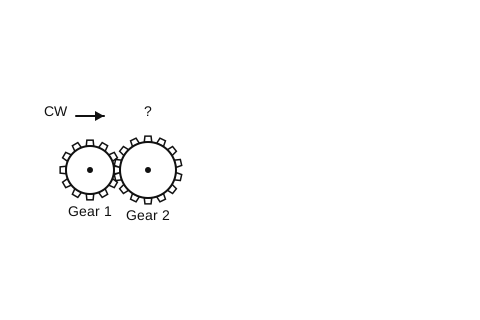
Gear 1 turns clockwise. Gear 1 is the first of the train of meshed gears in the diagram, each meshing with the next. What direction does the LAST gear in the train turn?
Show the answer
Answer: Opposite direction to Gear 1
Meshed gears turn in opposite directions.
Turning the same way would need a third gear between them.
Meshed gears keep turning together, each with a clear direction.
Item 2 of 15
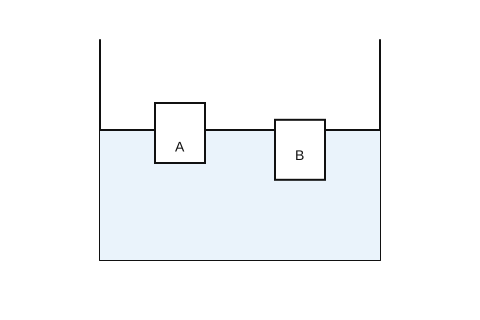
Blocks A and B are the same size but made of different materials. Both are floating at rest in the same tank of water, as shown. Which block is LESS dense?
Show the answer
Answer: Block A
A less dense block floats higher, with less of it underwater.
Block A sits higher than Block B, so A is less dense.
The blocks are the same size and float at different heights.
Item 3 of 15
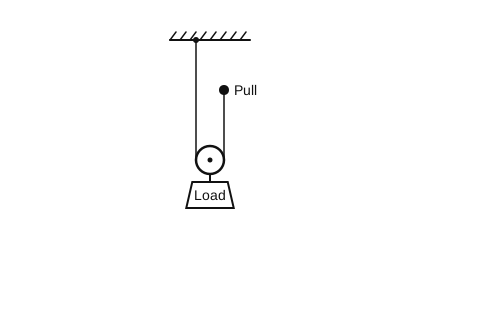
The pulley system shown is used to raise a load. Which statement about the rope pulled through the system, compared to the height the load rises, is TRUE?
Show the answer
Answer: MORE rope is pulled through the system than the load rises
Two rope segments hold the load, so it rises half as far.
This pulley moves up with the load, so it does move.
Pulling less rope than the load rises would need more force.
Item 4 of 15
Springs A and B support identical weights, as shown. Both are stretched from the same natural length. Which spring is stiffer (has the greater spring constant)?
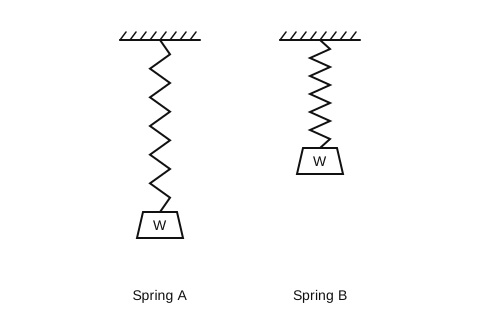
Show the answer
Answer: Spring B is stiffer
Under the same weight, the stiffer spring stretches less.
Spring B stretches less than Spring A, so B is stiffer.
The springs stretch differently, and the longer one is the softer.
Item 5 of 15
Two identical blocks are released from rest, at the same instant, at the top of two identical ramps tilted at the same angle, Surface A and Surface B. Look closely at each surface's texture. Which surface's block reaches the bottom first?
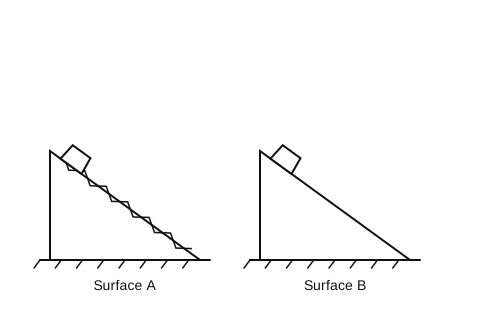
Show the answer
Answer: Surface B
Friction slows a block, and smooth Surface B has less friction.
Rough Surface A slows its block, so it arrives later.
Different friction means different times; roughness never speeds a block up.
Item 6 of 15
Points A and B are marked at different depths inside the same tank of water, as shown. Which point experiences GREATER pressure?
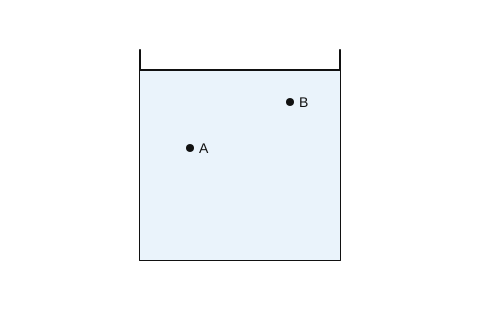
Show the answer
Answer: Point A
Pressure grows with depth; Point A sits deeper than B.
Point B is nearer the surface, so less water presses on it.
Different depths mean different pressures; the tank wall changes nothing.
Item 7 of 15
The lever shown has a load near the pivot and four marked points (A-D) along the effort arm, each at its own distance from the pivot (not in alphabetical order). Which point requires the LEAST force to lift the load?
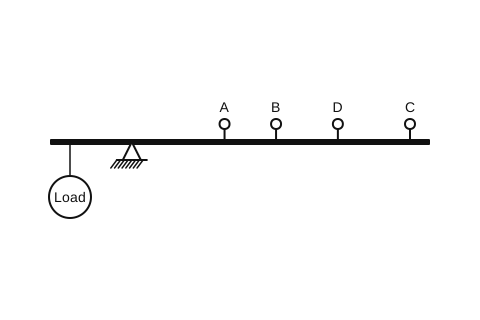
Show the answer
Answer: Point C
Farther from the pivot, the same load needs less force.
Point C is the farthest point from the pivot.
Points A, B and D sit closer, so each needs more force.
Item 8 of 15
A door swings open around the hinge shown. Points A and B mark two places to push it, at different distances from the hinge. Pushing at which point requires the LEAST force to open the door?
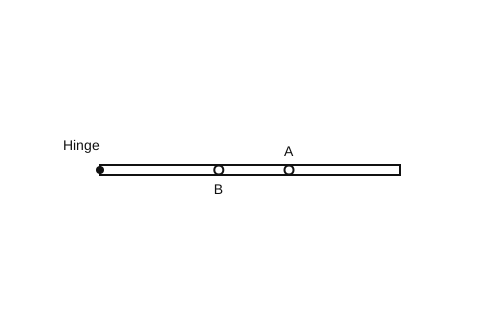
Show the answer
Answer: Point A
A push turns a door more easily farther from the hinge.
Point A is farther from the hinge than Point B.
Different distances need different forces; the door's weight plays no part.
Item 9 of 15
Two identical shelving units, shown side by side with their shelves and stacked load drawn, carry the same load: one stacked near the top, the other near the bottom. Which one is MORE stable (less likely to tip over)?
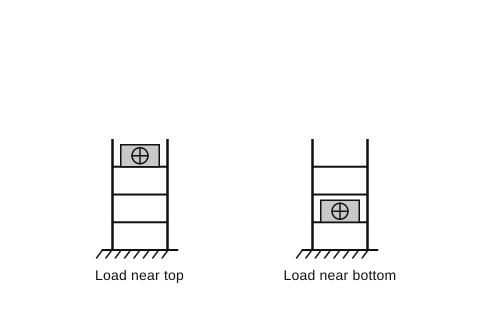
Show the answer
Answer: The shelf with the load near the bottom
A lower center of gravity makes a unit harder to tip.
Loaded on top, a small tilt carries it past the base.
Both units are the same width, so only load height differs.
Item 10 of 15
A beam rests on two supports, A on the left and B on the right, with a single load placed somewhere along its length, as shown. Which support carries the GREATER share of the load (or do they share it equally)?
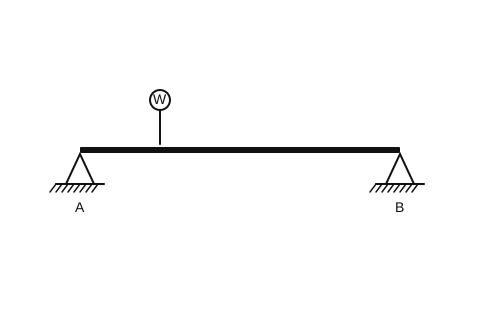
Show the answer
Answer: Support A (left)
The weight hangs much closer to Support A, so A carries more.
Equal shares would need the load at the exact middle.
Both supports share the load; neither sits directly under it.
Item 11 of 15
Two identical springs support the same weight in two separate arrangements, one in series and one in parallel, as shown. The springs are drawn at their natural length. Which arrangement stretches LESS under that weight?
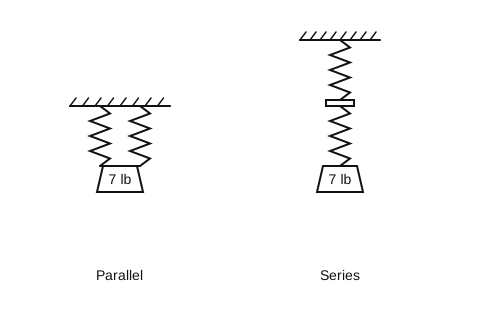
Show the answer
Answer: The parallel arrangement
Side by side, the springs share the weight, so each stretches less.
End to end, each spring carries the full weight; the stretches add.
The springs are identical, so material decides nothing here.
Item 12 of 15
Wedges A and B are shown in the diagram, driven into an identical block of material. Which wedge requires LESS force to split the material?
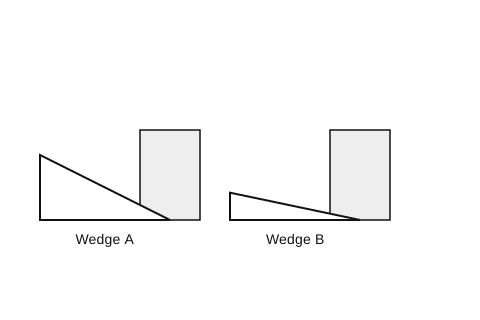
Show the answer
Answer: Wedge B
A thinner wedge acts like a gentler ramp: less force, longer push.
Wedge B has the narrower angle, so it needs less force.
Different angles need different forces, and both wedges can split it.
Item 13 of 15
Objects A and B are shown with their base width and height to scale. If both are tilted slowly from the side, which one tips over FIRST (at the smaller tilt angle)?
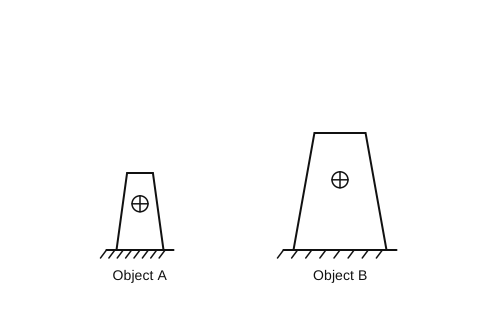
Show the answer
Answer: Object A
An object tips once its center of gravity passes the base edge.
Object A's narrow base lets it tip at a smaller angle.
Taller Object B tips later thanks to its much wider base.
Item 14 of 15
Screws A and B are shown in the diagram, each driven the same depth into identical material. Look closely at the thread spacing on each. Which screw requires MORE turns to reach the same depth?
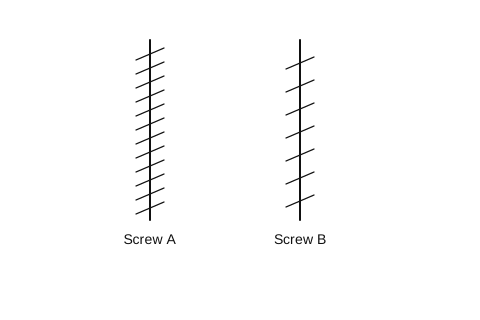
Show the answer
Answer: Screw A
Each turn drives a screw forward by one thread spacing.
Screw A's threads sit closer, so it needs more turns.
Different spacing means different turn counts; both screws drive in.
Item 15 of 15
The weight hangs at rest from two ropes anchored to the ceiling at the angles shown. Which rope, if either, is under GREATER tension?
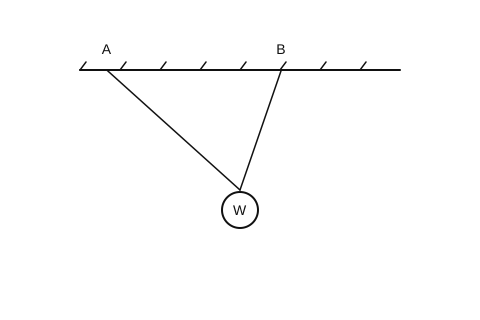
Show the answer
Answer: Rope B
The rope closer to vertical carries more of the weight.
Rope B hangs steeper, so it carries more tension.
Rope B is shorter yet carries more; different angles mean unequal tensions.
Assembling Objects
15 questions
Item 1 of 15
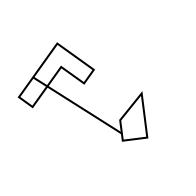
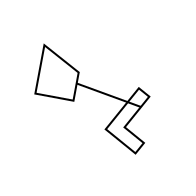
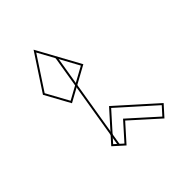
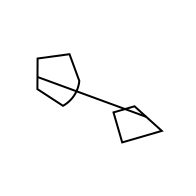
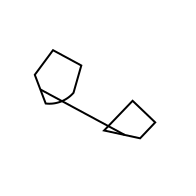
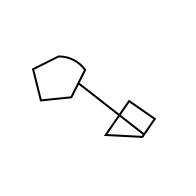
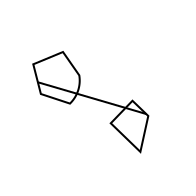
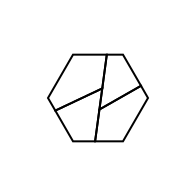
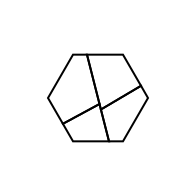
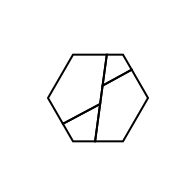
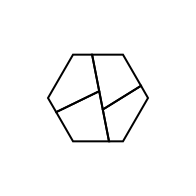
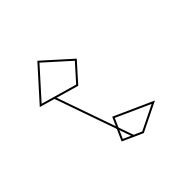
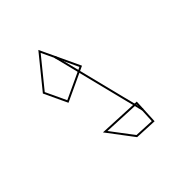
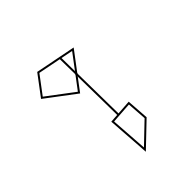
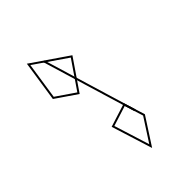
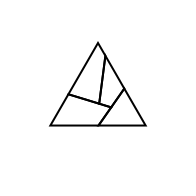
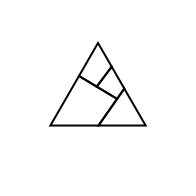
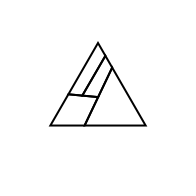
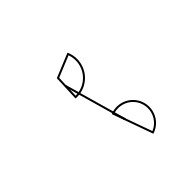
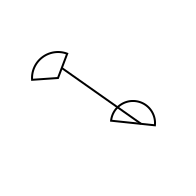
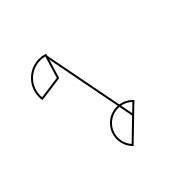
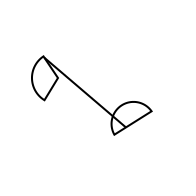
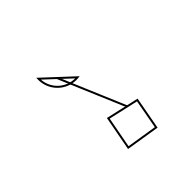
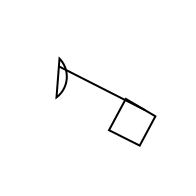
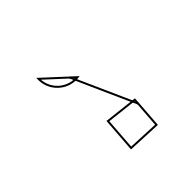
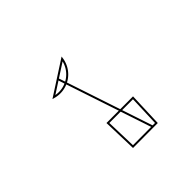
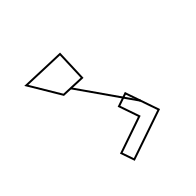
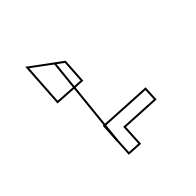
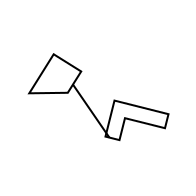
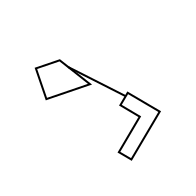
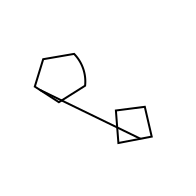
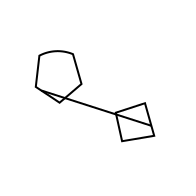
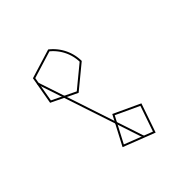
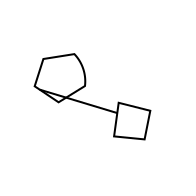
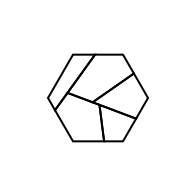
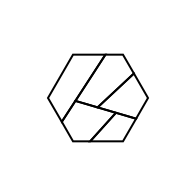
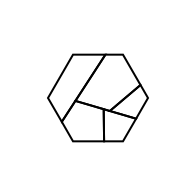
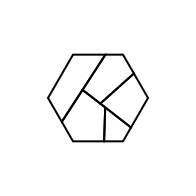
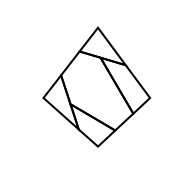
Select the drawing that joins the two objects at points a and b correctly.
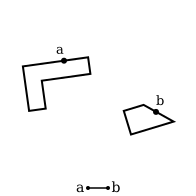
Show the answer
Answer: Drawing 4 of 4, item 1
Item 2 of 15
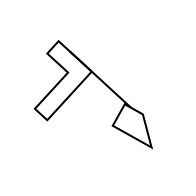
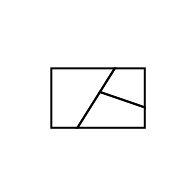
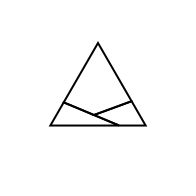
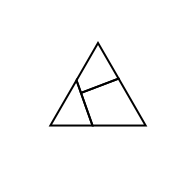
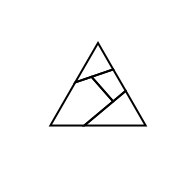
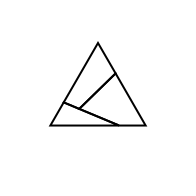
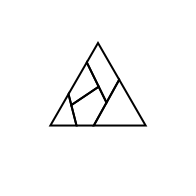
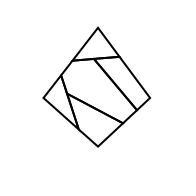
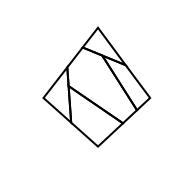
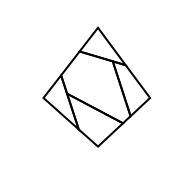
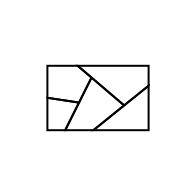
Select the drawing that shows how the parts above go together correctly.
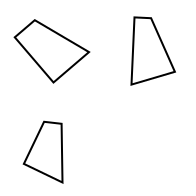
Show the answer
Answer: Drawing 1 of 4, item 2
Item 3 of 15
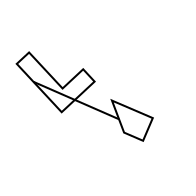
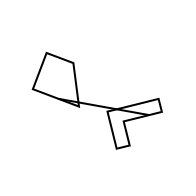
Select the drawing that joins the two objects at points a and b correctly.
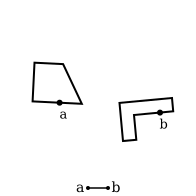
Show the answer
Answer: Drawing 3 of 4, item 3
Item 4 of 15
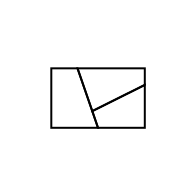
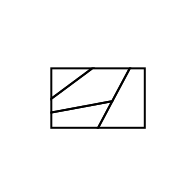
Select the drawing that shows how the parts above go together correctly.
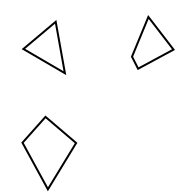
Show the answer
Answer: Drawing 2 of 4, item 4
Item 5 of 15
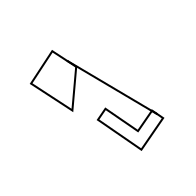
Select the drawing that joins the two objects at points a and b correctly.
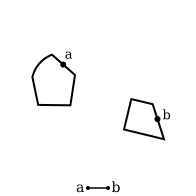
Show the answer
Answer: Drawing 2 of 4, item 5
Item 6 of 15
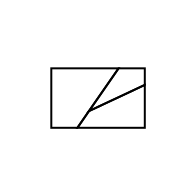
Select the drawing that shows how the parts above go together correctly.
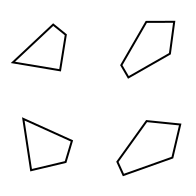
Show the answer
Answer: Drawing 1 of 4, item 6
Item 7 of 15
Select the drawing that joins the two objects at points a and b correctly.
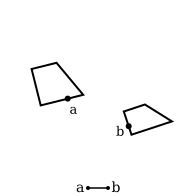
Show the answer
Answer: Drawing 2 of 4, item 7
Item 8 of 15
Select the drawing that shows how the parts above go together correctly.
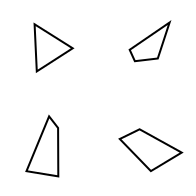
Show the answer
Answer: Drawing 2 of 4, item 8
Item 9 of 15
Select the drawing that joins the two objects at points a and b correctly.
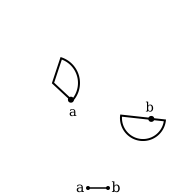
Show the answer
Answer: Drawing 4 of 4, item 9
Item 10 of 15
Select the drawing that joins the two objects at points a and b correctly.
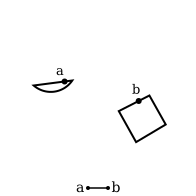
Show the answer
Answer: Drawing 2 of 4, item 10
Item 11 of 15
Select the drawing that joins the two objects at points a and b correctly.
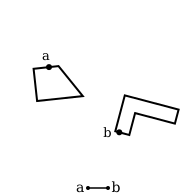
Show the answer
Answer: Drawing 3 of 4, item 11
Item 12 of 15
Select the drawing that joins the two objects at points a and b correctly.
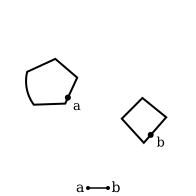
Show the answer
Answer: Drawing 2 of 4, item 12
Item 13 of 15
Select the drawing that shows how the parts above go together correctly.
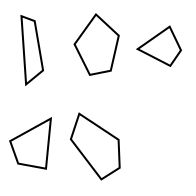
Show the answer
Answer: Drawing 1 of 4, item 13
Item 14 of 15
Select the drawing that shows how the parts above go together correctly.
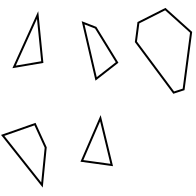
Show the answer
Answer: Drawing 4 of 4, item 14
Item 15 of 15
Select the drawing that shows how the parts above go together correctly.
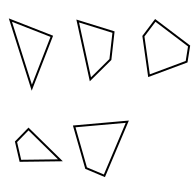
Show the answer
Answer: Drawing 4 of 4, item 15
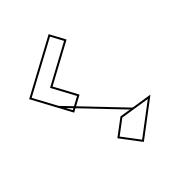
Your results
- General Science
- Arithmetic Reasoning
- Word Knowledge
- Paragraph Comprehension
- Mathematics Knowledge
- Electronics Information
- Auto Information
- Shop Information
- Mechanical Comprehension
- Assembling Objects
- Total
Explore each subtest
Format, scoring, and five more free questions on every subtest page.