
ASVAB · Line scores
Mechanical Comprehension
Mechanical Comprehension is the ASVAB subtest on mechanical and physical principles, each item a drawing and one question.
- Items
- 15
- Time
- 22 minutes
- Format
- Computer-adaptive
- Answer options
- 4
- Counts toward
- Line scores, not the AFQT
Screens of the trainer
The subtest
Measures
The subtest measures knowledge of mechanical and physical principles.
It does not count toward the AFQT. It counts toward the line scores the services use to qualify applicants for jobs.
Format
The subtest has 15 items in 22 minutes, each with four answer options.
It is computer-adaptive: each item is chosen from your earlier answers, and an answer cannot be changed once submitted.
On paper, the subtest has 25 items in 19 minutes.
Scoring
The subtest is reported as a standard score. The items are scaled for difficulty, so the score is comparable between test-takers who saw different items.
Item types
A drawing and one question
Each item is a drawing and one question about it: what shifts on a crane as its boom reaches out, which way friction acts on a skier going down a slope, why a pump's intake valve opens as the piston goes down, which of four braces holds a shelf best, what gear arrangement the drawing shows.
You read the drawing and pick the answer among four.
Free practice test
Item 1 of 5
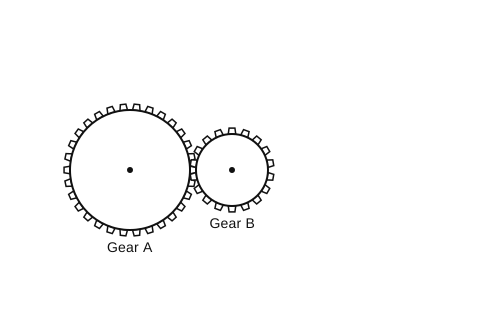
Gear A meshes with Gear B, as shown. Compared to Gear B, how does Gear A's rotational speed compare?
Show the answer
Answer: Gear A turns slower than Gear B
Meshed gears pass the same number of teeth per second.
The gear with more teeth needs fewer turns to do it.
Gear A has more teeth, so it turns slower.
Item 2 of 5
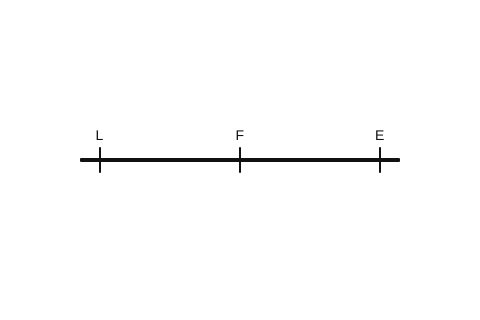
The diagram shows a bar with its Fulcrum (F), Load (L) and Effort (E) marked. Based on which one sits in the MIDDLE, what class of lever is this?
Show the answer
Answer: First Class Lever
The class is set by what sits in the middle.
Here the fulcrum sits between the load and the effort: first class.
Second class has the load in the middle, third class the effort.
Item 3 of 5
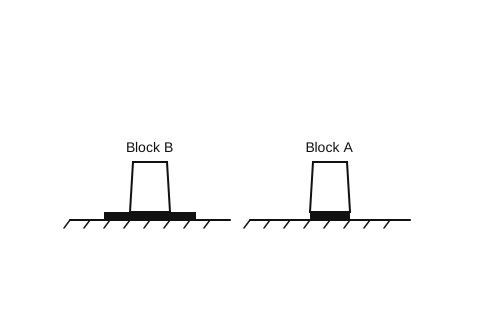
Blocks A and B weigh the same but rest on the ground through footprints, as shown. Which block exerts GREATER pressure on the ground (or do they exert the same pressure)?
Show the answer
Answer: Block A
Pressure is force spread over area.
Both blocks weigh the same; Block A stands on the narrower footprint.
Same force on a smaller area: Block A presses harder.
Item 4 of 5
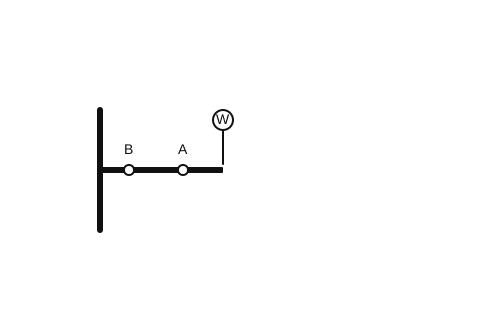
A beam is fixed rigidly into the wall on the left and carries a load at its free (right) end, as shown. Points A and B mark two spots along the beam. Under the load, which point deflects (bends) the MOST?
Show the answer
Answer: Point A
A beam fixed at one end bends most far from the wall.
Point A sits farther from the wall than Point B.
Point A deflects the most.
Item 5 of 5
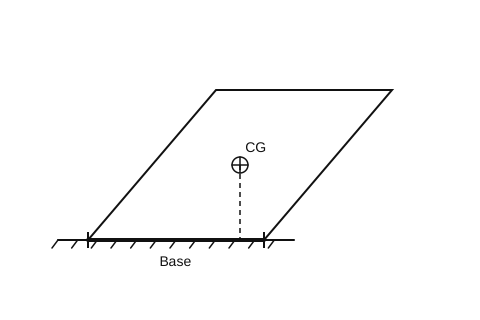
An object is shown resting on its base (the thick segment), with a dashed line dropped straight down from its center of gravity (CG) to the ground. What happens to the object?
Show the answer
Answer: The object remains standing (does not tip)
An object stands while its center of gravity stays over its base.
The dashed line meets the ground inside the base.
The object remains standing.
The Frontline Forge trainer
-
Feedback after each item
Training shows the correct answer and its explanation after each pick, and the clock stops while the correction is on screen. Training is scored and saved like a Test, and you can move back and forth between items.
-
15 items in 22 minutes, ranked
Test mode runs 15 items in 22 minutes, the count and time of the real subtest, four choices each, with no feedback until the end. Each score is ranked against the scores of other test-takers, and the Statistics page plots the ranking of every attempt.
-
12 families, no formula
Every session is built fresh from 12 families: levers, pulleys, inclined planes, gears, springs, center of gravity and stability, fluids and pressure, buoyancy, rotation and torque, statics and tension, friction, and structural support. No formula is shown. Everything you need is drawn or labeled on the picture, and you answer by reasoning about it.