
ASVAB · AFQT
Mathematics Knowledge
Mathematics Knowledge is the ASVAB subtest in which you work out an expression, solve an equation or find a measure from a labeled figure, and pick the correct answer among four.
- Items
- 15
- Time
- 31 minutes
- Format
- Computer-adaptive
- Answer options
- 4
- Calculator
- Not allowed
- Counts toward
- AFQT
Screens of the trainer
The subtest
Measures
The subtest measures knowledge of high school mathematics principles.
It counts toward the AFQT, with Word Knowledge, Paragraph Comprehension and Arithmetic Reasoning. The AFQT decides eligibility to enlist.
Format
The subtest has 15 items in 31 minutes and is computer-adaptive: each item is chosen from your earlier answers, and an answer cannot be changed once submitted.
Each item offers four answer options. No calculator is allowed.
On paper, the subtest has 25 items in 24 minutes.
Scoring
The subtest is reported as a standard score. The items are scaled for difficulty, so the score is comparable between test-takers who saw different items.
That standard score is combined with those of the three other AFQT subtests into the AFQT, a percentile from 1 to 99.
Item types
Expressions, equations and figures
Most items are a bare expression or equation to work out. Some items state a short property, such as which ratio equals another. Some show a labeled figure, such as a box with its edge lengths, and ask for a measure.
Items cover number theory and number properties, algebraic operations and equations, geometry and measurement, and probability.
Free practice test
Item 1 of 5
12 − 6 ÷ 2 =
Show the answer
Answer: 9
Division comes before subtraction: 6 ÷ 2 = 3.
12 − 3 = 9.
Item 2 of 5
3/4 ÷ 2/3 =
Show the answer
Answer: 9/8
Dividing by a fraction means multiplying by its reciprocal.
3/4 ÷ 2/3 = 3/4 × 3/2 = 9/8.
Item 3 of 5
If x + y = 10 and x − y = 4, then x =
Show the answer
Answer: 7
Adding the two equations eliminates y: 2x = 10 + 4 = 14.
x = 7.
Item 4 of 5
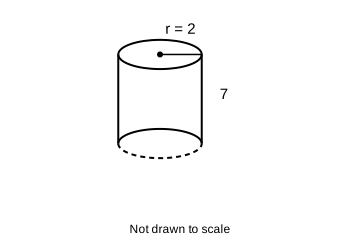
The volume of the cylinder shown, in terms of π, is
Show the answer
Answer: 28π
Volume of a cylinder = πr²h.
π × 2² × 7 = 28π.
Item 5 of 5
A bag has 4 red and 6 blue marbles. Two marbles are drawn without replacement. What is the probability both are red?
Show the answer
Answer: 2/15
First draw: 4 red out of 10, so 4/10.
Second draw, without replacement: 3 red out of 9, so 3/9.
4/10 × 3/9 = 12/90 = 2/15.
The Frontline Forge trainer
-
Feedback after each answer
Training mode shows the correct answer and its calculation after each answer, and the clock pauses while you read.
-
15 items in 31 minutes, ranked
Test mode runs 15 items in 31 minutes, the count and time of the real subtest. Each score is ranked against the scores of other test-takers, and the Statistics page plots the ranking of every attempt.
-
Worked by hand
Each attempt draws its 15 items from a bank of 600: arithmetic and number properties, fractions, decimals, percents and ratios, algebra up to simple systems and factoring, geometry with the Pythagorean theorem, scientific notation, basic probability, mean and median. 90 of them show a figure such as a labeled solid, a triangle, a circle or an angle, a number line, a small table or bar chart. Every item is written to be worked without a calculator.