
ASVAB · Line scores
Electronics Information
Electronics Information is the ASVAB subtest on electricity and electronics, with four choices per item, and its score counts toward line scores, not the AFQT.
- Items
- 15
- Time
- 10 minutes
- Format
- Computer-adaptive
- Answer options
- 4
- Counts toward
- Line scores, not the AFQT
Screens of the trainer
The subtest
Measures
The subtest measures knowledge of electricity and electronics: electrical currents, circuits, electrical and electronic systems, tools, symbols, devices and materials.
It does not count toward the AFQT. It counts toward the line scores the services use to qualify applicants for jobs.
Format
The subtest has 15 items in 10 minutes. It is computer-adaptive: each item is chosen from your earlier answers, and an answer cannot be changed once submitted.
Each item is a question or an incomplete statement with four choices, and you pick the one that answers it or completes it. On paper, the subtest has 20 items in 9 minutes.
Scoring
The subtest is reported as a standard score. The items are scaled for difficulty, so the score is comparable between test-takers who saw different items.
Item types
A circuit diagram, one calculation
Some items show a circuit diagram with its source and resistor values and ask for one quantity, such as the current in one resistor. One Ohm's-law step gives it.
A component, an instrument, an abbreviation
The other items are text: what a component does, which quantity an instrument measures, what an abbreviation such as AC stands for.
Free practice test
Item 1 of 5
Which of these symbols represents a closed switch?
Show the answer
Answer: Symbol 2 of 4
A closed switch joins its two contacts with a straight line.
The lifted contact is an open switch: the circuit is broken.
The boxed line is a fuse; the triangle, a diode.
Item 2 of 5
A resistor is placed in series with an LED mainly to:
Show the answer
Answer: Limit current so the LED is not damaged
Too much current destroys an LED; a series resistor holds the current to a safe level.
A resistor stores no charge and cannot reverse polarity.
Limiting the current keeps the LED at its rating, never above it.
Item 3 of 5
The number of complete reversal cycles an AC signal completes each second is called its:
Show the answer
Answer: Frequency, measured in hertz
Frequency counts the cycles an AC signal completes each second, in hertz; US household power runs at 60 hertz.
Resistance in ohms opposes current, and amplitude in volts is the signal's height.
Duty cycle is the share of each cycle spent on, in percent.
Item 4 of 5
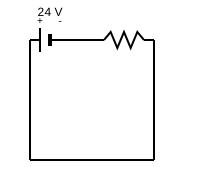
The circuit shown draws a current of 4 A from the source. What is the resistance of the resistor?
Show the answer
Answer: 6 ohms
Ohm's law: R = V ÷ I = 24 ÷ 4 = 6 ohms.
12 ohms would draw 2 A; 3 ohms, 8 A.
5 ohms would draw 4.8 A, not 4 A.
Item 5 of 5
In an induction motor, the rotor's speed is normally:
Show the answer
Answer: Only slightly slower than the rotating magnetic field
The rotor lags the rotating field by a small margin, called slip.
That lag is what induces the rotor current; a rotor at the field's speed would induce none.
A rotor faster than the field, or independent of it, is not driven by induction.


The Frontline Forge trainer
-
An explanation after each answer
Training mode shows the correct answer after each item and explains why it is right. The clock stops while you read.
-
15 items in 10 minutes, ranked
Test mode runs 15 items in 10 minutes, the count and time of the real subtest, then reviews every item. Each score is ranked against the scores of other test-takers, and the Statistics page plots the ranking of every attempt.
-
600 items, 120 of them on a schematic
Each session draws its 15 from a bank of 600 items, 120 of them on a schematic drawn with US symbols: name the symbol shown, pick a symbol among four, or read a circuit, with one calculation at most. The five items above come from that bank.