
TBAS · Pilot selection
Airplane Tracking
Airplane Tracking is three TBAS tests: the Horizontal Tracking Test (HTT) with rudder pedals, the Airplane Tracking Test (ATT) with a joystick, and the Airplane and Horizontal Tracking Test (AHTT) with both at once.
- Tests
- HTT, ATT, AHTT
- Practice
- 30 s before each test
- Scored runs
- 60 s, 60 s, 120 s
- Counts toward
- PCSM
- Equipment
- Joystick, rudder pedals
Screens of the trainer
The subtest
Measures
Each test asks you to keep a sight on a moving airplane, with the pedals, then the stick, then both, and the Airplane Tracking Test measures the ability to track a target moving in two dimensions.
The tracking scores correlate .19 to .24 with completion of pilot training.
Format
The three tests come in this order: Horizontal, then Airplane, then the combined test.
Each test opens with 30 seconds of practice. The scored run then lasts 60 seconds for the Horizontal and Airplane Tracking Tests and 120 seconds for the combined test.
The airplanes speed up during each test. An airplane turns when it reaches an edge of the screen, and the test changes its direction once you have held it in your sights for a few seconds.
Scoring
The score rises with time on target: the time the gunsight stays on its airplane and the airplane stays inside the box.
The tracking tests count toward the PCSM (Pilot Candidate Selection Method). No TBAS score is released.
Item types
Horizontal Tracking Test
An airplane moves side to side in a strip at the bottom of the screen. The rudder pedals move a box left and right to keep it over the airplane.
Airplane Tracking Test
An airplane moves around the screen, and the joystick keeps a gunsight on it. Pushing the stick moves the gunsight down, pulling moves it up.
Airplane and Horizontal Tracking Test
Horizontal lines split the screen. Above them, the joystick keeps the gunsight on one airplane. Below them, the rudder pedals keep the box over a second airplane.
The trainer in play
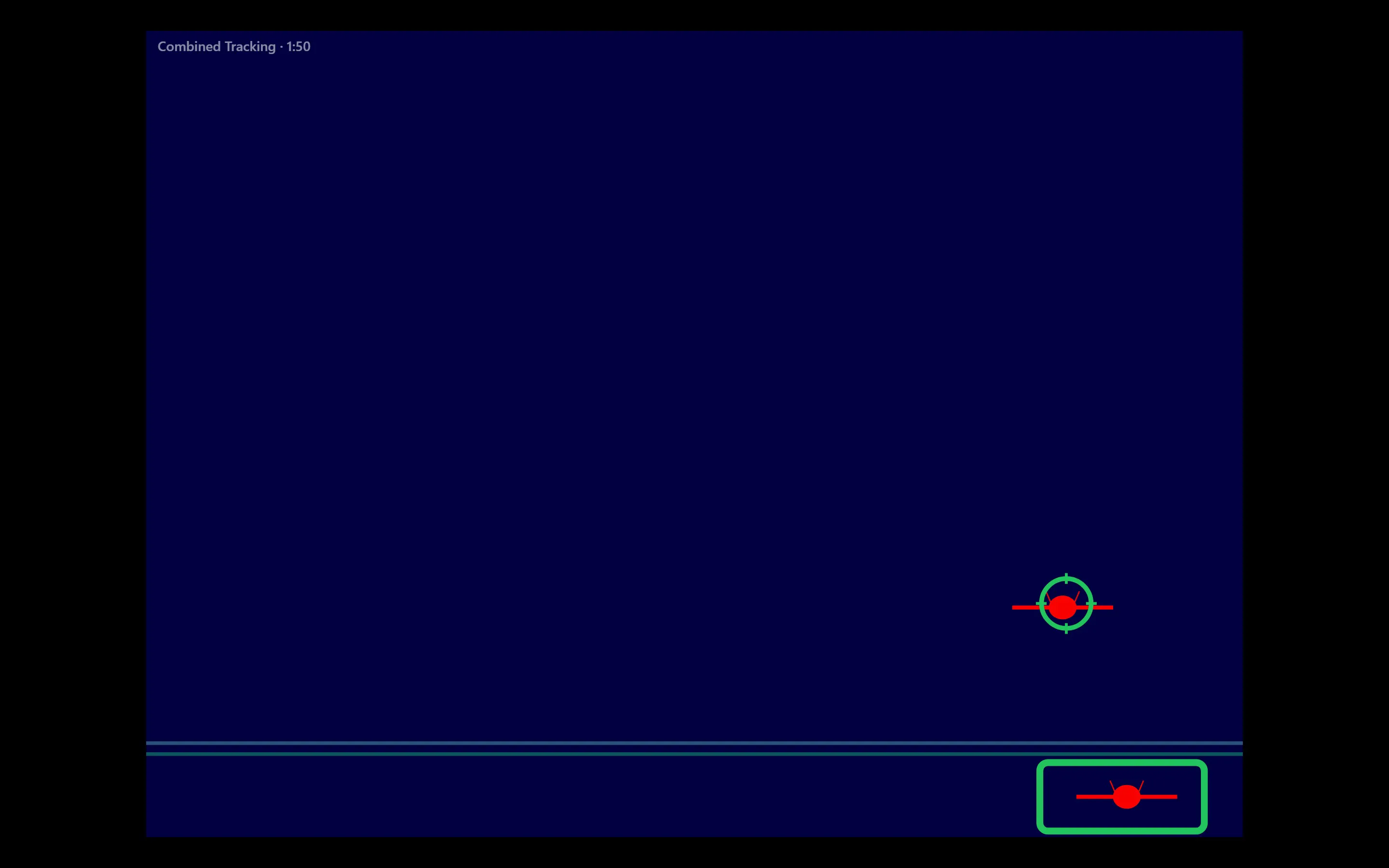
The Frontline Forge trainer
-
Three runs, one ranked
Each test is a separate run. The Horizontal and Airplane Tracking runs end on your time on target and are not ranked. The ranked run is the combined one with random control settings: on every ranked run, the gunsight and the box respond at a new speed and with a new amount of slack, so you train on controls set differently each time. The results split your time on target across the start, middle and end of the run, and between stick and rudder on the combined run.
-
Your stick and pedals, or the keyboard
The Controllers panel picks the device for the stick and the pedals, finds it with Auto-detect and shows its position live. Without a joystick, the arrow keys work the stick, with the down arrow as a push, and A and D work the pedals.
-
Ranked against other test-takers
Each ranked run is set against the scores of other test-takers, and the Statistics page plots the ranking of every one.