
ASTB-E · Officer Aptitude Rating (OAR)
Mechanical Comprehension
Mechanical Comprehension is the ASTB-E subtest on mechanical concepts and simple machines, and its score counts toward the Officer Aptitude Rating (OAR).
- Items
- 15
- Time
- 10 minutes
- Format
- Computer-adaptive
- Answer options
- 3
- Calculator
- Not allowed, formulas provided
- Counts toward
- OAR
Screens of the trainer
The subtest
Measures
The subtest measures familiarity with mechanical concepts and simple machines.
With Math Skills and Reading Comprehension it forms the OAR. Applicants to Officer Candidate School take the OAR alone; pilot and flight officer applicants take the full battery.
Format
The subtest is computer-adaptive: a right answer brings a harder item, a wrong one an easier item. No item can be skipped, and no answer can be changed once given.
The subtest can end before its time is up once enough answers are in.
Each item has three answer options. No calculator is allowed; the formulas needed are provided, and scrap paper is supplied.
Scoring
Items are scaled for difficulty, so the score is comparable between test-takers who saw different items.
Item types
A setup line, often a drawing, three choices
Each item is one short setup sentence and three choices, with no passage. Many items come with a line drawing: lettered points, arrows for force or flow.
Topics include pulleys, electricity, fluids and pressure, buoyancy, center of gravity, tension, rolling and thrown objects, and energy. Units are US and metric: pounds on one item, meters per second on the next.
Free practice test
Item 1 of 5
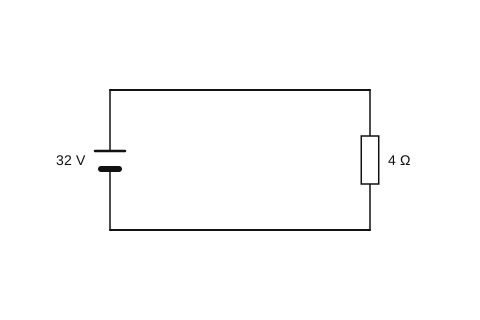
The circuit shown has a battery supplying 32 V through a resistor of 4 Ω. Find the current I flowing through the circuit.
Show the answer
Answer: 8 A
I = V / R = 32 / 4 = 8 A.
5 A or 4 A would need 6.4 Ω or 8 Ω.
Item 2 of 5
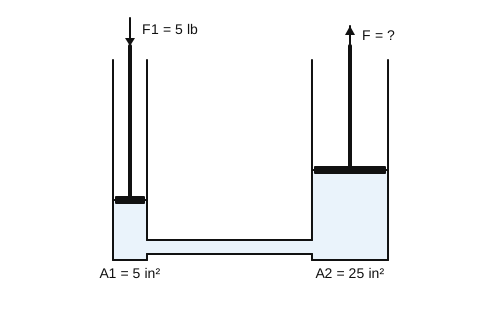
A hydraulic press has a small piston of area 5 in² and a large piston of area 25 in², connected by an enclosed, incompressible fluid. A force of 5 lb is applied to the small piston. Find the force F the large piston can support.
Show the answer
Answer: 25 lb
F2 = F1 × A2 / A1 = 5 × 25 / 5 = 25 lb.
5 lb skips the area ratio; 125 lb uses 25, not 5.
Item 3 of 5
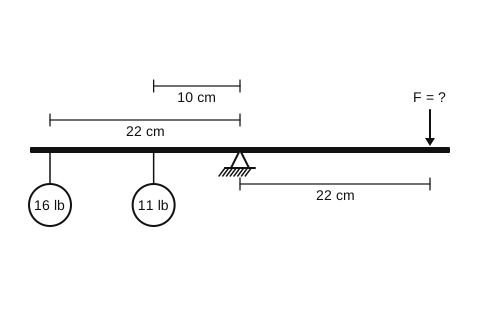
The beam is balanced on the pivot shown. Find the unknown force F needed at the marked point on the right so the beam stays level.
Show the answer
Answer: 21 lb
Left moments: 16 × 22 + 11 × 10 = 462 lb-cm.
F = 462 / 22 = 21 lb balances the right side.
46 lb divides by 10 cm, not 22; 27 lb just adds the weights.
Item 4 of 5
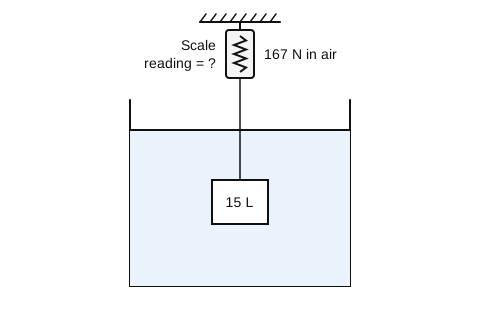
A 15 L object weighs 167 N in air. It is fully submerged in fresh water. Find its apparent weight while submerged (the reading on a scale holding it underwater).
Show the answer
Answer: 20 N
Water lifts 9.8 N per liter: 15 × 9.8 = 147 N.
Apparent weight = 167 - 147 = 20 N.
15 N or 10 N would need 152 N or 157 N lifted.
Item 5 of 5
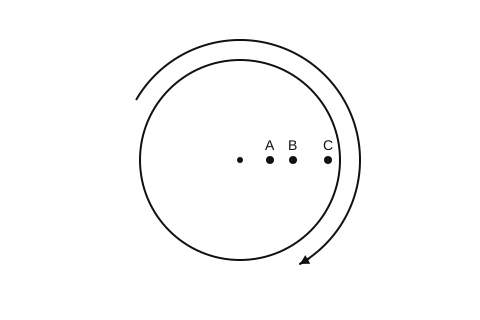
The disk spins as one rigid piece at a constant rate. Points A, B and C are marked at different distances from the center, as shown. Which point moves slowest?
Show the answer
Answer: Point A (near the center)
Every point shares one angular speed; v = ω × r.
The smallest radius moves slowest: point A.
C at the rim moves fastest, B in between.
The Frontline Forge trainer
-
Feedback after each item
Training shows the correct answer and its explanation after each pick, and the clock stops while the correction is on screen. Training is graded and timed like a Test, and you can move back and forth between items.
-
The real format, from 14 families
Test mode runs 15 items in 10 minutes, three options each, with the formula you need under the diagram and a Formulas panel on demand. In a Test your choice locks in when you click, with no going back. Every session is built fresh from 14 families: levers, pulleys, inclined planes, gears, pendulums, springs, center of gravity and stability, fluids, buoyancy, circuits, energy and work, projectiles, rotation and torque, and tension.
-
Ranked against other test-takers
Each score is ranked against the scores of other test-takers. The Statistics page plots the ranking of every attempt, so you see whether you are beating more test-takers than before.