
SIFT · Cognitive Abilities Test
Math Skills
Math Skills is the SIFT subtest in which you solve math problems, in words or in symbols, and pick the correct answer among four, each answer deciding the next item.
- Format
- Computer-adaptive
- Items
- 30
- Time
- 40 minutes
- Answer options
- 4
- Calculator
- Not allowed
- Counts toward
- SIFT score
Screens of the trainer
The subtest
Measures
The subtest measures computational skill and mathematical aptitude: how well you solve a short math problem.
It is part of the Cognitive Abilities Test and counts toward the one SIFT score that applicants to Army aviation receive.
Format
The subtest is computer-adaptive: harder after a right answer, easier after a wrong one, and no going back.
The 30 items run in 40 minutes, and the subtest can end before the time is up once enough answers are in.
Each item offers four answer options. No calculator is allowed.
Scoring
The items are scaled for difficulty, so the score is comparable between test-takers who saw different items.
The SIFT reports one score, from 20 to 80. The subtest has no score of its own.
Item types
Word problems and computation
Items mix word problems and pure computation. They run from fractions and one-step equations through algebra, the geometry of circles and triangles, and probability.
A computation item gives an expression to evaluate or an equation to solve. A word problem gives a job and the time it takes, a distance and a speed, a set of values to average, or a price and a count, and asks for one figure.
Free practice test
Item 1 of 5
5/6 − 3/8 =
Show the answer
Answer: 11/24
The smallest common denominator of 6 and 8 is 24: 5/6 = 20/24 and 3/8 = 9/24. Subtracting gives 20/24 − 9/24 = 11/24.
Item 2 of 5
What value of x satisfies 9x − 2x = 154?
Show the answer
Answer: 22
The left side collects to 9x − 2x = 7x, so 7x = 154. Dividing both sides by 7 gives x = 22.
Item 3 of 5
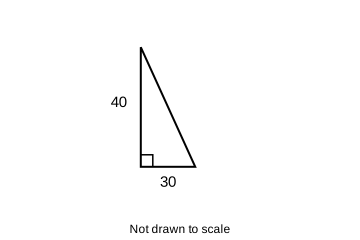
A garden plot is the right triangle shown, with its two perpendicular sides in feet. Edging runs around all three sides and is sold only in 8-foot lengths. How many lengths does the plot take?
Show the answer
Answer: 15
The third side is √(30² + 40²) = √2,500 = 50 feet, so the edging runs 30 + 40 + 50 = 120 feet, and 120 ÷ 8 = 15 lengths.
Item 4 of 5
One conveyor loads a truck in 40 minutes and a second conveyor loads the same truck in 60 minutes. Running at the same time, how many minutes do they need?
Show the answer
Answer: 24
In one minute the conveyors load 1/40 + 1/60 = 3/120 + 2/120 = 5/120 = 1/24 of the truck, so together they need 24 minutes.
Item 5 of 5
A fair six-sided die is rolled twice. The probability that at least one roll shows a number greater than 4 is
Show the answer
Answer: 5/9
Only 5 and 6 are greater than 4, so a roll misses with probability 4/6 = 2/3.
Both rolls miss with probability 2/3 × 2/3 = 4/9.
At least one roll hits is what is left: 1 − 4/9 = 5/9.
The Frontline Forge trainer
-
Feedback after each answer
Training mode shows the correct answer and its calculation after each answer, and the clock pauses while you read. Previous and Next move among the questions you have answered.
-
The real format, ranked
Test mode runs 30 items with four options in 40 minutes and locks each answer: no going back, as on the real subtest. Each score is ranked against the scores of other test-takers, and the Statistics page plots the ranking of every attempt.
-
Worked by hand
Each attempt draws its 30 items from a bank of 600 items, fractions to quadratics, plane geometry, probability and word problems, 75 of them with a figure. Every item is built to be worked by hand: the formula is stated in the item for volumes, circles, trapezoids and parallelograms, never for rectangles, triangles or the Pythagorean theorem.