
SIFT · Cognitive Abilities Test
Mechanical Comprehension
Mechanical Comprehension is the computer-adaptive SIFT subtest on practical mechanics.
- Format
- Computer-adaptive
- Items
- 20
- Time
- 15 minutes
- Answer options
- 4
- Calculator
- Not allowed
- Counts toward
- SIFT score
Screens of the trainer
The subtest
Measures
The subtest measures the ability to perceive physical relationships and solve practical problems in applied mechanical science.
It is part of the SIFT's Cognitive Abilities Test, with Reading Comprehension and Math Skills, and counts toward the SIFT score.
Format
The subtest is computer-adaptive: the difficulty of the items varies from one test-taker to the next, within 15 minutes.
It can end before its time is up once enough answers are in.
No calculator is allowed.
Scoring
The SIFT reports one score, from 20 to 80; the subtest has no score of its own.
Items are scaled for difficulty, so test-takers who saw different items are scored on one scale.
Item types
A drawing and one question
Items cover forces and motion, pulleys and inclined planes, fluids and electricity.
An item is a drawing and one question. One shows a block with a 4 lb and a 12 lb force pushing on one face and an unknown force on the opposite face, and asks how strong that force is if the block does not move. Another shows two identical barrels, each half full of a different liquid, floating at different levels in a tank of water, and asks what difference between the liquids explains it.
Free practice test
Item 1 of 5
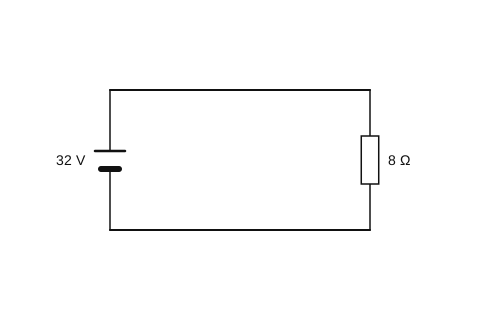
The circuit shown has a battery supplying 32 V through a resistor of 8 Ω. Find the current I flowing through the circuit.
Show the answer
Answer: 4 A
I = V / R = 32 / 8 = 4 A.
1 A, 2 A or 16 A would need 32 Ω, 16 Ω or 2 Ω.
Item 2 of 5
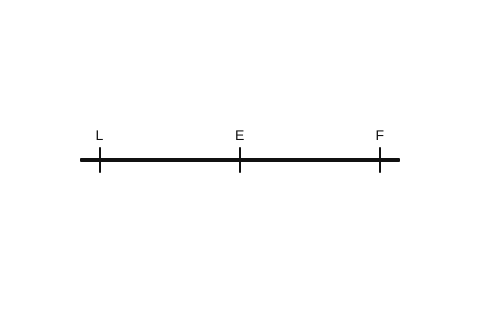
The diagram shows a bar with its Fulcrum (F), Load (L) and Effort (E) marked. Based on which one sits in the MIDDLE, what class of lever is this?
Show the answer
Answer: Third Class Lever
The class is set by what sits in the middle.
Here the effort sits between the load and the fulcrum: third class.
First class has the fulcrum in the middle, second class the load.
Item 3 of 5
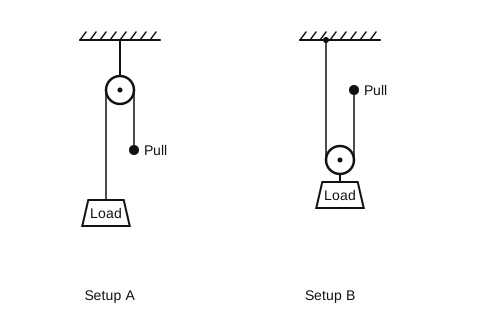
Setup A and Setup B each lift an identical load, as shown. Which setup requires LESS effort to lift it?
Show the answer
Answer: Setup B
A fixed pulley only turns the pull around: effort equals load.
A movable pulley splits the load over two rope segments: half the effort.
Setup B needs less effort.
Item 4 of 5
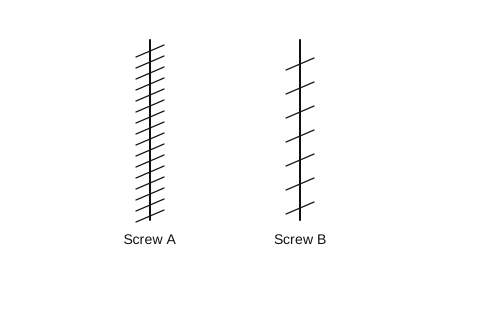
Screws A and B are shown in the diagram, each driven the same depth into identical material. Look closely at the thread spacing on each. Which screw requires MORE turns to reach the same depth?
Show the answer
Answer: Screw A
A screw is an inclined plane wrapped around a shaft.
Each turn advances one thread spacing: finer threads, less depth per turn.
Screw A has the finer threads, so it takes more turns.
Item 5 of 5
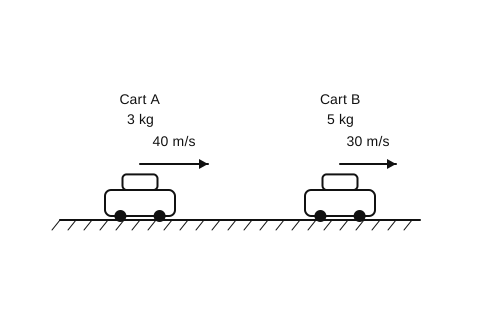
Cart A has a mass of 3 kg moving at 40 m/s. Cart B has a mass of 5 kg moving at 30 m/s, as shown. Which cart has the greater momentum (mass × velocity)?
Show the answer
Answer: Cart B
Momentum = mass × velocity.
Cart A: 3 × 40 = 120. Cart B: 5 × 30 = 150.
The larger product is Cart B's.
The Frontline Forge trainer
-
Feedback after each item
Training shows the correct answer and its explanation after each pick, and the clock stops while the correction is on screen. Training is scored and saved like a Test, and you can move back and forth between items.
-
The real format, ranked
Test mode runs 20 items in 15 minutes, four choices each, with a drawing on every item and everything you need labeled on it. Your choice locks in when you click, and each score is ranked against the scores of other test-takers; the Statistics page plots the ranking of every attempt.
-
12 families, worked by hand
Every session is built fresh from 12 families: levers, pulleys, gears, inclined planes, springs, center of gravity and stability, fluids and pressure, buoyancy, rotation and torque, statics and tension, circuits, and kinematics. No formula is shown, and the numeric items use round values you work in your head.