
SIFT · Perceptual Speed and Accuracy
Simple Drawings
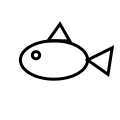
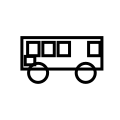
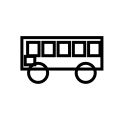
Simple Drawings is the first subtest of the SIFT, in which five drawings sit side by side, four of them identical, and you pick the one that differs.
- Items
- 100
- Time
- 2 min
- Answer options
- 5 drawings
- Guessing penalty
- Yes
- Counts toward
- SIFT score
Screens of the trainer
The subtest
Measures
The subtest measures how fast a test-taker detects the one object that differs within a group of similar objects.
Format
The subtest is fixed, not adaptive.
Few test-takers reach the last item.
Scoring
The SIFT reports one score from 20 to 80, and the subtest has no score of its own.
Each wrong answer costs part of a point; an unanswered item costs nothing.
Item types
Five drawings, one odd
Five drawings sit side by side. Four are identical, one differs, and you pick it.
Free practice test
Item 1 of 5
Pick the drawing that is different.
Show the answer
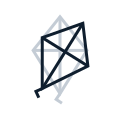
Answer: Drawing 3 of 5, item 1
The odd figure is rotated.
Item 2 of 5
Pick the drawing that is different.
Show the answer
Answer: Drawing 5 of 5, item 2
One extra segment was added.

Item 3 of 5
Pick the drawing that is different.
Show the answer
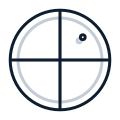
Answer: Drawing 3 of 5, item 3
The odd figure is a different size.
Item 4 of 5
Pick the drawing that is different.
Show the answer
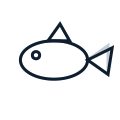
Answer: Drawing 3 of 5, item 4
One corner is moved.
Item 5 of 5
Pick the drawing that is different.
Show the answer
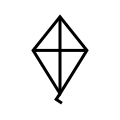
Answer: Drawing 1 of 5, item 5
One repeated element is missing.



The Frontline Forge trainer
-
The difference named
Training runs untimed blocks of 20 items. After every pick, the odd drawing is laid in black over the four alike in gray and the difference is named.
-
The real format
Test mode runs 100 items in 2 minutes, one click per item, the next item at once and no going back. A wrong answer costs a quarter point and an item not reached costs nothing. Each score is ranked against the scores of other test-takers, and the Statistics page plots the ranking of every attempt.
-
Eight kinds of difference
The trainer draws from 12,276 items built on 238 base drawings, with eight kinds of difference: rotation, mirror, size, a segment added, a segment removed, a moved corner, a moved inner detail and a missing repeated element. A Test draws 100 items and never shows the same motif twice.