Performance-Based Measures
The simulator-style finale: stick-and-throttle hardware, headphones, and forty-five minutes of tracking, listening, and orientation — all scored continuously.
- Hardware
- Stick · throttle · headset
- Measures
- 4 abilities
- Format
- Hands-on, not multiple choice
- Counts toward
- Not part of the OAR
See the modules in action
Review the core interface for each PBM module, then jump directly into the full walkthrough.
The 3 PBM modules you must master
Each module tests a different part of aviation aptitude. Together, they measure how well you process information, control actions, and stay consistent under pressure.
Terrain Identification
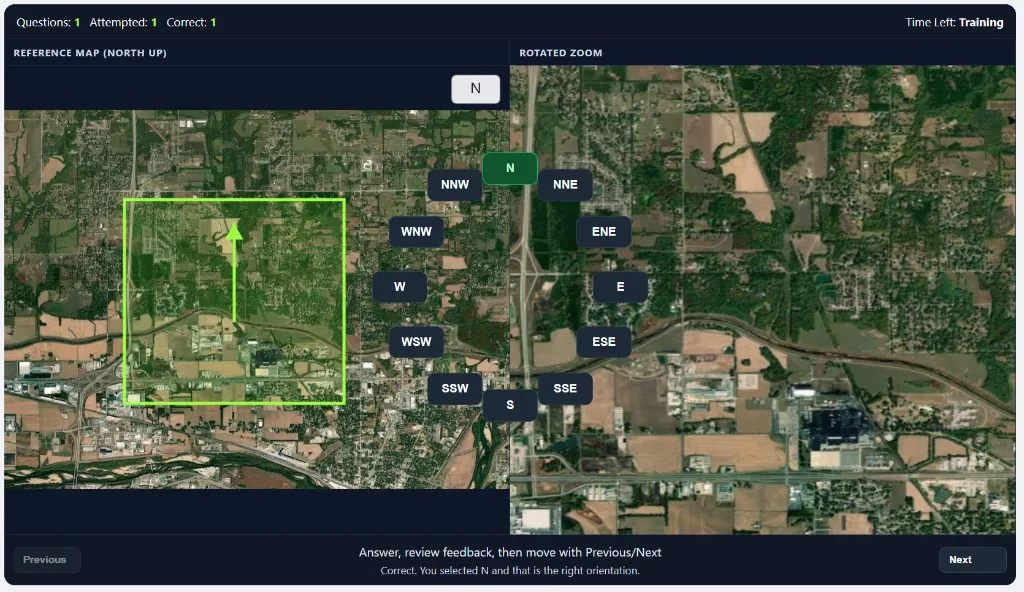
Compare a north-up reference map with a rotated zoomed image and identify orientation quickly and accurately. Core demand: visual anchor recognition + rotation logic.
Directional Orientation
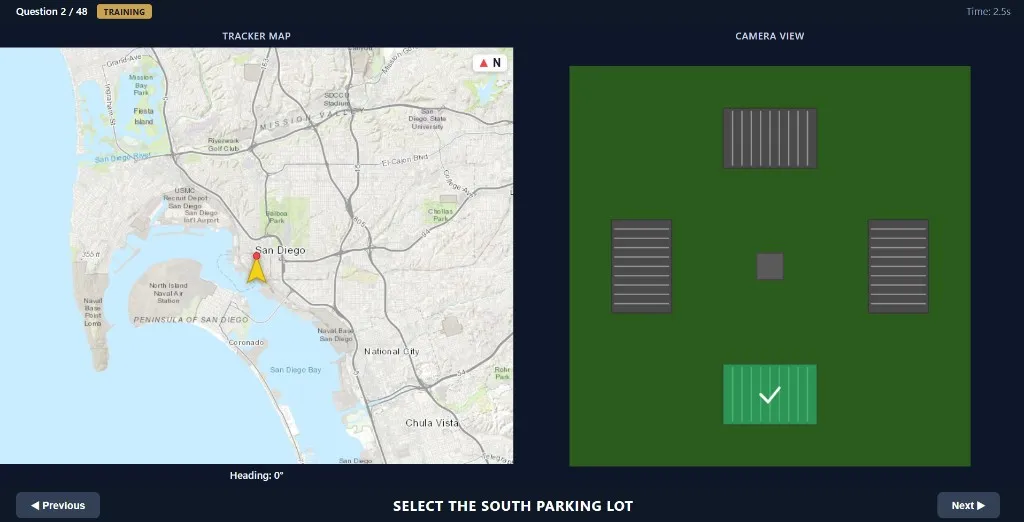
Read heading, convert to pilot perspective, and select the correct direction target with minimal delay. Core demand: spatial mental rotation + response speed.
Stick and Throttle
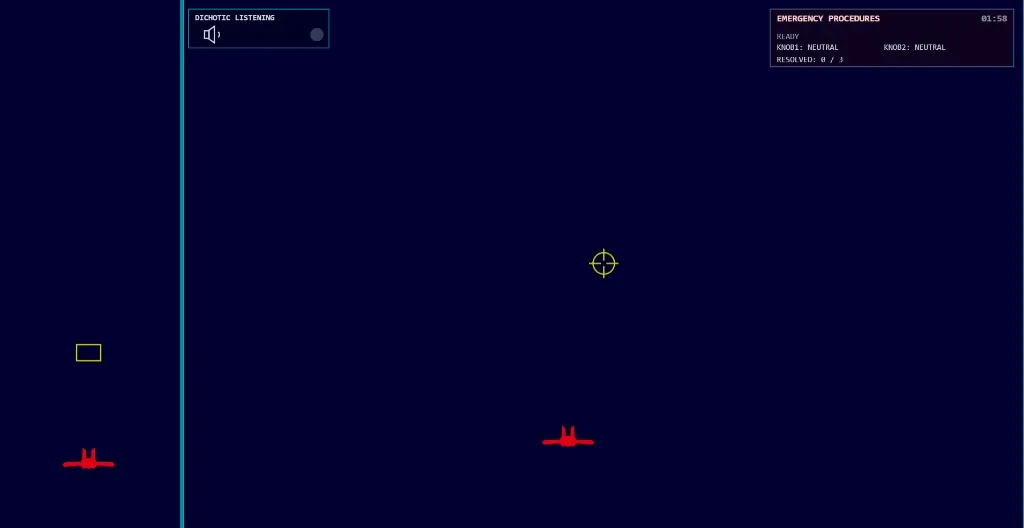
Maintain stable joystick and throttle control while handling dichotic audio and emergency prompts in parallel. Core demand: motor precision + divided-attention discipline.
How each module works
Terrain Identification: reference vs rotated view
You solve by anchoring one distinctive landmark on the reference map, confirming with a second feature, then committing to orientation. High performers avoid single-feature guessing and keep a consistent two-anchor loop.
Read the full Terrain Identification breakdown →Directional Orientation: heading-to-target mapping
You must answer from pilot/UAV viewpoint, not static map intuition. Fast candidates apply a fixed sequence: heading → layout type → requested direction → click. This reduces hesitation and protects timing.
Read the full Directional Orientation breakdown →Stick and Throttle: full-stack multitasking
Workload rises from basic control to a four-task stack: joystick, throttle, dichotic audio, emergencies. Scores improve when corrections stay small and routine-driven rather than aggressive and reactive.
Read the full Stick and Throttle breakdown →Cross-module strategy: what actually raises PBM scores
Use fixed decision loops
Each module rewards consistent process. Standardize your internal sequence so pressure does not change your logic.
Train speed + stability together
PBM is not solved by accuracy alone. Work toward fast, repeatable answers without losing control quality.
Avoid panic corrections
In both spatial and control modules, over-correction causes cascading errors. Small, deliberate actions perform better long-term.
Recover fast after errors
Do not carry one miss into the next item. Reset immediately and return to your sequence.
Ready to train all 3 PBM modules?
Start with the module that is weakest today, then build full-stack PBM performance.
The PBM, quick answers
What modules are included in ASTB-E Performance-Based Measures?
PBM is built around three core modules: Terrain Identification, Directional Orientation, and Stick and Throttle.
How does Terrain Identification differ from Directional Orientation?
Terrain Identification is map-to-rotation matching with landmark anchors. Directional Orientation is pilot-viewpoint direction mapping under strict time pressure.
What causes the most score loss in Stick and Throttle?
Over-correcting controls and poor task-priority discipline. Most candidates lose points when one channel (audio or emergency) disrupts total control stability.
What is the most effective way to prepare for all three modules?
Train with module-specific routines, track both speed and consistency, and use short repeated sessions that simulate real PBM pressure.
Build your test-day method
- Exam-aligned drills under deliberate time pressure
- Instant explanations after every item
- Your score estimate, tracked drill after drill