
Auto & Shop Information
Engines, tools, and shop practice — the most hands-on knowledge on the battery.
- Questions
- 10 + 10 (CAT)
- Time limit
- 7 + 6 min
- Pace
- ~39 s per item
- Counts toward
- MM + AS composites
See what the test looks like
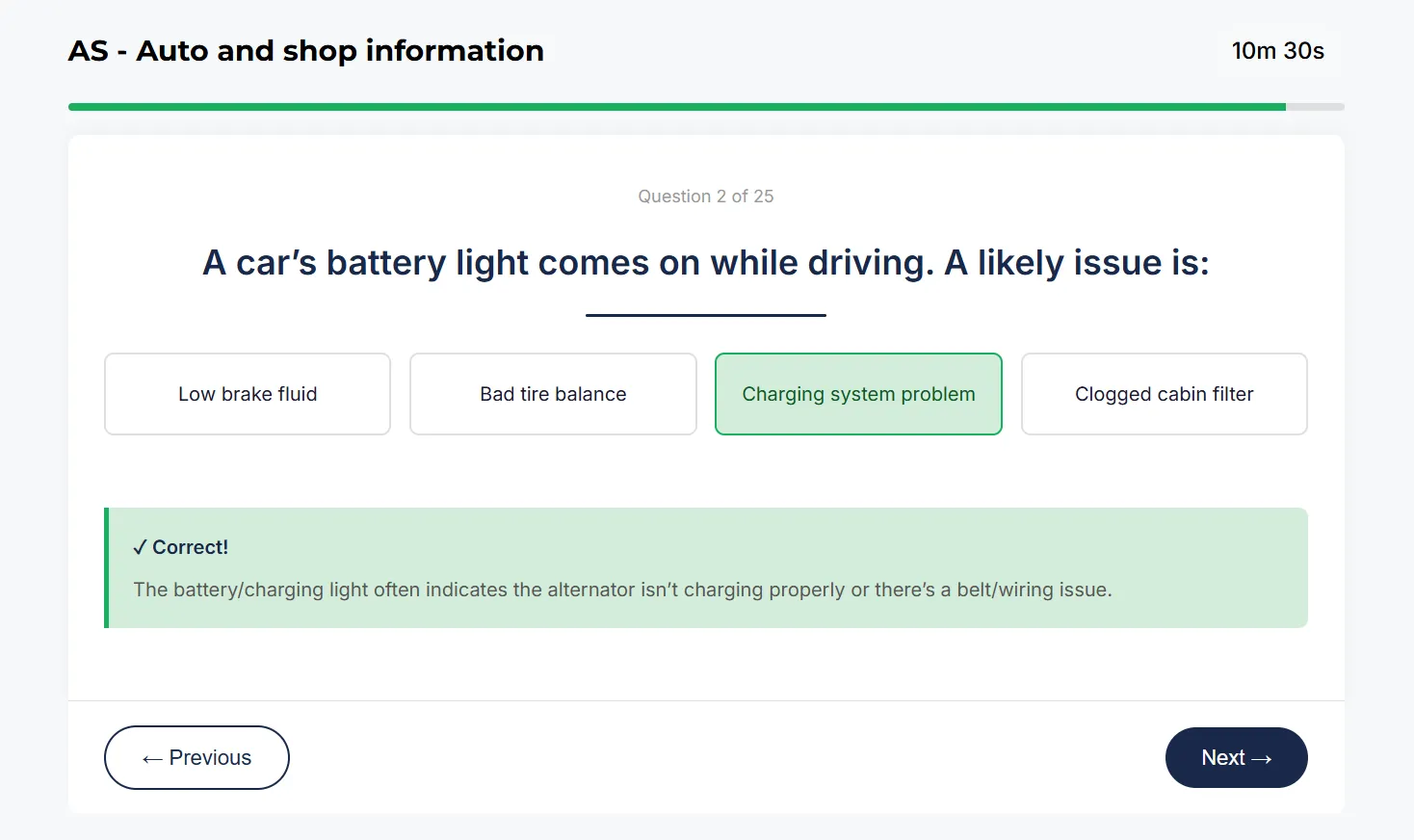
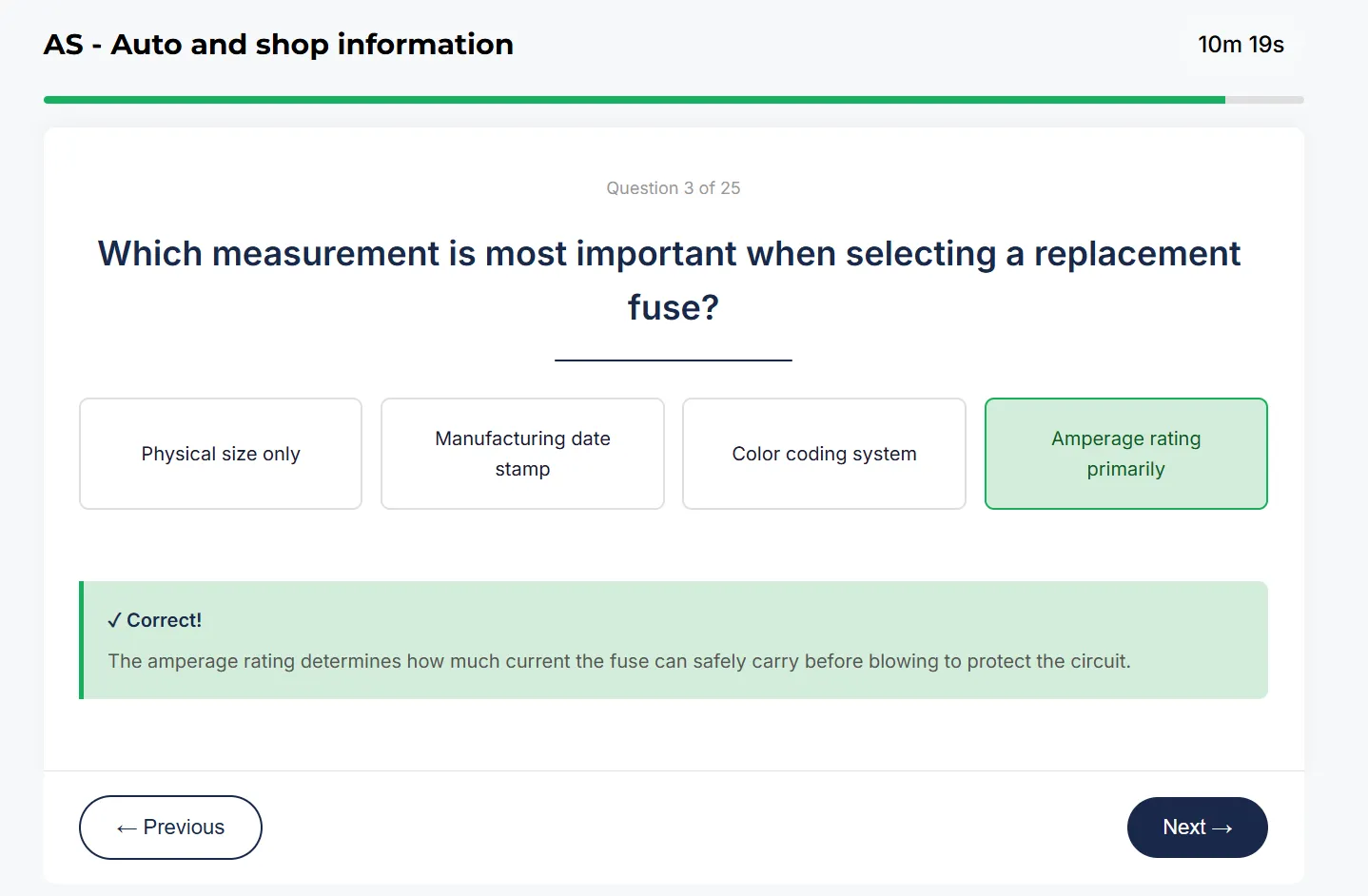
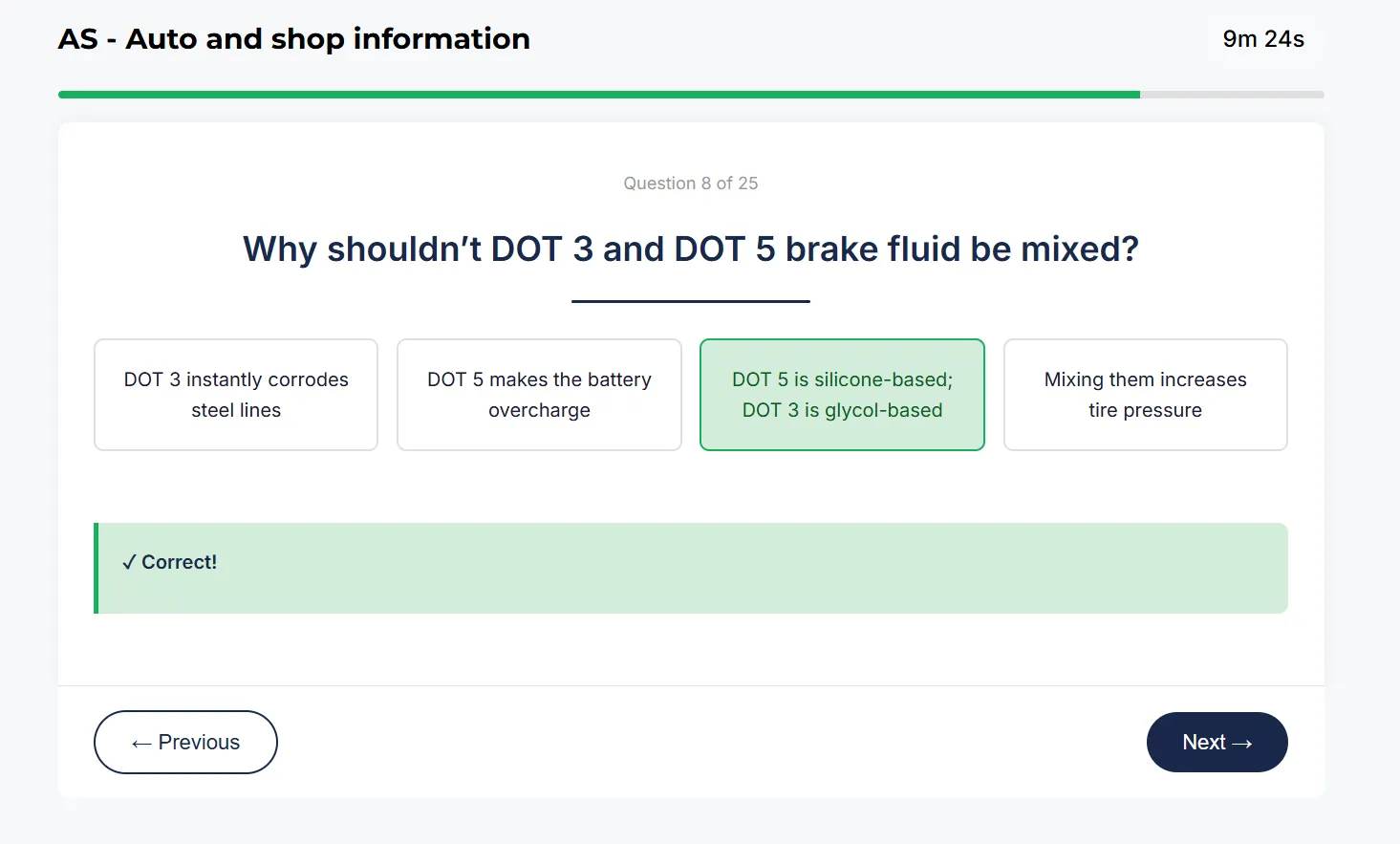
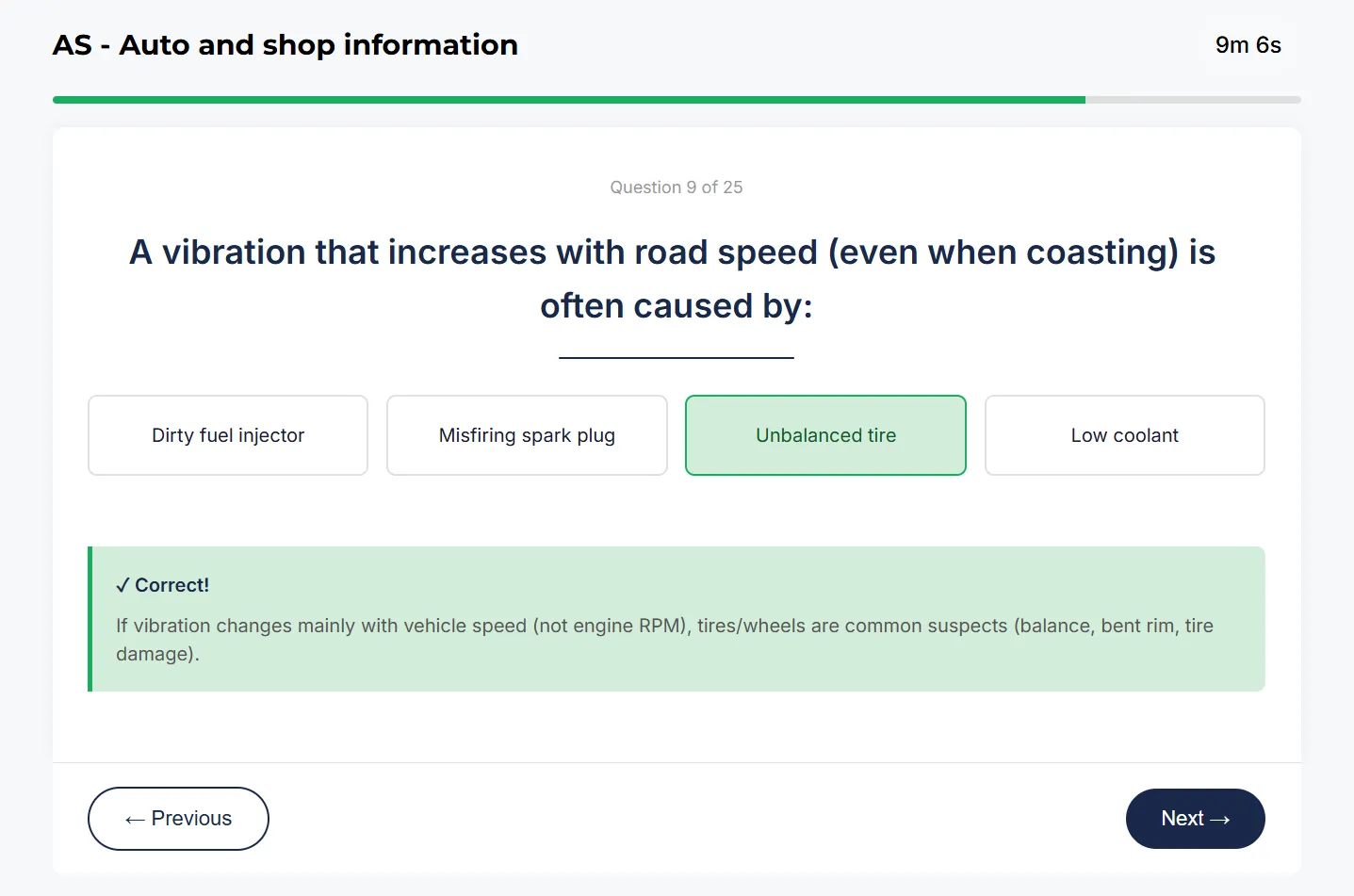
Here are sample questions from our Auto & Shop Information practice tests. Each question comes with a clear explanation of the correct answer.
Inside the Auto & Shop subtest
Half the questions live under a hood: engine systems, brakes, cooling, electrical basics. The other half live on a workbench: naming the right tool, fastener, or technique for a job. On the computerized test they run as two short back-to-back sections.
This is the subtest that least rewards cramming from text — it rewards having seen the parts. If you have never turned wrenches, picture-based flashcards and teardown videos close the gap fastest.
Which tool measures the inside diameter of an engine cylinder?
A bore gauge reads internal diameters. Feeler gauges measure small clearances; a tap cuts threads — classic near-miss distractors.
Coach's tip. Watch one engine-teardown video a day and say each part’s name out loud as it comes off. Naming aloud is what converts pictures into test answers.
How the subtest is delivered
Two versions of the same subtest, and they are not the same sitting. Which one you take depends on where you test.
CAT-ASVAB
Computer, at a MEPS — what most enlistees take
- Auto Information
- 10 questions · 7 min
- Shop Information
- 10 questions · 6 min
On the computer version these are two separate subtests, taken back to back. Each adapts to your answers, and neither lets you return to a question once you have answered it.
Paper & Pencil
Booklet and answer sheet, at a MET site
- Questions
- 25
- Time limit
- 11 min
- Pace
- ~26 s per question
On paper the two are merged into a single Auto & Shop Information subtest. Fixed difficulty, fixed order, and you may skip a question and come back to it.
What topics to study for AS
AS covers two distinct areas. Here's what to prioritize in each.
Auto Information (AI): Engine Basics
How cars work under the hood: Four-stroke combustion cycle (intake, compression, power, exhaust) · Cooling system (radiator, thermostat, coolant) · Lubrication system (oil pump, oil filter)
Auto Information (AI): Systems & Maintenance
Vehicle systems and diagnostic logic: Drivetrain and suspension fundamentals · Braking systems (disc vs drum) · Basic maintenance and diagnostic logic · Key auto vocabulary (alternator, carburetor, distributor)
Shop Information (SI): Tools
Know your tools by name and function: Hand tools: wrenches, pliers, screwdrivers, hammers · Power tools: drills, grinders, saws · Measuring tools: calipers, tape measures, levels
Shop Information (SI): Practices
Workshop knowledge and procedures: Workshop terminology and safety practices · Basic shop procedures and use-cases · Material handling and fasteners (bolts, nuts, screws, rivets)
Auto & Shop Information, quick answers
Is Auto & Shop Information hard on the ASVAB?
It depends on your background. If you've worked on cars or used shop tools, AS will feel straightforward. Most questions test practical knowledge, not theory. If you have zero hands-on experience, it can feel unfamiliar. The good news: AS content is very learnable. A few weeks studying engine basics, common tools, and shop vocabulary is usually enough to score well.
Is AS part of the AFQT score?
No. The AFQT is calculated from only four subtests: AR, MK, WK, and PC. However, AS contributes to several important line scores — especially the Mechanical Maintenance (MM) and Auto & Shop (AS) composites — that determine eligibility for automotive, mechanical, and maintenance-related military jobs.
Can I use a calculator on the ASVAB?
No. Calculators are not allowed on any ASVAB section. For AS specifically, this is rarely an issue. The vast majority of questions test your knowledge of automotive systems and shop practices, not your ability to calculate. Any numbers involved are simple enough to handle mentally.
How should beginners study for AS?
Start with the basics: learn the four-stroke engine cycle, understand what major car systems do (cooling, braking, electrical), and memorize common hand and power tools by name and function. Use visual guides and diagrams. AS is very visual. Then do practice tests to identify gaps. YouTube videos of basic car maintenance are surprisingly helpful for building intuition.
How long should I prepare before test day?
If you have no automotive or shop background, plan for 3–4 weeks at 30 minutes per day. If you already have some hands-on experience, 1–2 weeks of focused review and practice tests should be enough. Prioritize engine basics and tool identification first. They cover the most questions.
Is the PiCAT easier than the CAT-ASVAB?
The PiCAT covers the same content as the CAT-ASVAB but is taken at home without proctoring. It's not inherently easier. The questions are similar. However, some people find it less stressful because there's no test-center environment. You'll still need to verify your score at MEPS with a short confirmation test.
Can I retake the ASVAB if my AS score is low?
Yes. You can retake the ASVAB after 1 month, then again after another month, and every 6 months after that. There's no lifetime limit. Your most recent score replaces the previous one, so only retake if you're confident you'll improve. Focus your study on the specific areas (AI or SI) where you scored lowest.
Build your test-day method
- Exam-aligned drills under deliberate time pressure
- Instant explanations after every item
- Your score estimate, tracked drill after drill