
Arithmetic Reasoning
Math word problems with the most generous clock on the exam. The question is never whether you can compute — it’s whether you set the problem up right.
- Questions
- 25
- Time limit
- 29 min
- Pace
- ~70 s per item
- Counts toward
- Quantitative · Academic
See what the test looks like
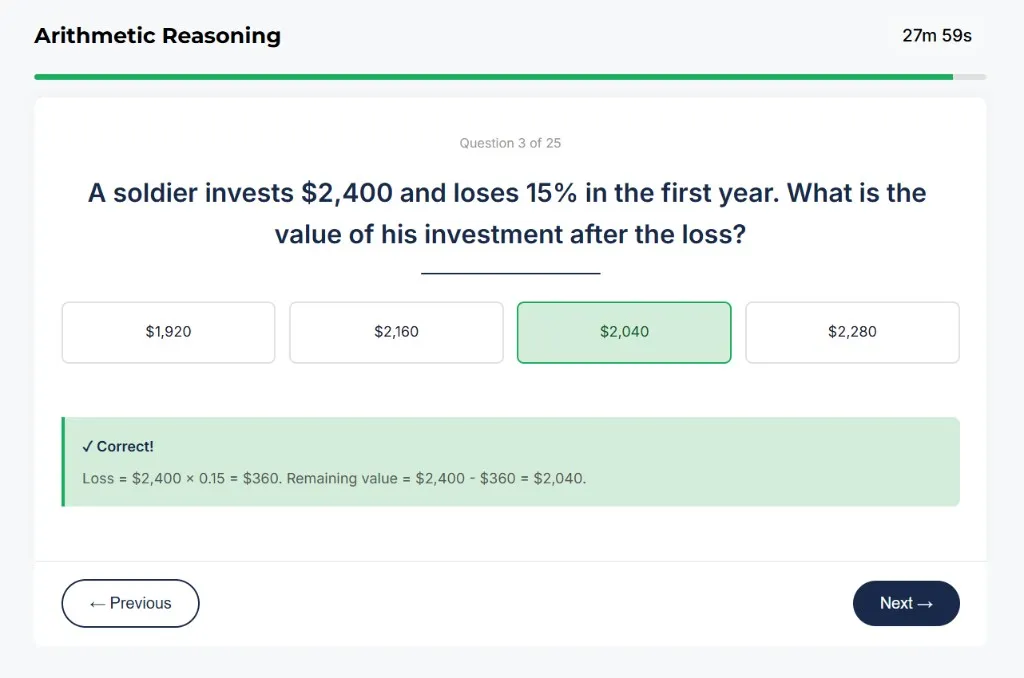
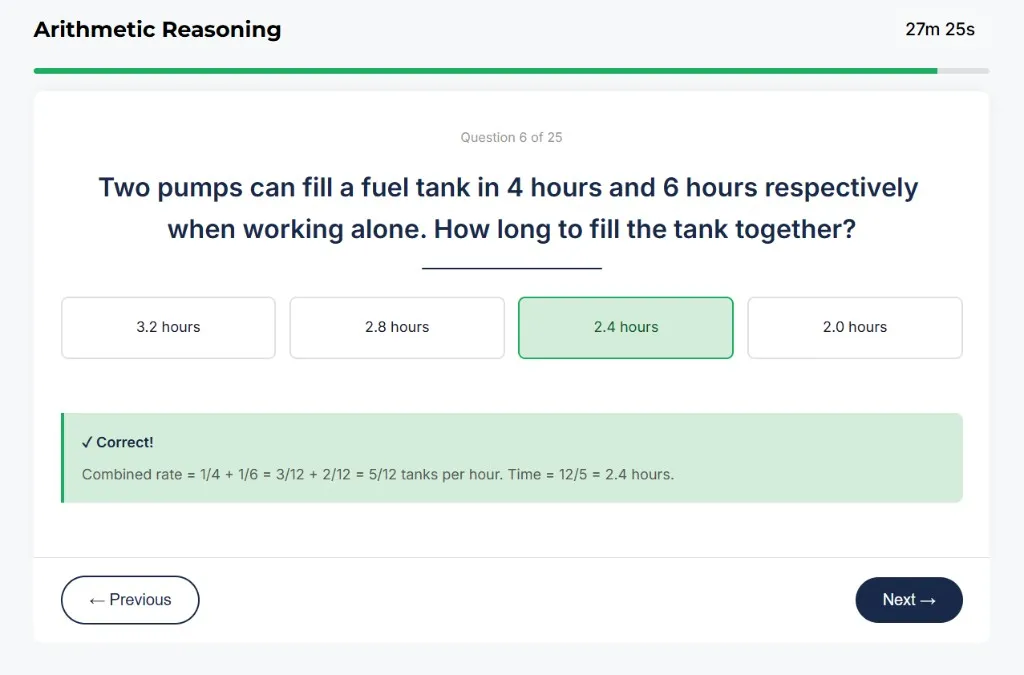
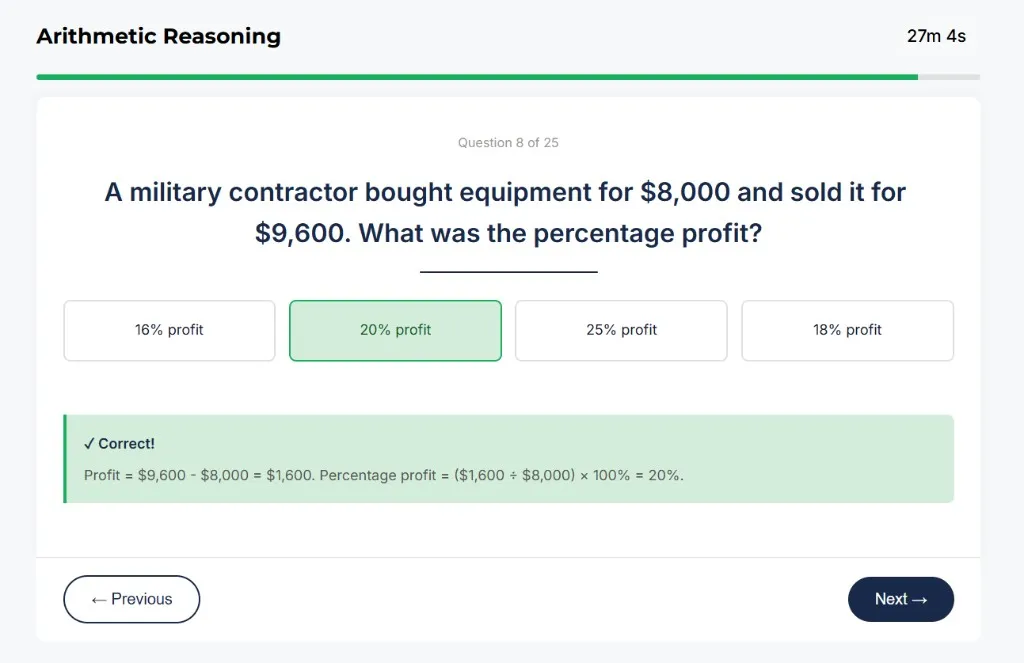
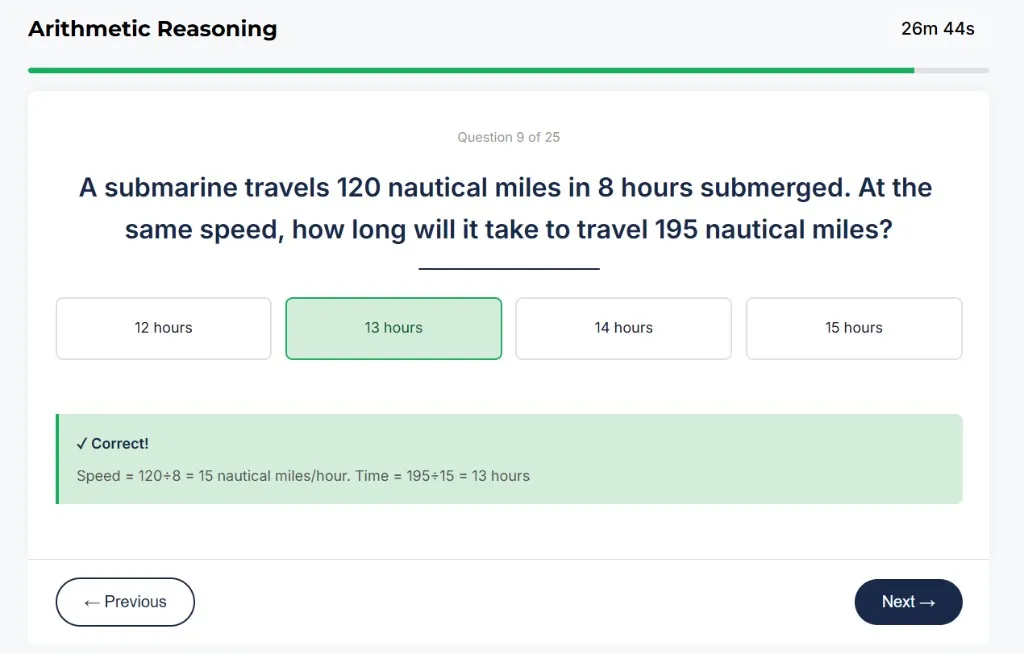
Sample questions from our AFOQT Arithmetic Reasoning practice tests. Each question comes with a detailed explanation so you understand the reasoning, not just the answer.
What is the Arithmetic Reasoning subtest?
Arithmetic Reasoning tests your ability to solve practical math problems presented as word problems. Unlike Math Knowledge (which tests pure math concepts), this subtest asks you to read a scenario, extract the relevant numbers and relationships, set up an equation, and compute the answer.
Problems cover everyday situations: calculating costs, distances, time, percentages, and measurements. The math itself rarely goes beyond basic algebra, but the challenge is translating the words into the right mathematical operations under time pressure.
This subtest contributes to the Quantitative composite and the Academic Aptitude composite.
What the questions are made of
Most AFOQT Arithmetic Reasoning questions fall into these categories.
Distance, rate & time
How far, how fast, how long? Use the formula D = R × T. Watch for unit conversions between miles/km and hours/minutes.
Percentages & discounts
Sale prices, tax calculations, tips, percent increase/decrease. Know how to find the part, whole, or percent from any two given values.
Ratios & proportions
Scaling recipes, map distances, mixing solutions. Set up cross-multiplication to solve for the unknown value.
Work-rate problems
If Person A can do a job in X hours and Person B in Y hours, how long working together? Combine rates: 1/X + 1/Y = 1/T.
Profit, cost & interest
Markup, profit margin, simple interest (I = PRT). Multi-step problems involving buying, selling, and calculating earnings.
Measurement & geometry
Area, perimeter, volume in real-world contexts: painting walls, fencing yards, filling containers. Apply formulas to practical scenarios.
Which composite scores?
Quantitative composite: Arithmetic Reasoning + Math Knowledge
Academic Aptitude composite: Verbal Analogies + Arithmetic Reasoning + Word Knowledge + Math Knowledge + Reading Comprehension + Physical Science
Arithmetic Reasoning does not contribute to the Pilot or CSO composites. See the full composite breakdown on the AFOQT guide.
Tips & strategy
Don’t start calculating after the first sentence. Read the full problem to understand what’s being asked, then identify the relevant numbers and the operation needed.
“Of” usually means multiply. “Per” means divide. “Combined” or “total” means add. Learn these keyword-to-operation mappings and the setup becomes automatic.
Round numbers to get a ballpark answer first. This lets you eliminate 2–3 wrong answer choices immediately and catch calculation errors before they cost you.
Many trap answers come from unit mismatches: hours vs. minutes, feet vs. inches, dollars vs. cents. Always check that your units match what the question asks for.
No calculator means you need fast arithmetic. Drill multiplication tables, fraction-to-decimal conversions, and common percentage shortcuts (10% = move the decimal).
Related AFOQT subtests
Arithmetic Reasoning, quick answers
What is AFOQT Arithmetic Reasoning?
Arithmetic Reasoning is one of 12 AFOQT subtests. You have 25 word problems and 29 minutes to solve them. Each question describes a real-world scenario that requires arithmetic to solve. It contributes to the Quantitative and Academic Aptitude composite scores.
How much time do I have per question?
With 25 questions in 29 minutes, you have approximately 70 seconds per question. This gives you more time than most AFOQT subtests, but multi-step word problems still require efficient work.
Does Arithmetic Reasoning count toward the Pilot composite?
No. Arithmetic Reasoning contributes to the Quantitative and Academic Aptitude composites, but not to the Pilot or CSO composites. Strong Quantitative scores are still valued across all Air Force officer career fields.
How should I prepare for Arithmetic Reasoning?
Focus on translating word problems into math equations. Practice the most common types: distance/rate/time, percentages, ratios, work-rate, and profit/loss. Drill mental math since no calculator is allowed.
Build your test-day method
- Exam-aligned drills under deliberate time pressure
- Instant explanations after every item
- Your score estimate, tracked drill after drill