
Instrument Comprehension
Read the attitude indicator and compass, pick the matching aircraft — twenty-five instruments in five minutes. The most trainable subtest on the Pilot composite.
- Questions
- 25
- Time limit
- 5 min
- Pace
- 12 s per item
- Counts toward
- Pilot · ABM
See what the test looks like
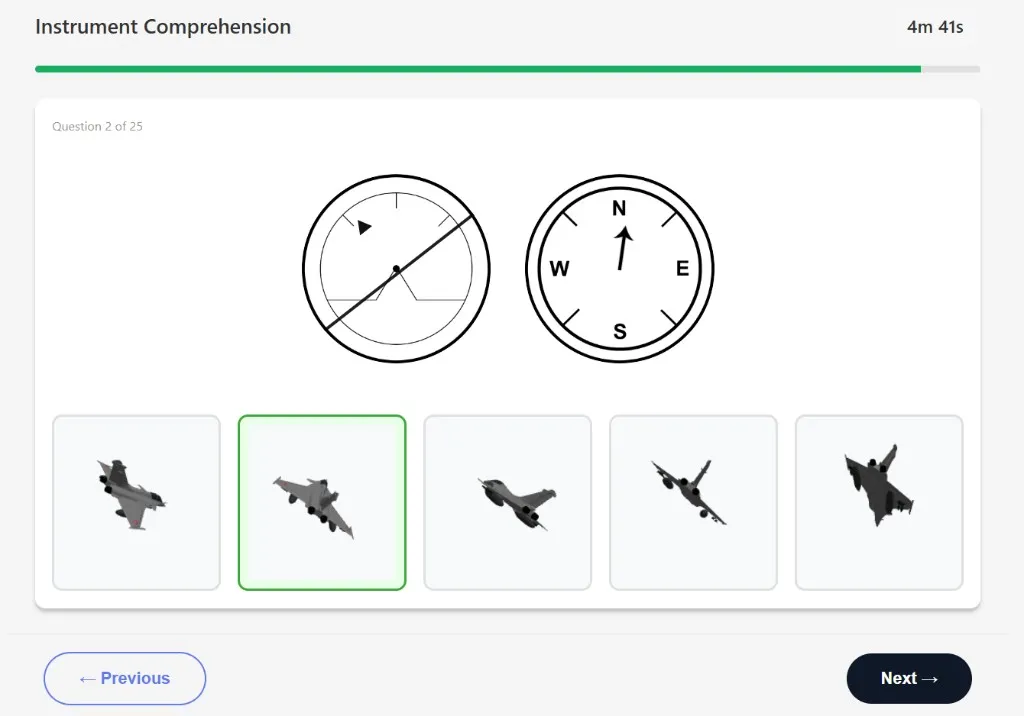
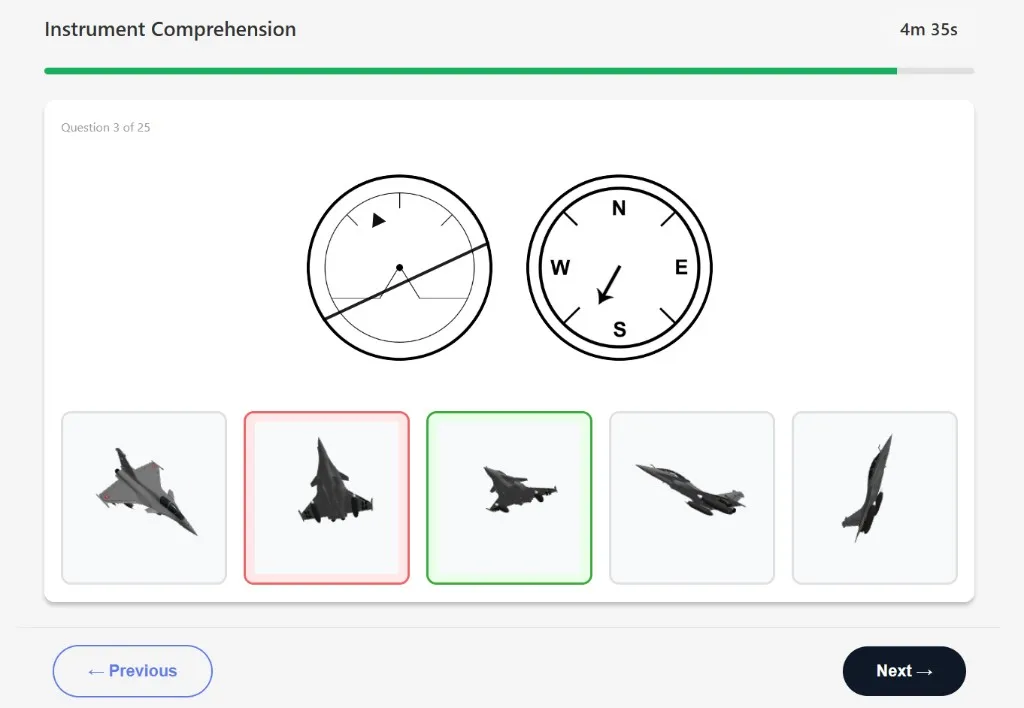
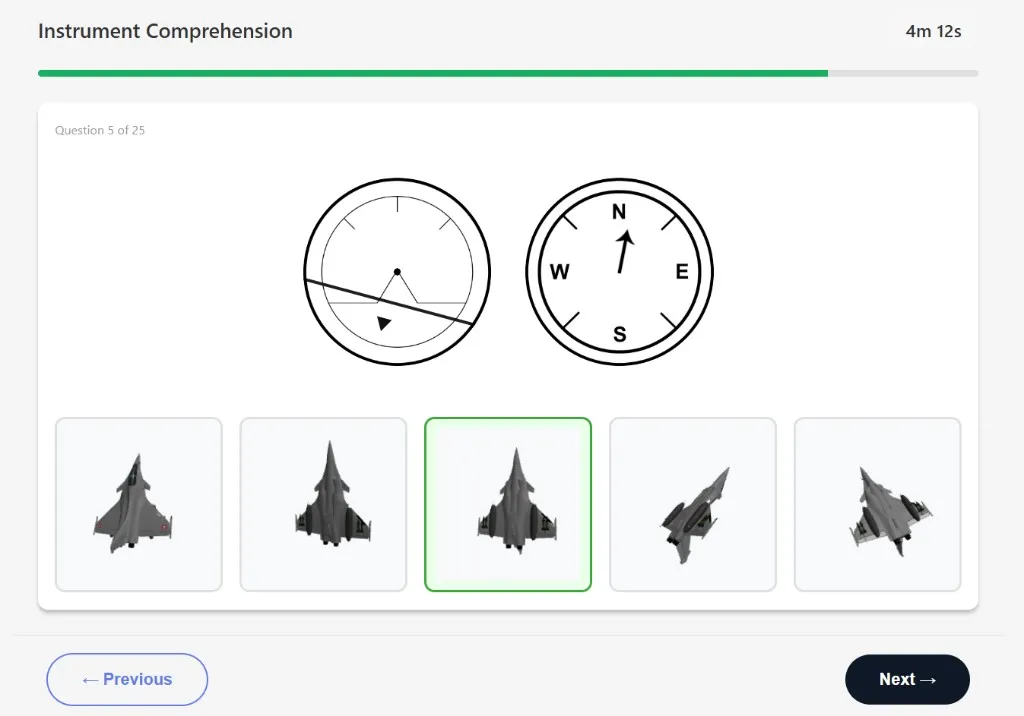
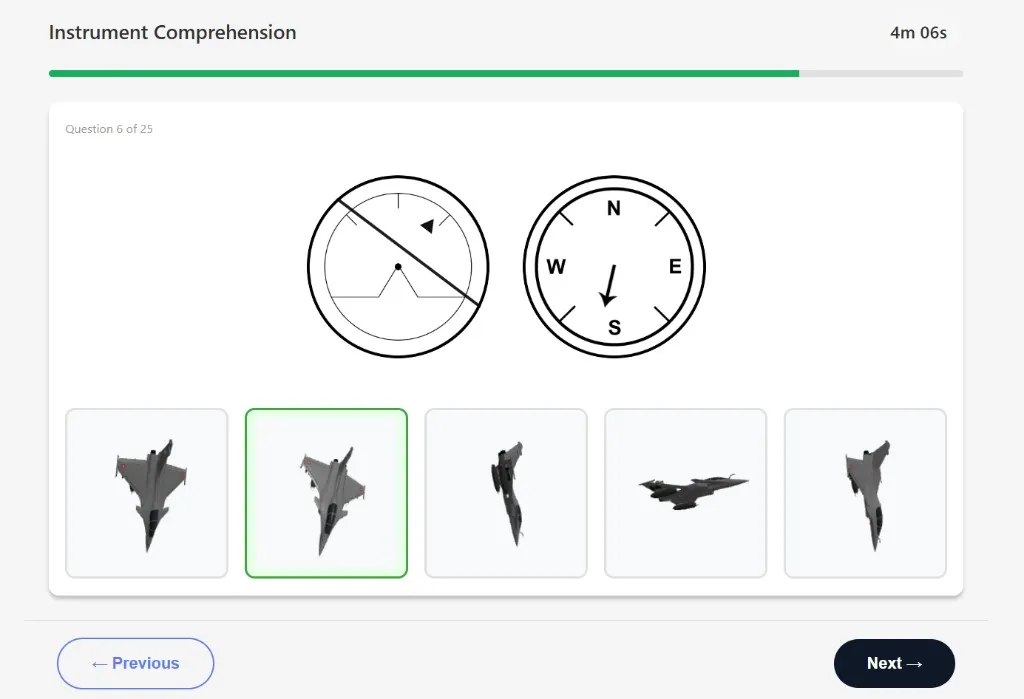
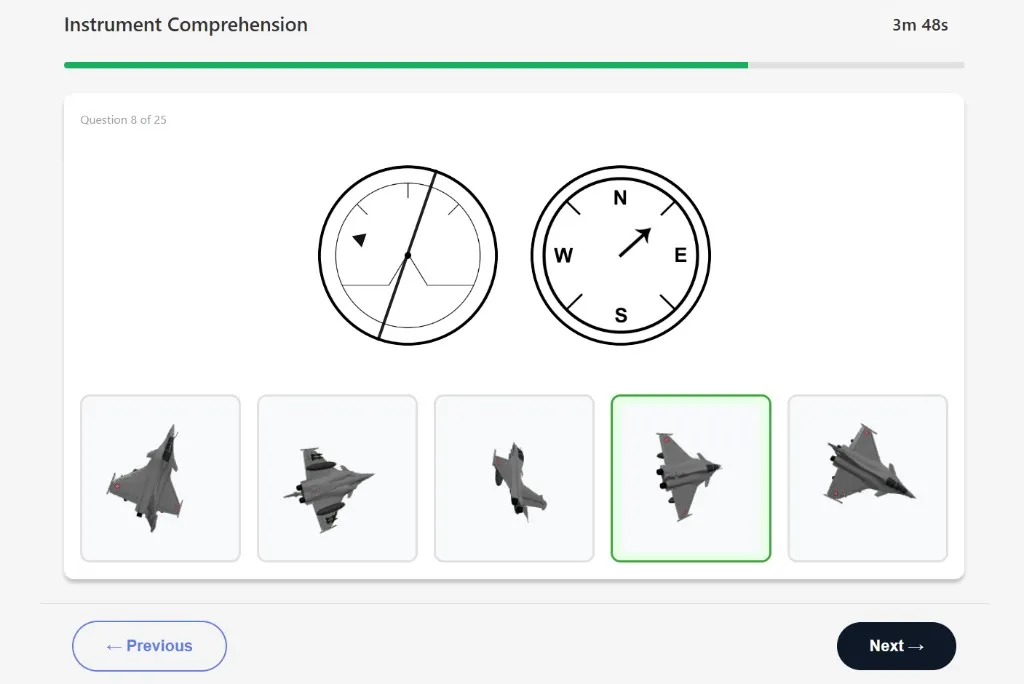
Sample questions from our AFOQT Instrument Comprehension practice tests. Each question comes with a detailed explanation so you understand the reasoning, not just the answer.
What is the Instrument Comprehension subtest?
Instrument Comprehension measures your ability to read and interpret aircraft flight instruments, primarily focusing on the attitude indicator (artificial horizon) and heading indicator (compass). Each question presents instrument readings and asks you to determine the aircraft's orientation, flight path, or movement based on those readings.
This subtest doesn't require actual flight experience, but it does demand familiarity with basic instrument symbology and the ability to quickly combine information from multiple instruments. The extreme time pressure — just 12 seconds per question — makes this one of the fastest-paced AFOQT subtests.
Most importantly, Instrument Comprehension is one of four subtests that directly contribute to the Pilot composite, which is essential for Air Force pilot selection. The other three Pilot-composite subtests are Math Knowledge, Table Reading, and Aviation Information.
What the questions are made of
The subtest focuses on interpreting readings from primary flight instruments to determine aircraft orientation and flight path.
Attitude indicator (artificial horizon)
The attitude indicator shows aircraft pitch (nose up/down) and bank (roll left/right). The horizon line divides the instrument: blue above (sky) and brown below (ground). The miniature aircraft symbol shows your orientation relative to the horizon.
Heading indicator (compass)
The heading indicator displays the aircraft’s current heading in degrees (0–360°). North is typically at the top (0°/360°), with East at 90°, South at 180°, and West at 270°. Questions often require reading precise heading values.
Combining attitude + heading
Most questions require you to combine information from both instruments. For example, an attitude indicator showing a right bank combined with a heading change indicates a right turn. You must synthesize both readings quickly.
Distinguishing flight paths
You’ll need to identify climbs (nose up), descents (nose down), level flight, and turns (left/right bank) from instrument readings. Questions may ask which direction the aircraft is turning or whether it’s climbing or descending.
Understanding instrument symbology
Familiarity with standard instrument symbols is essential. The miniature aircraft on the attitude indicator, horizon line position, heading numbers, and directional indicators must be interpreted instantly without hesitation.
The six basic flight instruments
While the test focuses on attitude and heading, understanding all six basic instruments helps: attitude indicator, heading indicator, airspeed indicator, altimeter, turn coordinator, and vertical speed indicator. Context from other instruments may appear.
The Pilot composite
Pilot composite = Math Knowledge + Table Reading + Instrument Comprehension + Aviation Information
Instrument Comprehension is one of four essential subtests that determine your Pilot score. Strong performance here directly impacts your eligibility for Air Force pilot training programs. All four subtests must be mastered for competitive Pilot scores.
ABM composite: Verbal Analogies + Math Knowledge + Table Reading + Instrument Comprehension + Block Counting + Aviation Information
Instrument Comprehension does not contribute to the Verbal, Quantitative, Academic Aptitude, or CSO composites. See the full composite breakdown on the AFOQT guide.
Tips & strategy
Master the attitude indicator, heading indicator, airspeed indicator, altimeter, turn coordinator, and vertical speed indicator. Understand what each shows and how they relate to aircraft movement. Start with attitude and heading, as these appear most frequently.
Study attitude indicator diagrams until you can instantly recognize pitch (nose up/down) and bank (left/right roll) angles. The horizon line position and miniature aircraft orientation must become second nature.
Learn to read heading values quickly and understand how heading changes relate to turns. Practice converting between degrees and cardinal directions (N, E, S, W). A right turn increases heading (clockwise); a left turn decreases it.
Flight simulators provide realistic instrument practice. Use programs like Microsoft Flight Simulator, X-Plane, or free online simulators to practice reading instruments in real-time scenarios. This builds the spatial reasoning needed for the test.
With only 12 seconds per question, hesitation is costly. Build pattern recognition through repetition and timed drills. If you can’t determine the answer quickly, make your best guess and move on — don’t waste time on a single question.
Related AFOQT subtests
Instrument Comprehension, quick answers
What is the AFOQT Instrument Comprehension subtest?
Instrument Comprehension is one of 12 AFOQT subtests and one of four subtests that contribute to the Pilot composite. You have 25 questions in 5 minutes to interpret aircraft instrument readings, primarily focusing on attitude indicators and heading indicators to determine aircraft orientation and flight path.
What instruments are tested on Instrument Comprehension?
The subtest focuses primarily on the attitude indicator (artificial horizon) showing pitch and bank, and the heading indicator (compass) showing aircraft heading. Questions require you to combine readings from both instruments to determine the aircraft's flight path, including climbs, descents, and turns.
How important is Instrument Comprehension for the Pilot composite?
Instrument Comprehension is one of four critical subtests that make up the Pilot composite, along with Math Knowledge, Table Reading, and Aviation Information. Strong performance on Instrument Comprehension directly impacts your Pilot score, which is essential for Air Force pilot selection.
How can I practice for Instrument Comprehension?
Study the six basic flight instruments, practice reading attitude indicators until it becomes automatic, learn heading indicator mechanics, and use flight simulator software to visualize instrument readings in real-time. Speed is critical at 12 seconds per question, so build pattern recognition through repetition.
Build your test-day method
- Exam-aligned drills under deliberate time pressure
- Instant explanations after every item
- Your score estimate, tracked drill after drill