
Multi-Tasking
Track a target, monitor gauges, answer math, listen for your call sign — all at once. The TBAS finale measures how you split attention.
- Format
- Computer-based
- Tasks
- 4 simultaneous
- Key skill
- Attention management
- Counts toward
- PCSM score
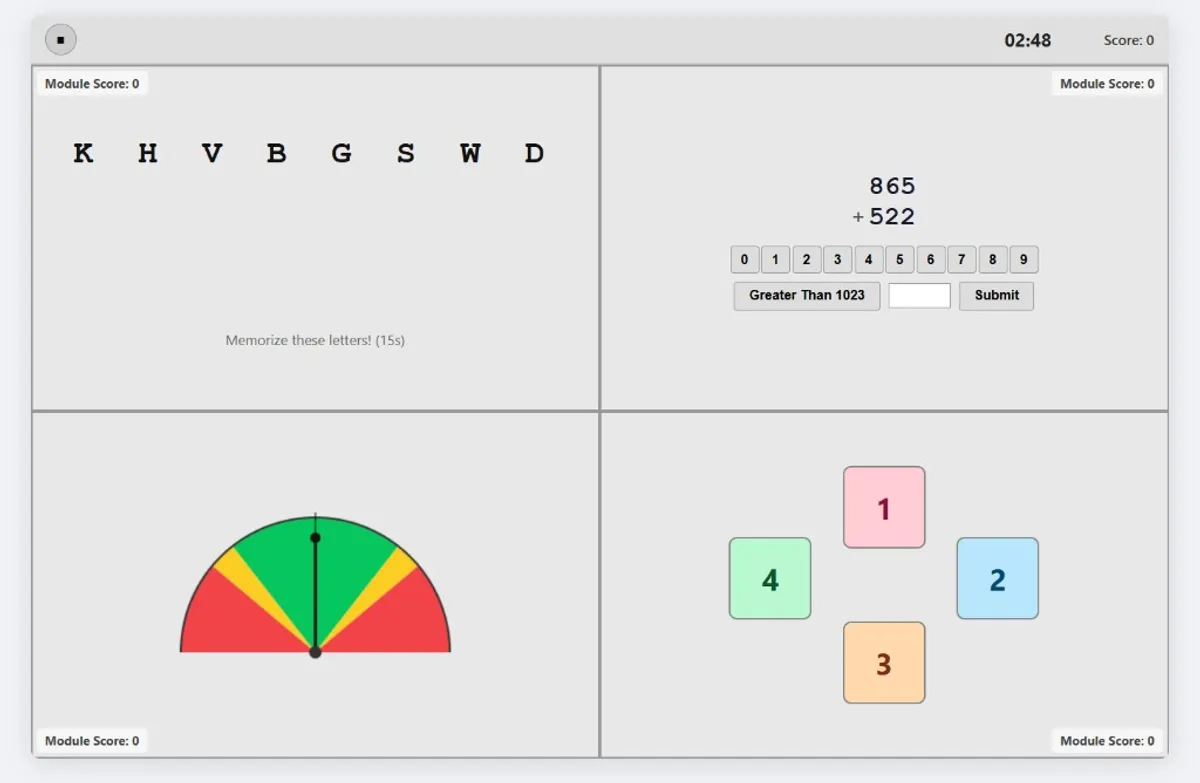
The Multi-Tasking test interface: four simultaneous tasks across four quadrants
What is the Multi-Tasking test?
The Multi-Tasking subtest measures your ability to divide attention across multiple simultaneous tasks — the single most important cognitive skill for military pilots. In a real cockpit, you must monitor instruments, control the aircraft, communicate on the radio, and maintain situational awareness all at the same time. This test evaluates whether you can handle that kind of cognitive load.
Your screen is divided into four quadrants, each running a completely independent exercise:
Top left — Letter memory
Memorize a series of letters, then identify them under time pressure.
Top right — Math calculations
Solve addition and subtraction problems with a number pad.
Bottom left — Gauge needle
Monitor a gauge and click at the right moment when the needle drifts.
Bottom right — Radio call sign
Listen for your call sign and respond to frequency instructions.
All four tasks run simultaneously for a set duration. The test begins with a brief screen showing your assigned call sign (which you must memorize), then all four quadrants activate at once. A timer counts down in the top-right corner.
Each task is intentionally simple when done alone. The difficulty comes entirely from doing all four at once, forcing you to constantly shift your attention without losing track of any single task.
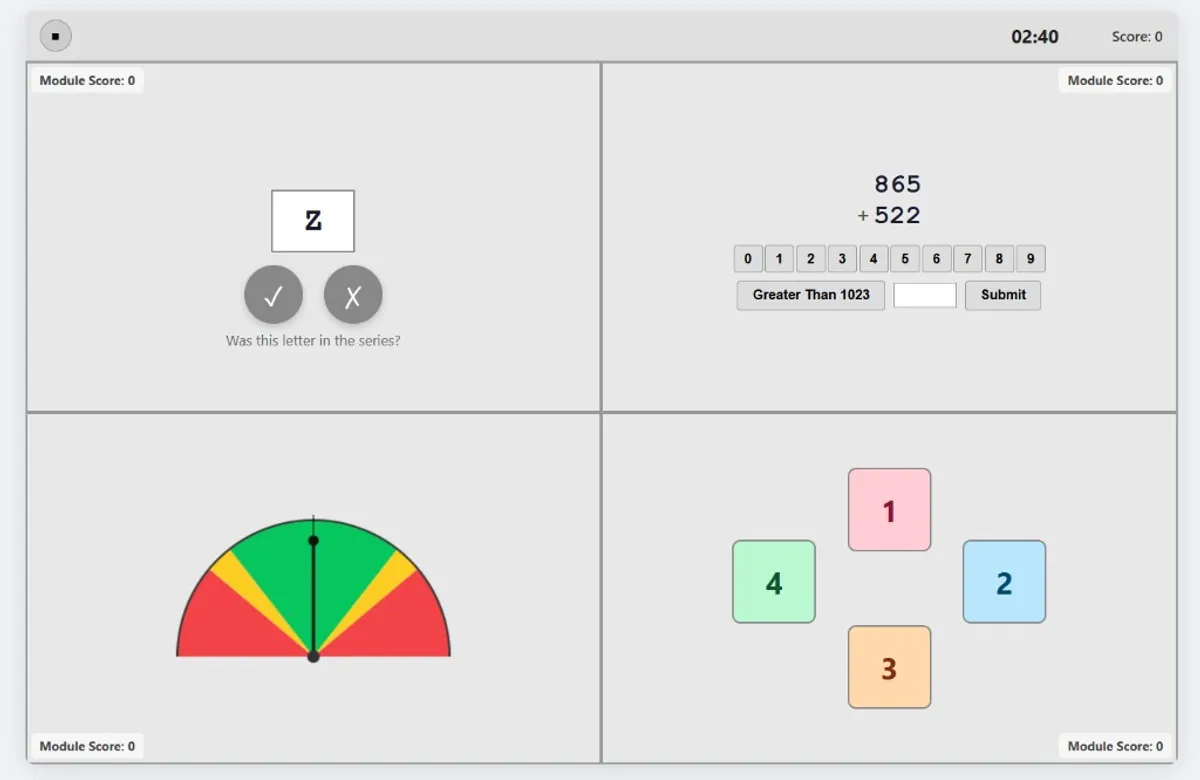
All four tasks running simultaneously during the test
The 4 sub-tasks explained
The Air Force does not publish the contents of the TBAS, and candidates are asked not to discuss specifics. The breakdown below is assembled from what test-takers consistently report, not from an official description — use it to prepare your attention, not as a guaranteed script.
Letter memory — top left
This task tests your working memory under divided-attention conditions.
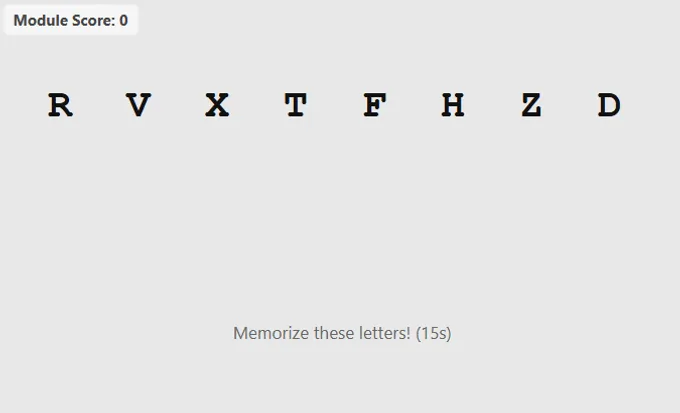
Phase 1 — Memorization: When the test starts, a series of random letters is displayed in the top-left quadrant. You have a short window to memorize as many as possible. During this time, the other three tasks are already running, so you cannot give this your full attention.
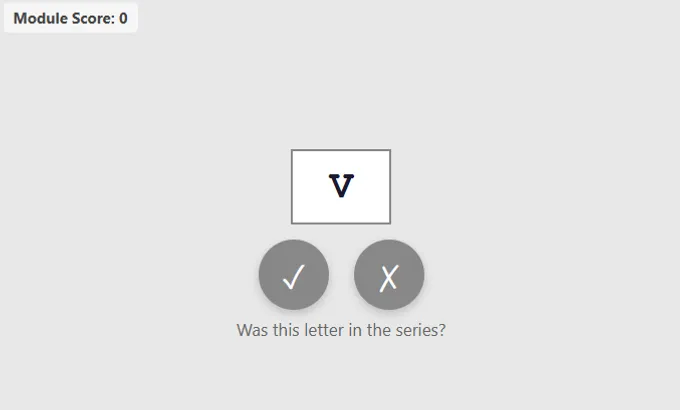
Phase 2 — Recognition: After the memorization phase ends, the letters disappear. Periodically, a single letter appears in a box. You must decide: was this letter in the original series? Click the checkmark if yes, or the X if no. You have a limited time to answer before the next letter appears.
Math calculations — top right
This task tests your mental arithmetic speed under pressure.
New addition or subtraction problems appear periodically. The numbers are displayed vertically (like pen-and-paper math), with the operator (+/−) shown to the left of the second number. You enter your answer using the on-screen number pad and press Submit.
At the start of the test, a “Greater Than” threshold is set. If you can tell that the result of the current problem is higher than this threshold, you can skip the calculation entirely and click the “Greater Than” button instead. This saves valuable time for your other tasks.
You have a limited time to answer before the problem times out.
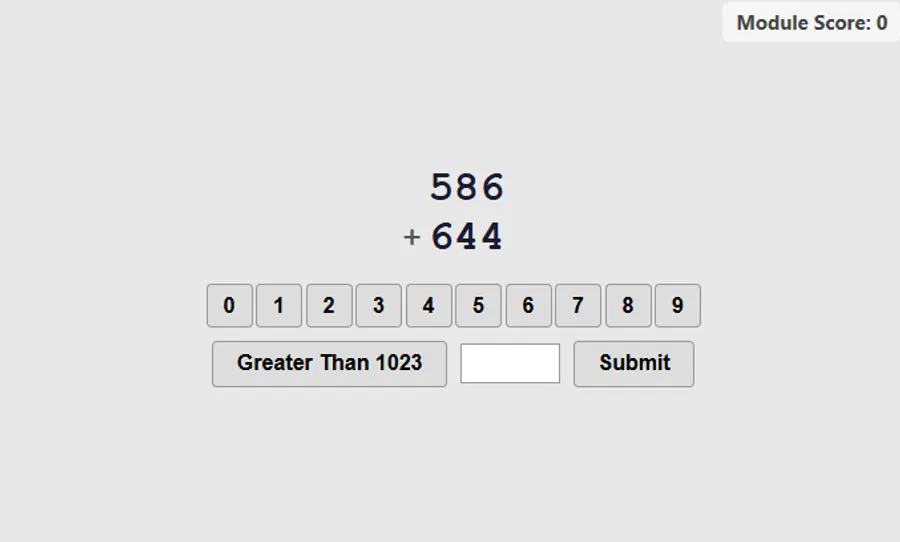
Enter your answer with the number pad, or use “Greater Than” when the result clearly exceeds the threshold
Gauge needle — bottom left
This task tests your visual monitoring and reaction timing.
A semicircular gauge is displayed with colored zones: green in the center, yellow on either side of green, and red at the outer edges. A needle starts centered in the green zone.
After a random delay, the needle begins drifting to one side at a random speed (sometimes slow, sometimes fast). Your goal is to click on the gauge when the needle is in the yellow zone. Clicking in the yellow zone earns the most points, while clicking in the green zone earns fewer. If you wait too long and the needle reaches the red zone, you get nothing.
After each click (or miss), the needle resets to center and the cycle repeats. Clicks made before the needle starts drifting are ignored.
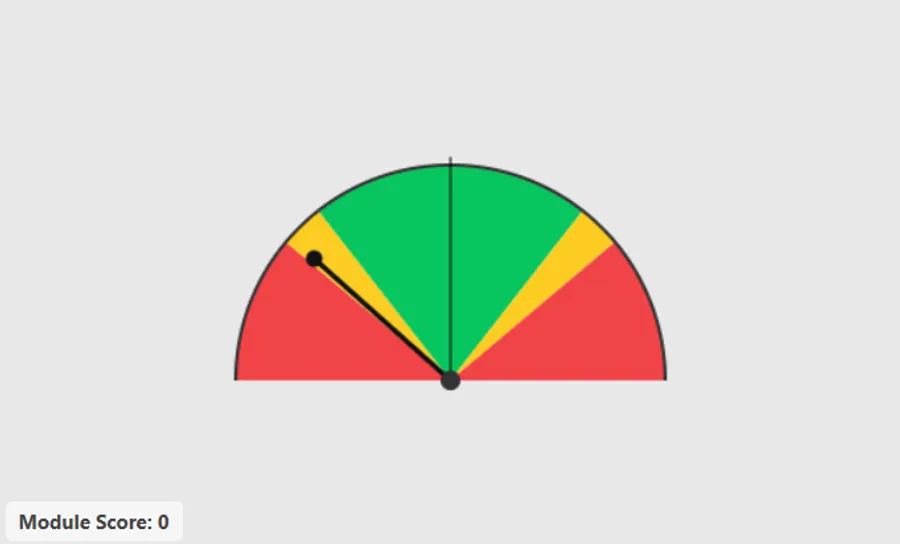
The needle has drifted left — click at the right moment for maximum points
Radio call sign — bottom right
This task tests your auditory attention and memory recall under distraction.
Before the test begins, you are briefly shown your assigned call sign (like “Uniform Victor”). You must memorize it — it will not be displayed again during the test.
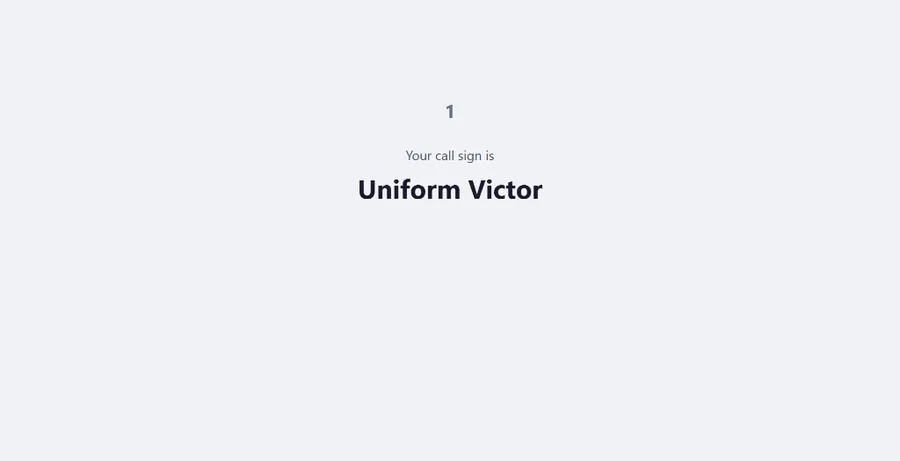
Your call sign is shown briefly — memorize it before the test begins
During the test, audio messages play through your speakers. Most are distractors — call signs that are not yours. When you hear your call sign followed by a frequency number (1, 2, 3, or 4), you must click the matching numbered box quickly.
The numbered boxes are scattered across the quadrant (not in a neat grid), which adds a visual search element on top of the auditory challenge. You must stay alert for your call sign at all times, even while focusing on other tasks.
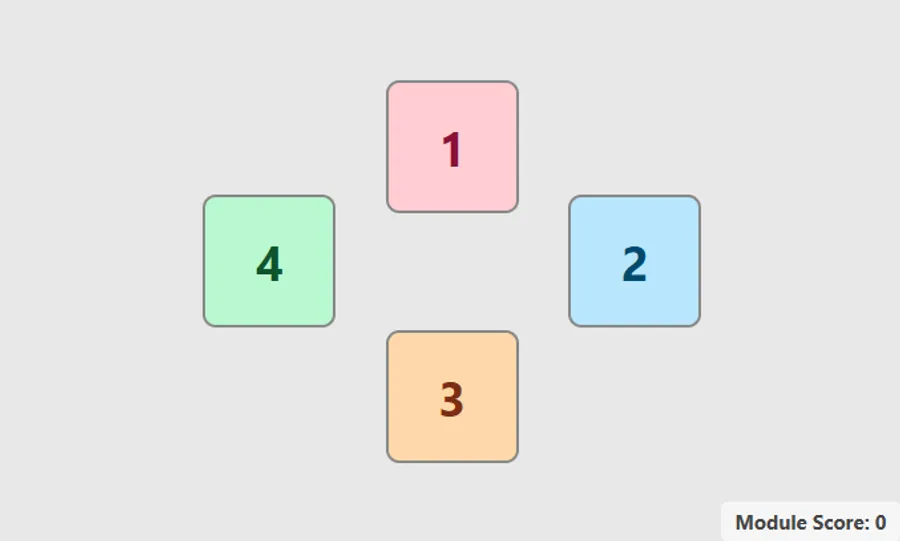
Click the correct frequency box quickly when you hear your call sign
How scoring works
There are no negative points in the Multi-Tasking test. Every response either earns you points or earns zero — you are never penalized for a wrong answer. Your final score is based on your overall performance across all four tasks.
Letter memory
Correct answers earn points. Wrong or timed-out answers earn nothing.
Math calculations
Correct answers (including correct “Greater Than”) earn points. Wrong or timed-out answers earn nothing.
Gauge needle
Clicking in the yellow zone earns the most points. Clicking in the green zone earns fewer points. Red zone or missed — no points.
Radio call sign
Correct frequency response earns points. Wrong or missed — no points.
Strategies & tips
The difference between a good and great multitasking score is rarely about skill at any single task — it is about how you manage your attention across all four. Here are the strategies that make the biggest difference:
Cycle your attention across all four quadrants in a regular pattern, like a clock. Never spend more than a few seconds focused on a single task. Even if you are mid-calculation, glance at the gauge to check if the needle has started moving. The candidates who score highest are not the smartest — they are the ones who never lose track of any quadrant.
The gauge needle is a visual task that rewards reaction timing, not sustained focus. After the needle resets, you do not need to stare at it — keep it in your peripheral vision and only shift focus when you notice movement. This frees up your attention for the more demanding letter and math tasks.
During the reveal screen, say your call sign to yourself several times. Then, periodically repeat it in your head during the test to keep it in working memory. Many candidates forget their call sign mid-test because they get absorbed in the visual tasks. If you forget it, you lose every radio point for the rest of the test.
For math problems, your first move should always be to estimate. Round the numbers mentally: “586 + 644” becomes “roughly 590 + 640 = 1230.” If the estimate is clearly above or below the “Greater Than” threshold, use the shortcut button immediately — no need to calculate further. Only invest time in a precise digit-by-digit calculation when your estimate lands close to the threshold and you cannot tell which side it falls on.
During the letter memorization phase, use a mnemonic strategy while the letters are visible: group them into chunks (pairs or a word-like sequence). You do not need to memorize every single letter perfectly — remembering most of them reliably is usually enough to score well on this task. Do not neglect the other quadrants entirely during this phase.
You will miss some answers. That is expected and by design. The test is not about getting 100% on every task — it is about maintaining adequate performance across all four simultaneously. If you miss a letter or a math problem, let it go immediately and move on. Dwelling on a mistake costs you points on every other task.
Common mistakes to avoid
Tunnel vision on one quadrant
The most common mistake is getting absorbed in a math problem or letter decision and completely forgetting about the other three tasks. While you are calculating 865 + 522, the gauge needle might be drifting into the red zone and a radio call might be going unanswered. Always keep scanning.
Forgetting your call sign
Your call sign is only shown briefly at the very start. Under the stress of multitasking, many candidates forget it within the first minute. Once you forget it, every radio call sign prompt becomes a lost point. Periodically repeat it to yourself.
Clicking the gauge before it moves
Some candidates try to “game” the gauge by clicking randomly. Clicks made while the needle is stationary (before a drift starts) are completely ignored. Wait for the needle to start moving, then time your click for the yellow zone.
Overthinking math problems
Spending too long on a single math problem is never worth it. If you cannot solve it quickly, submit your best guess or use the “Greater Than” button if the numbers look large enough. The time you save is better spent on the other three tasks.
Panicking after a mistake
Missing a letter, getting a math answer wrong, or missing a radio call can be frustrating. But the worst thing you can do is dwell on it. There are no negative points — a missed question simply earns zero. Reset mentally and focus on the next opportunity across all four tasks.
Multi-Tasking, quick answers
How long does the Multi-Tasking test last?
The Multi-Tasking test runs for a set duration. Before the test begins, you are briefly shown your assigned call sign, which you must memorize. Once the timer starts, all four sub-tasks — letter memory, math calculations, gauge monitoring, and radio call sign — run simultaneously until the countdown reaches zero. A timer is displayed on screen so you can track how much time remains. The entire experience is fast-paced: every second counts, and you must constantly shift your attention between quadrants to maximize your score.
How is my final score calculated?
Your final score is based on your overall performance across all four sub-tasks. There are no negative points — every response either earns points or earns zero. The scoring is purely additive: correct answers add to your total, while wrong or missed answers simply add nothing.
Is this practice test exactly like the real TBAS?
Our practice tool trains the same core skill the real TBAS measures: divided attention under pressure. While the real TBAS uses joystick tracking, rudder pedals, and audio digit sequences, our tool uses four screen-based tasks that challenge the same cognitive abilities — working memory, mental math, visual monitoring, and auditory processing — all performed simultaneously. The cognitive load and attention-switching demands are directly comparable.
What is the best strategy for a high score?
Develop a scanning pattern: cycle your attention across all four quadrants regularly instead of fixating on one. Use peripheral vision for the gauge, mentally rehearse your call sign, and estimate math answers rather than calculating precisely. The goal is adequate performance across all tasks, not perfection on any single one. See our full strategies section above for detailed tips.
Can I practice individual sub-tasks separately?
The practice exercise runs four sub-tasks simultaneously to train divided attention under pressure. The Air Force does not publish the exact TBAS task design or scoring, so this is a training model rather than a replica. During your first few attempts, focus on understanding how each task works, then shift your focus to managing all four together.
Build your test-day method
- Exam-aligned drills under deliberate time pressure
- Instant explanations after every item
- Your score estimate, tracked drill after drill