
Electronics Information
Current, circuits, and components — the gateway subtest to electronics, comms, and avionics jobs.
- Questions
- 15 (CAT)
- Time limit
- 10 min
- Pace
- ~40 s per item
- Counts toward
- EL line score
See what the test looks like
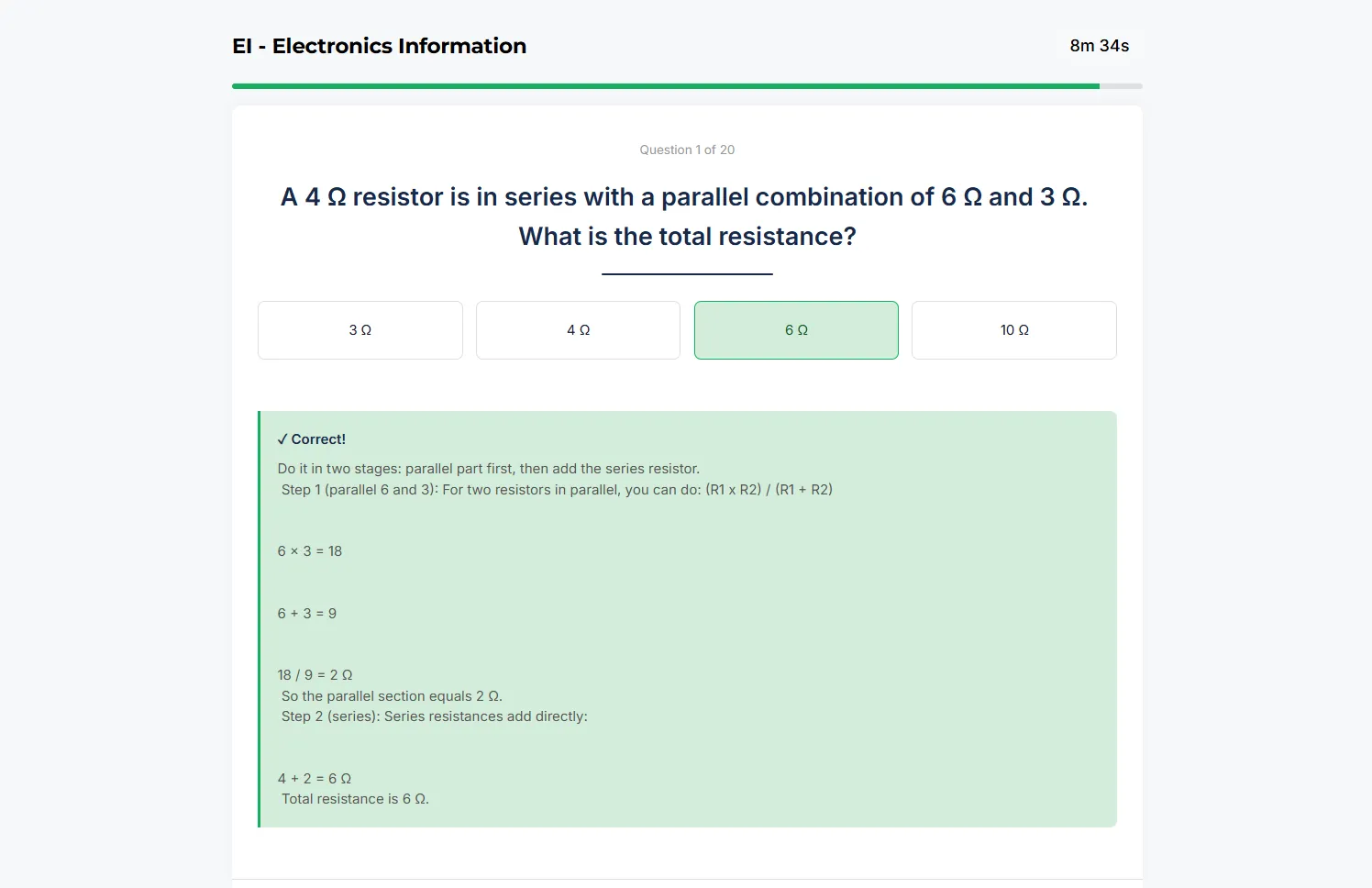
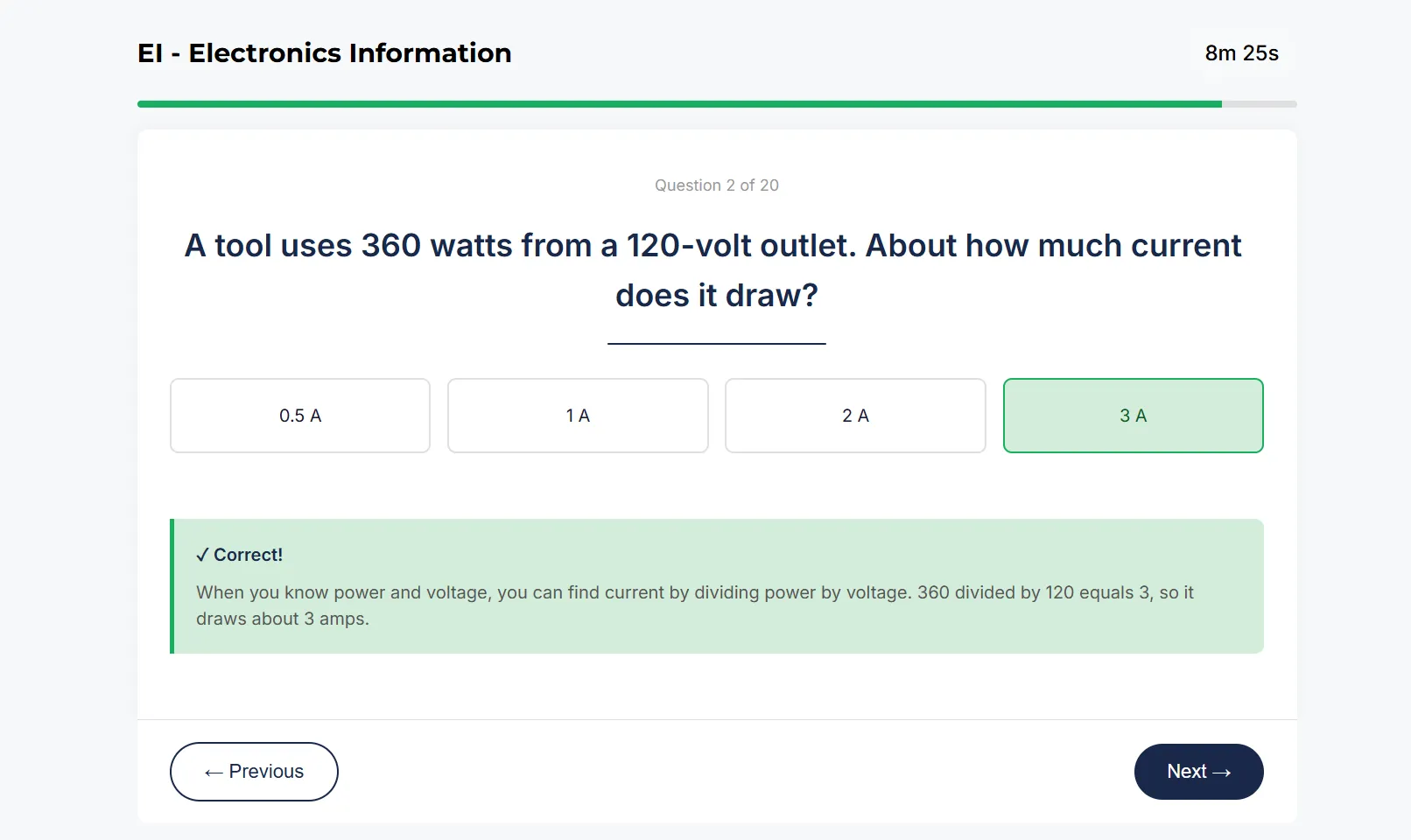
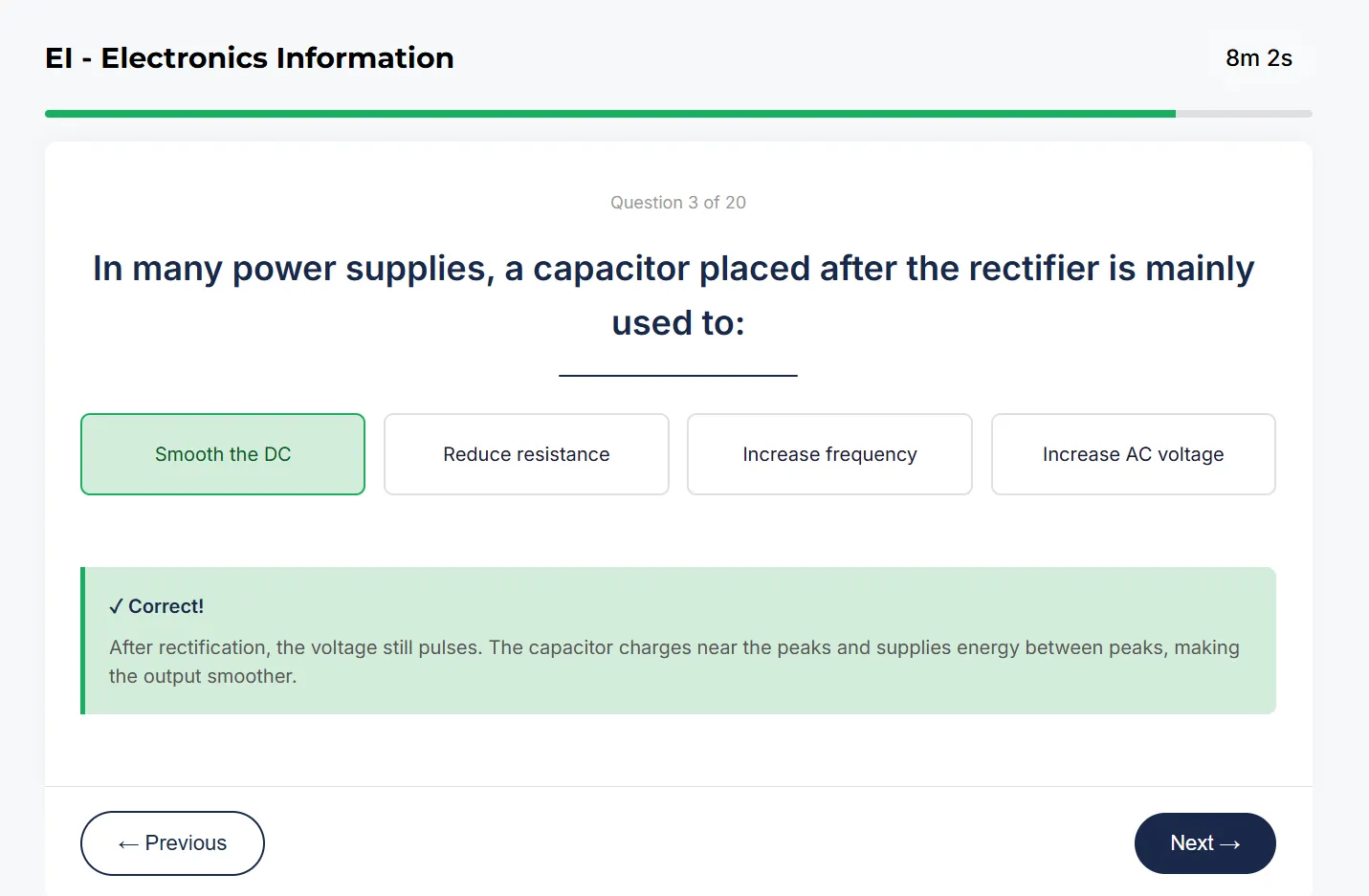
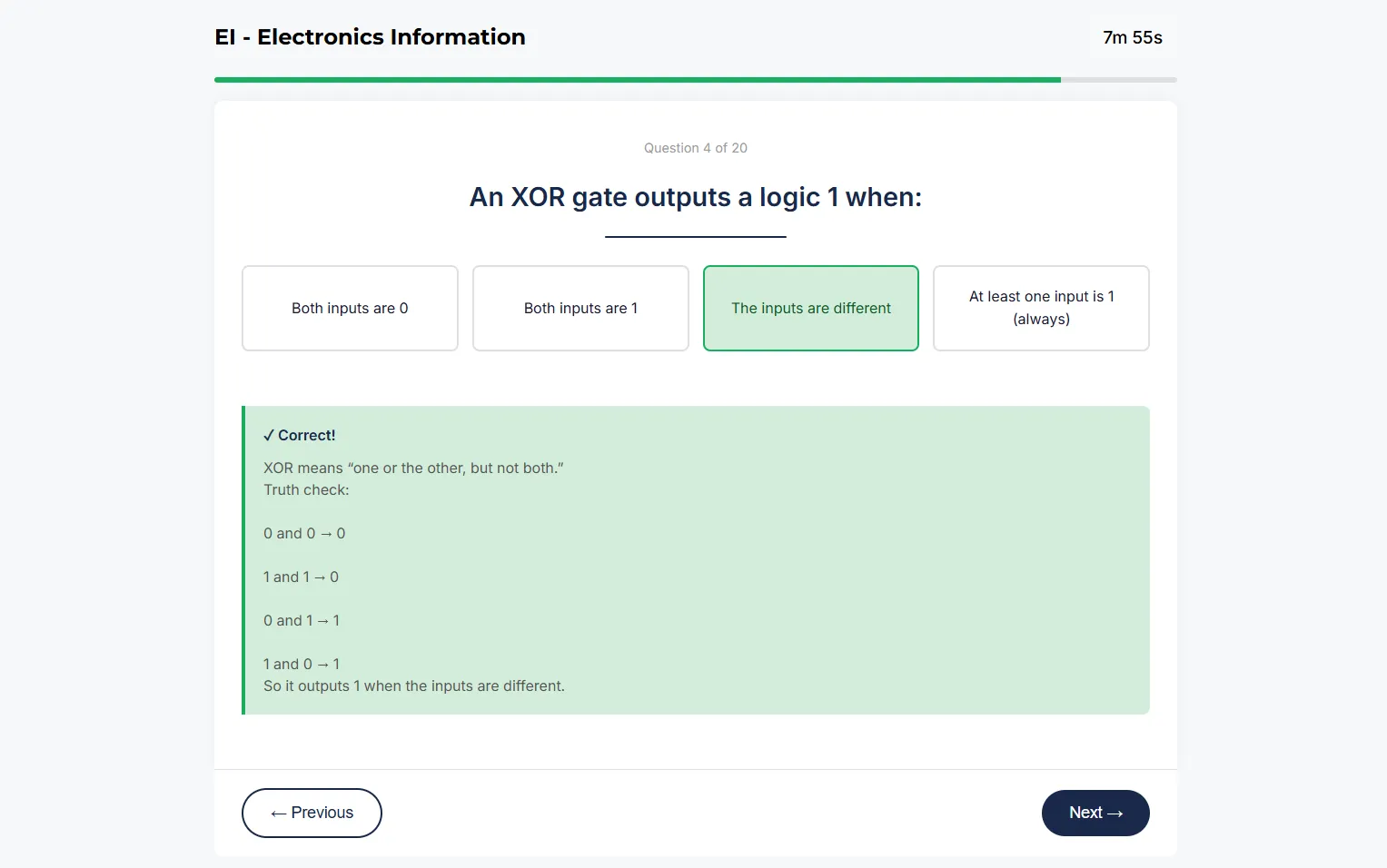
Here are sample questions from our Electronics Information practice tests. Each question comes with a clear explanation of the correct answer.

Inside the Electronics Information subtest
EI tests working vocabulary more than engineering: what current, voltage and resistance are, how series and parallel circuits differ, what each component does, and how to read the standard schematic symbols.
Ohm’s law and the series/parallel rules answer roughly a third of the questions on their own. Learn the dozen schematic symbols by sight — the test assumes them without explanation.
Which component stores electrical energy in an electric field?
A capacitor holds charge between its plates. The inductor (not listed) is its magnetic-field cousin — a favorite follow-up question.
Coach's tip. Draw the twelve basic schematic symbols on one card and quiz yourself until naming them is instant — symbol recognition is the cheapest EI points there are.
How the subtest is delivered
Two versions of the same subtest, and they are not the same sitting. Which one you take depends on where you test.
CAT-ASVAB
Computer, at a MEPS — what most enlistees take
- Questions
- 15 scored
- Time limit
- 10 min
- With tryout items
- up to 21 min
Adaptive: the difficulty follows your answers, and you cannot skip or go back. Up to 15 unscored tryout items may be added, which is what raises the limit to 21 minutes — you are never told which ones they are, so treat every question as scored.
Paper & Pencil
Booklet and answer sheet, at a MET site
- Questions
- 20
- Time limit
- 9 min
- Pace
- ~27 s per question
Fixed difficulty — everyone sits the same items in the same order. You may skip and come back, but unanswered questions are scored as wrong, so leave nothing blank.
EI topics you must master
Focus your study on these five areas. They cover everything you'll see on the test.
Electricity Fundamentals
The core of every EI question: Current, voltage, resistance, and power · Ohm's law: V = I x R · DC (direct current) vs AC (alternating current) · Units: volts, amps, ohms, watts
Circuits & Components
How electricity flows through systems: Series vs parallel circuit behavior · Resistors, switches, fuses, and batteries · What happens when a switch opens or a fuse blows
Circuit Diagrams & Schematic Symbols
Reading a circuit the way the test draws it: Identifying standard schematic symbols on sight · Reading a wired circuit diagram · Simple calculations from a diagram (Ohm’s law applied to what you see)
Basic Electronics Concepts
Introductory-level component knowledge: Conductors vs insulators · Diodes and transistors (intro level) · Simple troubleshooting logic
Measurement & Tools
Know what each tool measures: Ohmmeter: measures resistance · Ammeter: measures current · Voltmeter: measures voltage
Electronics Information, quick answers
Is ASVAB Electronics Information hard?
EI can feel unfamiliar if you've never studied electricity or circuits, but the content itself is introductory-level. Think basic physics, not electrical engineering. Most questions test vocabulary (voltage, resistance, current) and simple relationships (Ohm's law, series vs parallel). With 2–3 weeks of focused study, most people see significant improvement.
Is EI part of the AFQT score?
No. The AFQT is calculated from only four subtests: AR, MK, WK, and PC. However, EI is a critical component of several line scores — especially the Electronics (EL) composite — that determine which military jobs you qualify for. A strong EI score opens doors to high-demand technical and electronics-related MOS options.
Can I use a calculator on EI?
No. Calculators are not allowed on any section of the ASVAB. The math in EI is minimal — mostly basic multiplication, division, and applying Ohm's law (V = IR). Focus on understanding the concepts and relationships rather than complex calculations. If a question involves numbers, they're designed to be simple enough to solve by hand.
What topics are most important in EI?
Electricity fundamentals (voltage, current, resistance, Ohm's law) and circuit basics (series vs parallel, components) make up the majority of EI questions. Understanding conductors vs insulators, AC vs DC, and basic measurement tools (ohmmeter, multimeter) is also important. Master these core areas first for the highest score improvement.
How long should I study for EI?
If you have no electronics background, plan for 3–4 weeks at 30 minutes per day. Start with electricity basics (voltage, current, resistance), then move to circuits and components. If you already have some background, 1–2 weeks of practice tests and review should be enough. Focus on understanding concepts, not memorizing formulas.
Does a higher EI score help with military job options?
Absolutely. EI feeds directly into the Electronics (EL) line score, which is required for many high-demand technical MOS — including communications, radar, avionics, and IT-related roles. A strong EI score combined with good math scores (AR + MK) significantly expands the number of military jobs available to you.
Build your test-day method
- Exam-aligned drills under deliberate time pressure
- Instant explanations after every item
- Your score estimate, tracked drill after drill