
Mechanical Comprehension
Applied mechanical science, delivered adaptively: perceiving physical relationships and solving practical problems in 15 minutes.
- Questions
- Adaptive
- Time limit
- 15 min
- Score you see
- Composite only
- Counts toward
- SIFT score
See what our trainer looks like
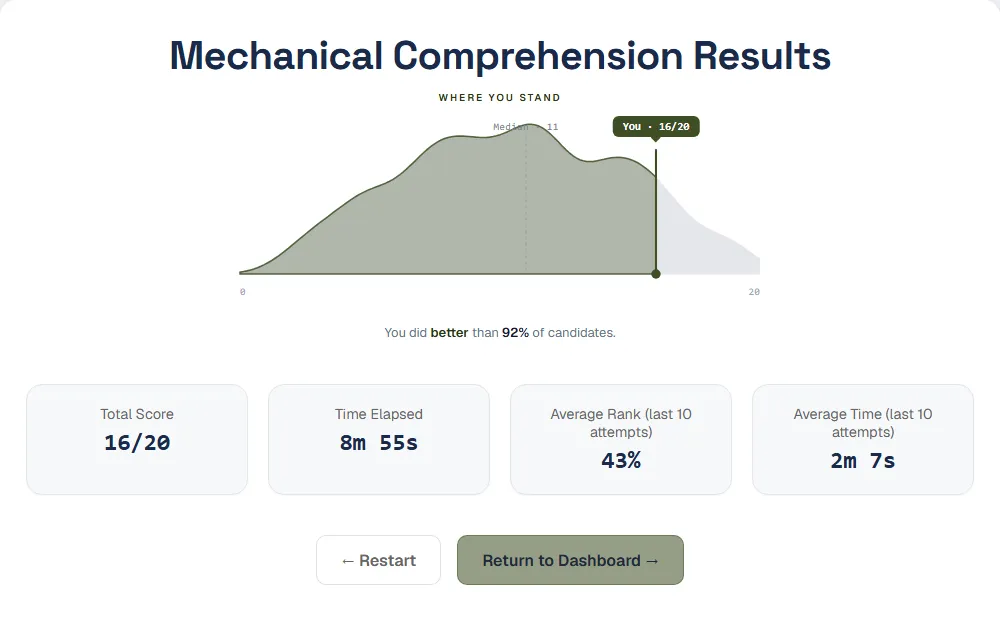
Our practice test runs 20 questions in 15 minutes, four-choice and diagram-based, generated fresh for each attempt. The real exam is adaptive; this format is ours. Training mode corrects every question with an explanation.
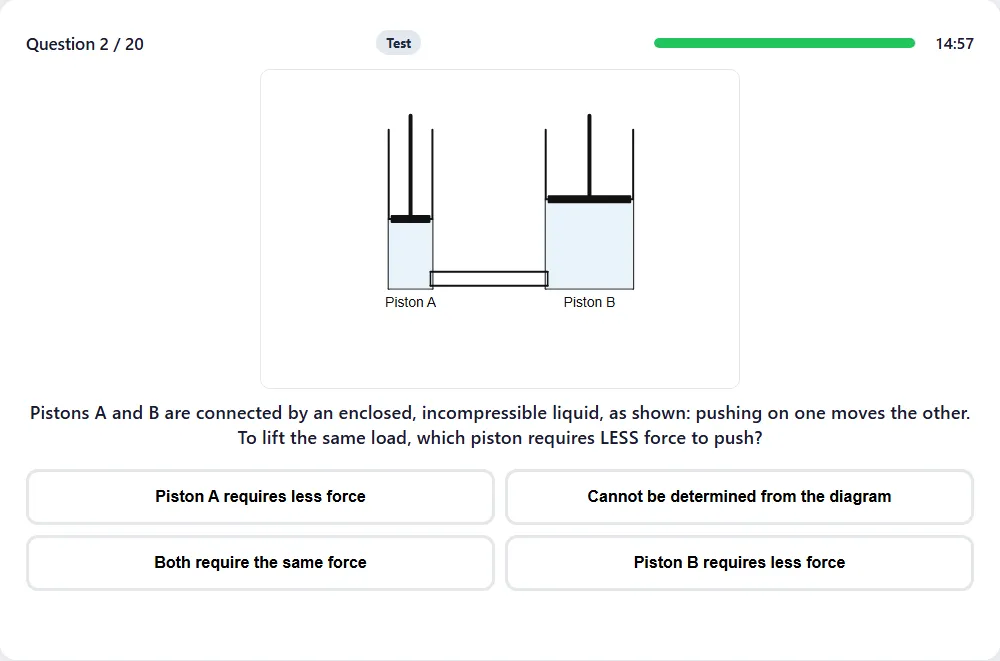
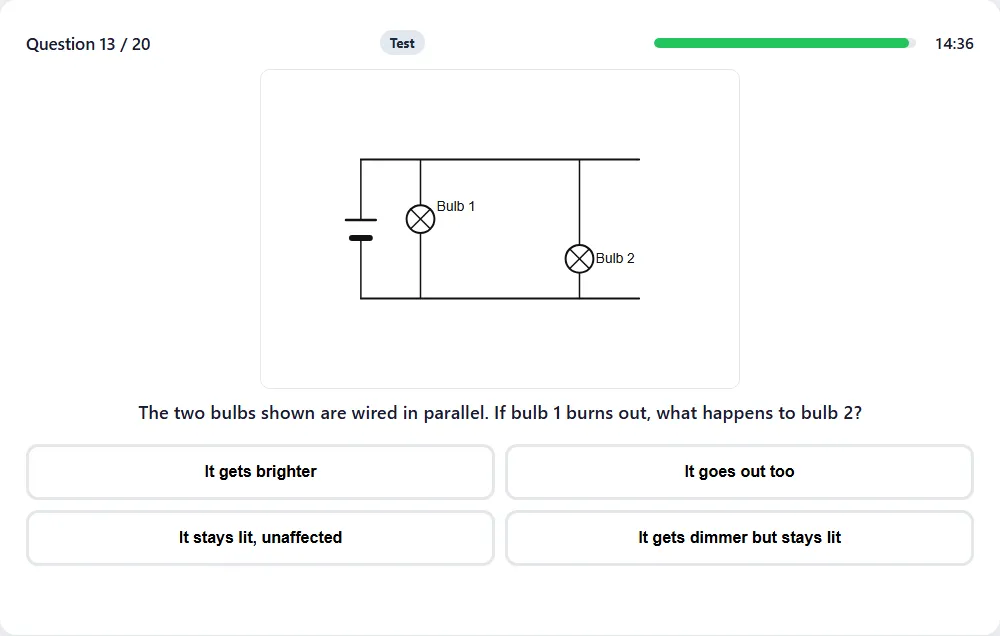
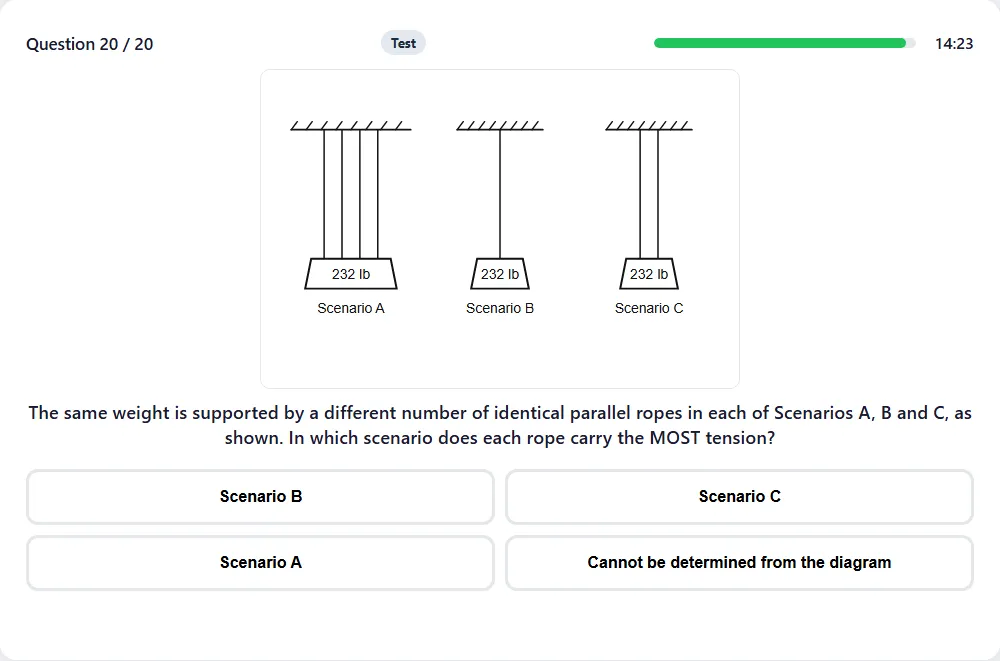
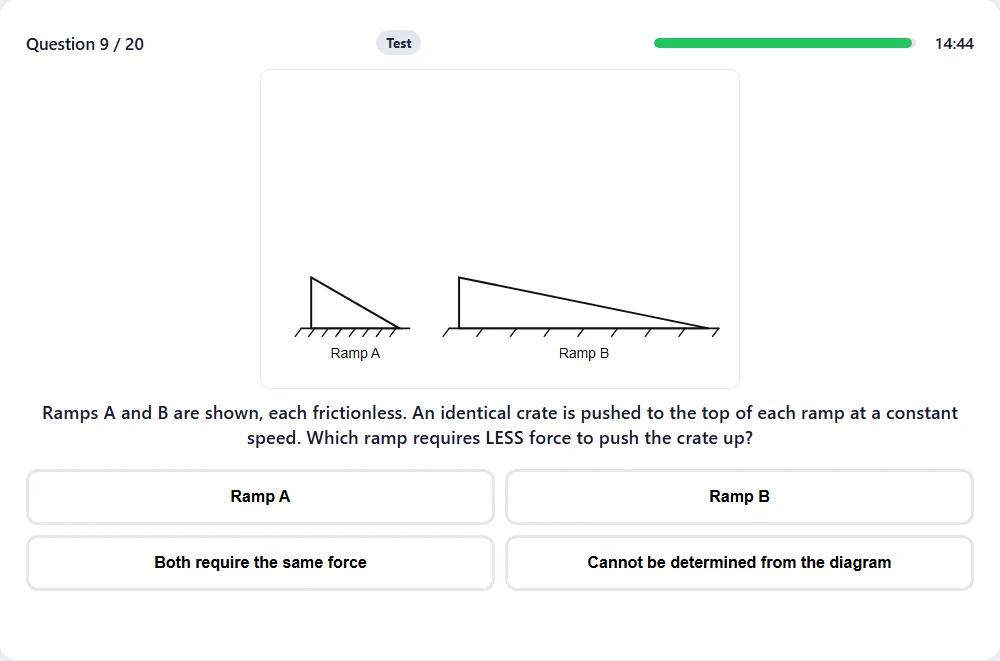
What is the Mechanical Comprehension subtest?
Mechanical Comprehension (MCT) tests your understanding of mechanical and physical principles. Like Math Skills, it's a Computer Adaptive Test (CAT): it adjusts difficulty based on your performance, so the number of questions varies. The one fixed figure is the 15-minute time limit. A 2013 post on the Air Warriors forum describes the sibling Math Skills Test as not letting you go back once you've answered; no source confirms whether the MCT behaves the same way.
The Army describes the subtest as testing your ability to "perceive physical relationships and solve practical problems in applied mechanical science." One candidate account (Air Warriors forum, 2016) lists questions on inclined planes, acceleration and velocity, Bernoulli's principle, pulleys, electrical components, displacement, and weight and gravity effects.
Mechanical Comprehension is one of seven subtests that collectively produce your SIFT score. You only ever see the single composite, never a per-subtest breakdown. A result of 40 or higher meets the cutoff for flight-training selection. The SIFT is required of every U.S. Army aviation candidate.
The MCT started as a Navy test: the Army adapted it from the ASTB with the Navy's permission. That is its origin, not proof the two tests still match today.
What the questions are made of
The official description stays broad. The topics below come from the forum account above and from the Army's illustrative example; the rest of what we train is listed underneath.
Simple Machines
The forum account names pulleys and inclined planes. Both come down to mechanical advantage, trading force for distance.
Motion & Forces
Acceleration, velocity, and displacement, plus the effect of weight and gravity on objects at rest or in motion.
Fluids
Bernoulli's principle: how a fluid's speed and pressure trade off against each other.
Electrical Components
Electrical components appear in that account. The circuits we draw carry batteries, resistors, and switches, and ask you to compare series and parallel paths.
Gears
Meshing gears turn in opposite directions, and a larger gear turns more slowly with more torque. A 2017 Army research report shows a gear-direction question: a driver gear turns, and you decide which neighboring gears turn with it. The report calls it an illustrative item adapted from a prep book, not a real test item.
We also cover levers, springs, center of gravity, statics, buoyancy, and rotation and torque. These are general mechanical-physics topics useful for the subtest, even though they aren't named in the sources above.
Tips & strategy
Our practice test rewards conceptual understanding: if you know why a lever gives mechanical advantage, the lever items follow.
Before you answer, read the drawing itself: the labels on each part, which way the arrows point, and what the diagram asks you to compare. Practice pulling that information out visually, not just the surrounding text.
Count the ropes supporting the load; that count is the mechanical advantage.
Newton's three laws, work = force × distance, pressure = force / area, and conservation of energy are the fundamentals worth reviewing. They cover most of what our practice test asks.
Physical intuition gets you a long way on mechanical items. Which way does a door swing? What happens when you step on a garden hose? How does a seesaw balance? Trust it, then verify with principles.
Mechanical Comprehension, quick answers
What is the SIFT Mechanical Comprehension subtest?
Mechanical Comprehension (MCT) is a computer-adaptive test that assesses your ability to perceive physical relationships and solve practical problems in applied mechanical science. It adapts to your performance level. The clock does not adapt. The time limit is a fixed 15 minutes, and it is the number of questions that varies.
Is SIFT Mechanical Comprehension similar to the ASVAB version?
Both test mechanical reasoning. The published formats differ. The computer version of the ASVAB fixes the count at 15 questions in 22 minutes. Only a 15-minute limit is published for the SIFT version, and the number of questions varies. Both computer versions adjust their difficulty to your answers.
Do I need to know advanced physics?
No advanced physics is documented as required. Solid grounding in the fundamentals covers what one candidate account describes seeing: how pulleys and inclined planes work, and basic motion concepts like acceleration and velocity.
What resources should I use to study?
SIFT-specific prep books, the ASVAB Mechanical Comprehension study material, and basic physics textbooks. Online physics simulations and mechanical reasoning practice tests are two other options.
Build your test-day method
- Exam-aligned drills under deliberate time pressure
- Instant explanations after every item
- Your score estimate, tracked drill after drill