
Mechanical Comprehension
Levers, pulleys, gears, and fluid pressure — physical intuition, measured on a clock.
- Questions
- 15 (CAT)
- Time limit
- 22 min
- Pace
- ~88 s per item
- Counts toward
- MM · GM line scores
See what the test looks like
Here are sample questions from our Mechanical Comprehension practice tests. Each question comes with a clear explanation of the correct answer.
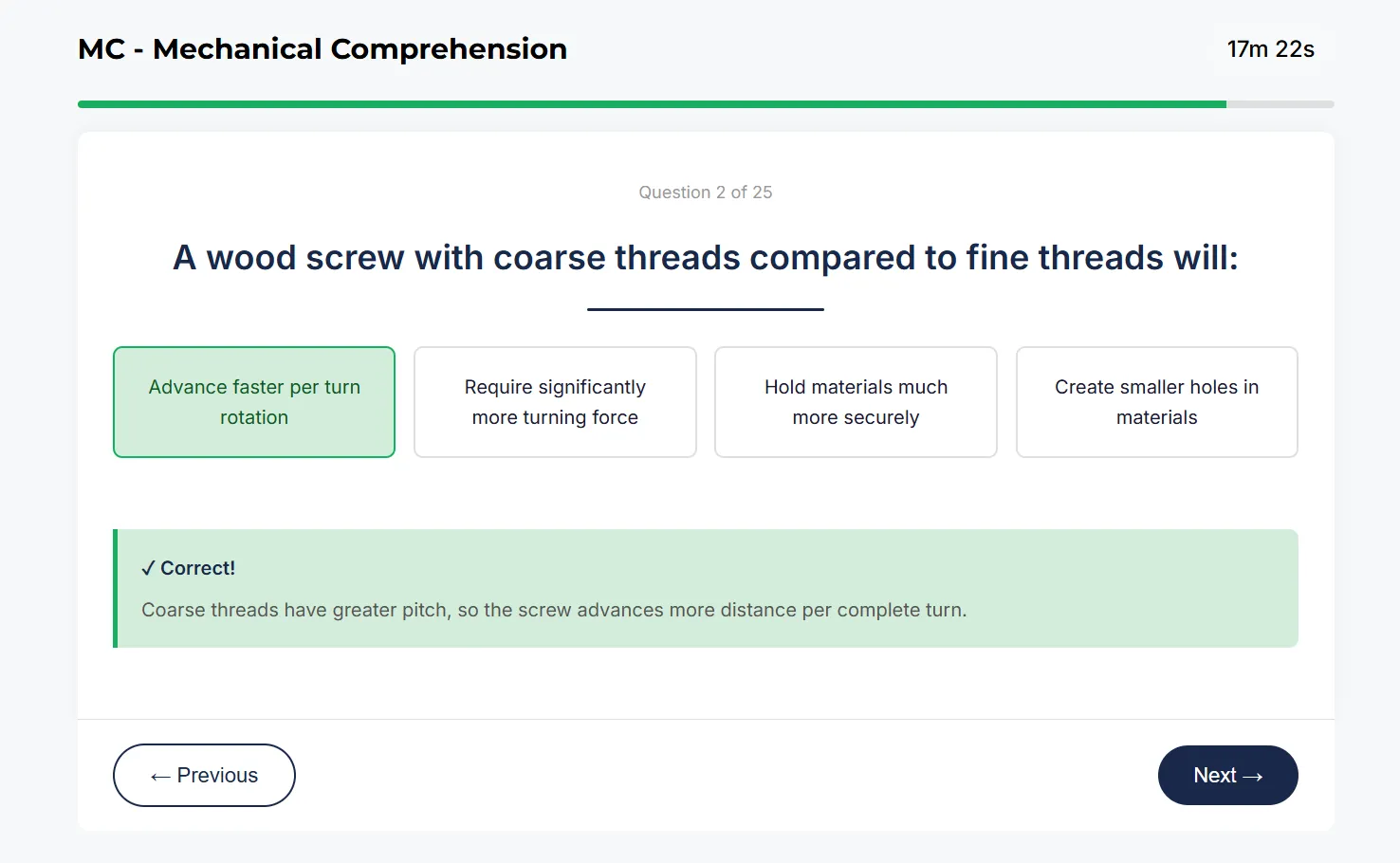
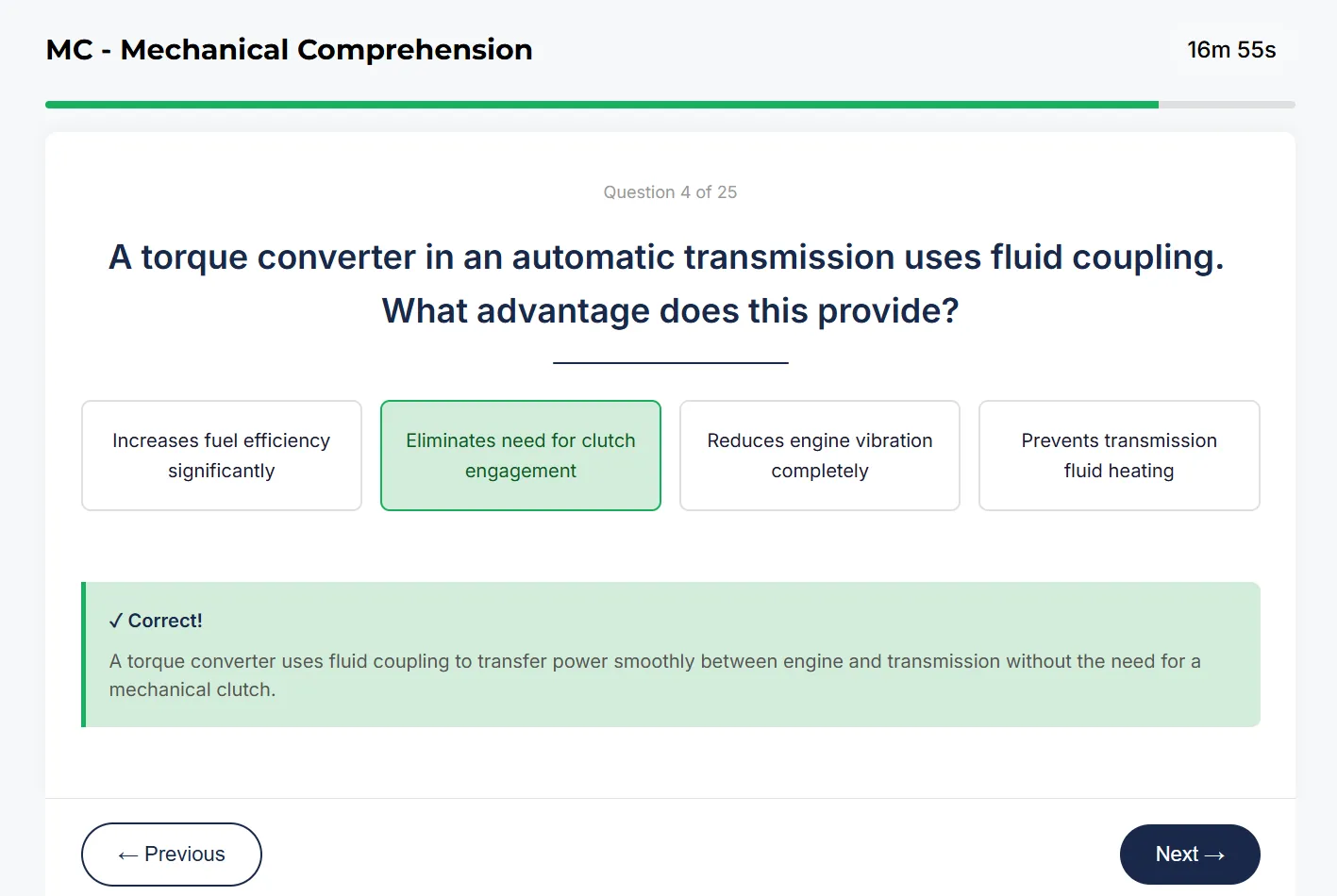
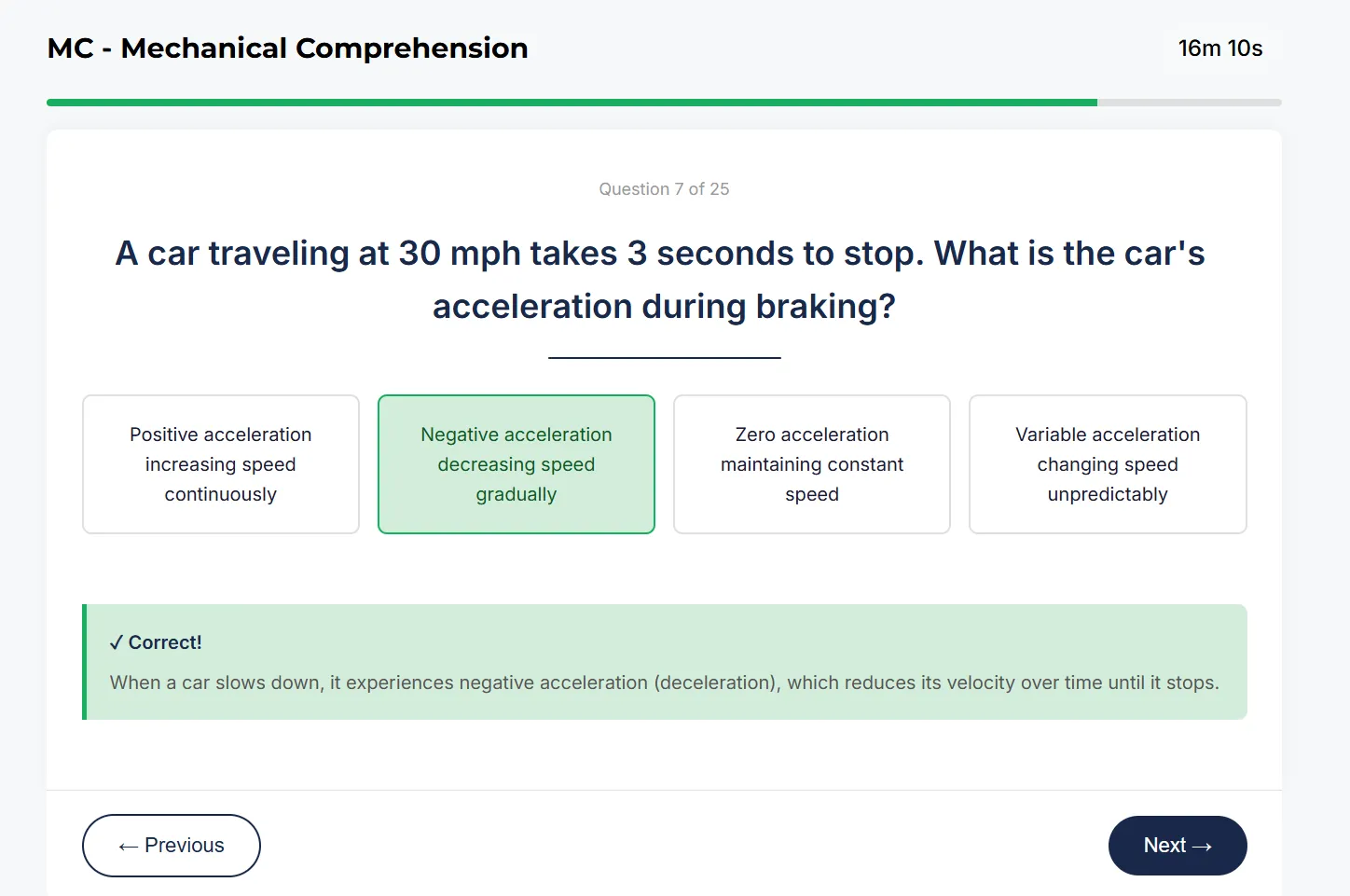
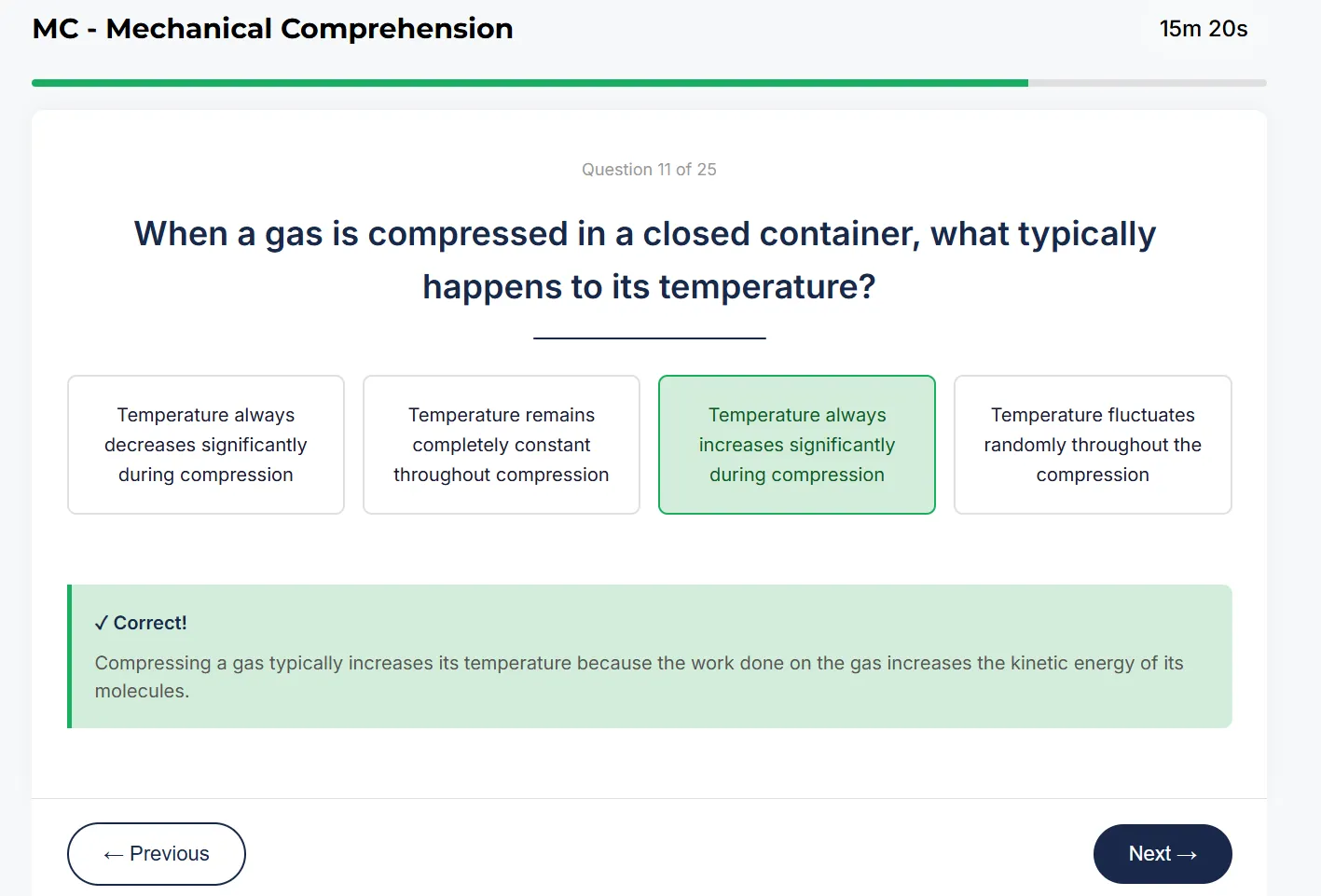

Inside the Mechanical Comprehension subtest
Every MC diagram is a machine asking one question: who wins, force or distance? Levers, pulley systems, gear trains, ramps, and hydraulic pistons all trade one for the other, and the test wants the ratio.
Most items fall to a single count: rope segments supporting the load, teeth on each gear, arm lengths on each side of the fulcrum. Count first, compute second — the picture is the problem.
A movable-pulley system with two supporting rope segments lifts a 100-lb load. The effort required is about:
Mechanical advantage equals the number of supporting segments: two segments halve the effort. You pay it back in rope pulled.
Coach's tip. Memorize the mechanical advantage of the six simple machines. If you can compute MA in your head, two thirds of MC becomes arithmetic.
How the subtest is delivered
Two versions of the same subtest, and they are not the same sitting. Which one you take depends on where you test.
CAT-ASVAB
Computer, at a MEPS — what most enlistees take
- Questions
- 15 scored
- Time limit
- 22 min
- With tryout items
- up to 42 min
Adaptive: the difficulty follows your answers, and you cannot skip or go back. Up to 15 unscored tryout items may be added, which is what raises the limit to 42 minutes — you are never told which ones they are, so treat every question as scored.
Paper & Pencil
Booklet and answer sheet, at a MET site
- Questions
- 25
- Time limit
- 19 min
- Pace
- ~46 s per question
Fixed difficulty — everyone sits the same items in the same order. You may skip and come back, but unanswered questions are scored as wrong, so leave nothing blank.
MC topic map: what to study first
Focus on these four areas in order of priority. Simple machines and forces account for the majority of questions.
Forces, Motion, and Friction
The foundation of every MC question: Force, direction, and acceleration (Newton's laws) · Friction: static vs kinetic, when it helps vs hinders · Gravity and weight distribution · Equilibrium: when forces balance out
Simple Machines & Mechanical Advantage
The highest-yield topic on MC: Levers: first, second, and third class · Pulleys: fixed, movable, and compound systems · Gears: direction, speed, and torque relationships · Inclined planes, wedges, and screws
Fluids, Pressure, and Basic Hydraulics
How pressure behaves in closed systems: Pressure = Force / Area (Pascal's principle) · Hydraulic systems: how small pistons move large loads · Fluid flow in pipes and pumps · Water pressure and depth relationships
Center of Gravity, Balance, and Structural Support
Stability and load distribution: Center of gravity: what makes objects tip or stay stable · Load distribution across supports and beams · Crane reach and cantilever problems · Structural shapes and their strength (triangles, arches)
Mechanical Comprehension, quick answers
Is Mechanical Comprehension hard on the ASVAB?
MC can feel challenging if you've never studied physics, but the questions test intuition more than math. Most items involve diagrams (gears turning, levers balancing, or forces acting on objects) and ask you to predict what happens. With a few weeks of focused practice, most test-takers see significant improvement even without a technical background.
Is MC part of the AFQT score?
No. The AFQT is calculated from only four subtests: AR, MK, WK, and PC. However, MC is a critical component of several line scores, especially the Mechanical Maintenance (MM) composite, that determine which military jobs you qualify for. A strong MC score is essential for engineering, maintenance, and combat vehicle MOS options.
Can I use formulas on test day?
No formula sheets, calculators, or reference materials are allowed on any ASVAB section. For MC, you don't need to memorize complex equations. The test focuses on understanding concepts and relationships. Know that force equals mass times acceleration, how levers balance, and how pressure works in fluids. The math involved is simple arithmetic.
What topics matter most in MC?
Simple machines (levers, pulleys, gears) and forces/motion account for the majority of MC questions. After that, focus on basic hydraulics and pressure, then center of gravity and structural support. If you can read a diagram showing gears turning and predict which direction the last gear spins, you're already ahead of most test-takers.
How long should I study for MC?
If you have no physics or mechanical background, plan for 3–4 weeks at 30 minutes per day. If you already have some hands-on or classroom experience, 1–2 weeks of focused review and practice tests should be enough. Start with simple machines and forces. They're the highest-yield topics and build the foundation for everything else.
Build your test-day method
- Exam-aligned drills under deliberate time pressure
- Instant explanations after every item
- Your score estimate, tracked drill after drill