
Word Knowledge
Straight vocabulary at twelve seconds a word — no context, no working it out. You know it or you don’t.
- Questions
- 25
- Time limit
- 5 min
- Pace
- 12 s per item
- Counts toward
- Verbal · CSO · Academic
See what the test looks like
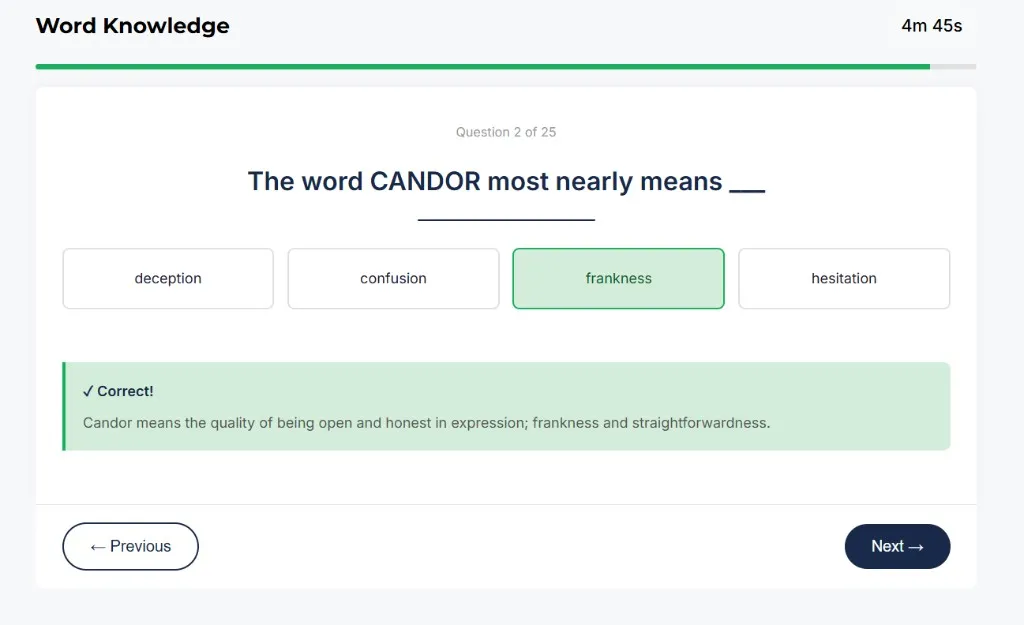
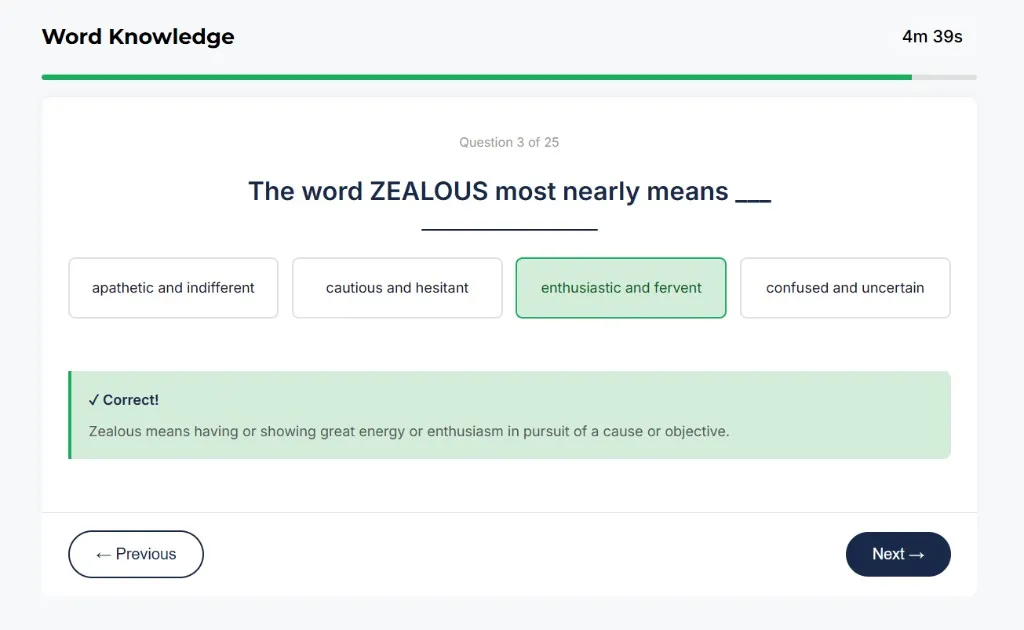
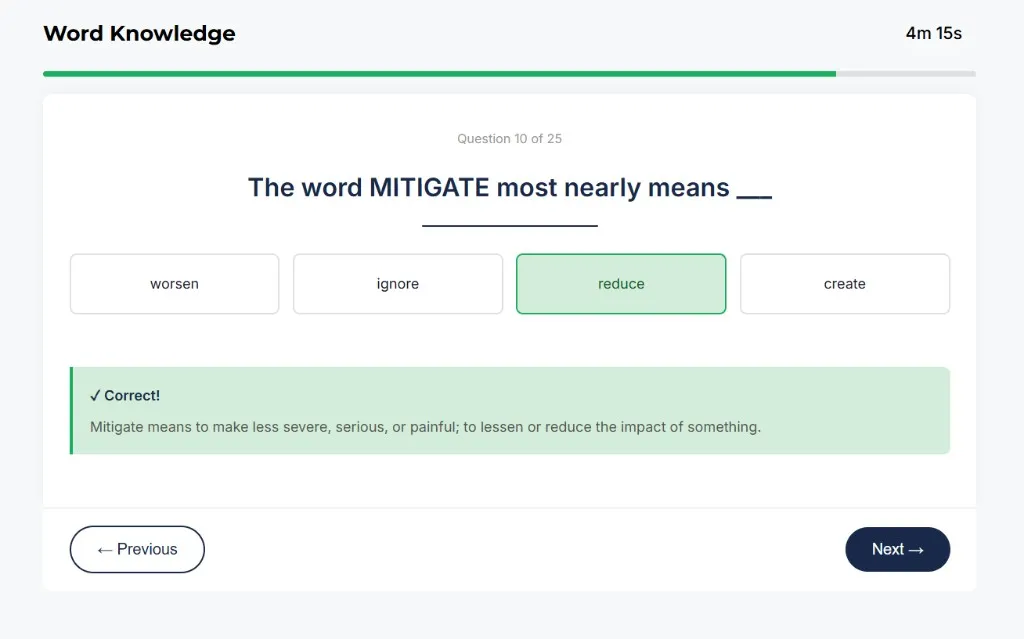
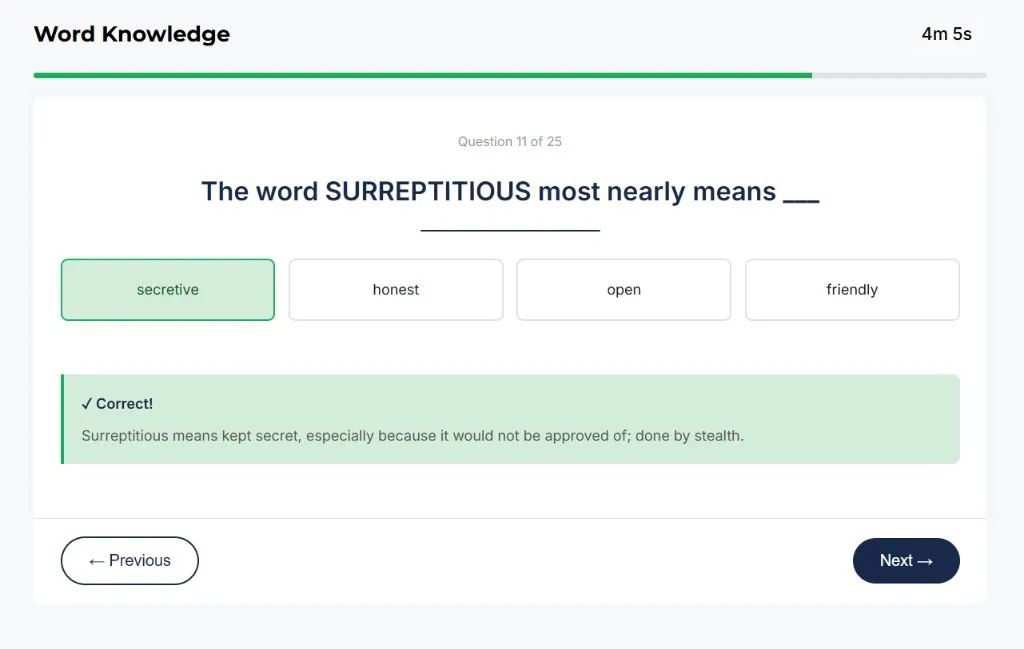
Sample questions from our AFOQT Word Knowledge practice tests. Each question comes with a detailed explanation so you understand the reasoning, not just the answer.
What is the Word Knowledge subtest?
Word Knowledge tests your vocabulary by asking you to identify words that are most similar in meaning to a given word, or to choose the best definition. Questions are straightforward — no tricks, no context clues — just pure vocabulary recognition.
The extreme time pressure is what makes this subtest challenging. At just 12 seconds per question, you don’t have time to think deeply or use context clues. You either know the word or you don’t. This tests both your vocabulary breadth and your ability to work quickly under pressure.
This subtest contributes to the Verbal composite (along with Verbal Analogies and Reading Comprehension), the Academic Aptitude composite, and the CSO composite. It does not count toward the Pilot composite.
What the questions are made of
Word Knowledge questions focus on these vocabulary areas.
Synonyms and definitions
Identify words with the same meaning or choose the correct definition. Example: “What does ‘abundant’ mean?” or “Which word is most similar to ‘profound’?”
Context clues
While less common, some questions may provide brief context. However, most rely on direct vocabulary knowledge rather than inference.
Latin and Greek word roots
Understanding common roots helps decode unfamiliar words. Example: “bene-” (good), “mal-” (bad), “phil-” (love), “phob-” (fear).
Prefixes and suffixes
Learn common prefixes (un-, re-, pre-, anti-) and suffixes (-tion, -able, -ous, -ly) to break down complex words and infer meanings.
Commonly confused words
Distinguish between similar words with different meanings. Example: affect/effect, accept/except, principle/principal, complement/compliment.
Academic and technical vocabulary
College-level words commonly found in academic texts, scientific writing, and formal discourse. Focus on GRE/SAT-level vocabulary lists.
Which composite scores?
Verbal composite: Verbal Analogies + Word Knowledge + Reading Comprehension
Academic Aptitude composite: Verbal Analogies + Arithmetic Reasoning + Word Knowledge + Math Knowledge + Reading Comprehension + Physical Science
CSO composite: Word Knowledge + Math Knowledge + Table Reading + Block Counting
Word Knowledge does not contribute to the Pilot or Quantitative composites. See the full composite breakdown on the AFOQT guide.
Tips & strategy
When you encounter an unknown word, break it down by roots, prefixes, and suffixes. Even if you’ve never seen the word, you can often infer its meaning. This skill is crucial when you’re working at 12 seconds per question.
Build vocabulary systematically using spaced repetition. Focus on GRE/SAT word lists, which align well with AFOQT difficulty. Review 50–100 words daily, prioritizing words you don’t know.
Reading exposes you to words in context, which helps retention. Read articles, books, and academic texts. When you encounter unfamiliar words, look them up and add them to your study list.
Even if you don’t know the exact answer, you can often eliminate 2–3 wrong choices immediately. This improves your odds and saves time. Make your best guess from the remaining options and move on.
If you don’t know a word immediately, eliminate wrong answers, guess, and move forward. Spending 30 seconds on one question means missing 2–3 others. Speed and pattern recognition are more valuable than deep analysis.
Related AFOQT subtests
Word Knowledge, quick answers
What is the AFOQT Word Knowledge subtest?
Word Knowledge is one of 12 AFOQT subtests. You have 25 vocabulary questions in just 5 minutes (~12 seconds each). Each question asks you to identify the word that is most similar in meaning to the given word, or to choose the best definition. It contributes to the Verbal, Academic Aptitude, and CSO composite scores.
How does AFOQT Word Knowledge compare to ASVAB Word Knowledge?
AFOQT Word Knowledge is significantly faster-paced than ASVAB Word Knowledge. AFOQT gives you 12 seconds per question vs 30+ seconds on ASVAB. The vocabulary level is similar (college-level words), but the extreme time pressure makes AFOQT more challenging.
What's the best way to study for Word Knowledge?
Use flashcard apps (Anki, Quizlet) daily to build vocabulary. Focus on GRE/SAT-level words, learn Latin and Greek roots, and study prefixes/suffixes. Read widely to build passive vocabulary. Practice with timed drills to build speed — 12 seconds per question requires instant recognition.
How do I manage time on Word Knowledge with only 12 seconds per question?
Don't linger on any question. If you know the answer immediately, select it and move on. If you're unsure, eliminate obviously wrong answers, make your best guess, and move forward. Spending 30 seconds on one question means missing 2-3 others. Speed and pattern recognition are critical.
Build your test-day method
- Exam-aligned drills under deliberate time pressure
- Instant explanations after every item
- Your score estimate, tracked drill after drill