
Army Aviation Information
Helicopter aerodynamics, flight controls, and Army aircraft: the SIFT knowledge subtest you can study for directly, with representative practice in our trainer.
- Questions
- 40
- Time limit
- 30 min
- Pace
- ~45 s per item
- Counts toward
- SIFT score
Representative questions from the trainer
Practice Army aviation knowledge with five-choice questions, matching the official sample item, and focused explanations. Flip through a few.
Inside the Army Aviation Information subtest
This is a knowledge test. The Army's own description names what it checks: "the examinee's knowledge of terminology and concepts relevant to Army Aviation." Unlike the perceptual SIFT subtests, there is no trick of speed or eyesight here. You either know that the collective changes the pitch of all blades at once, or you don't. That makes it a high-return subtest to prepare for.
The subtest is fixed-length, not adaptive. Every candidate answers 40 questions in 30 minutes, and an unanswered question counts as wrong, so an educated guess costs nothing and can only help. Each question offers five answer choices, A through E, matching the Army's own published sample item.
What our practice bank covers
The Army describes what this subtest covers in one sentence, with no further breakdown. The six themes below are ours, weighted roughly by what SIFT candidates report about the test, and by the FAA's own Helicopter Flying Handbook.
Lift, torque, dissymmetry of lift, translational lift, ground effect, retreating blade stall
Cyclic, collective, anti-torque pedals, rotor systems, transmission, powerplant
Hover, approach, autorotation, settling with power, dynamic rollover
Weight and balance limits, performance factors, the rotorcraft flight manual
The current Army fleet: AH-64, UH-60, CH-47, UH-72, and each aircraft's role
Flight preparation, aeronautical decision-making, core aviation vocabulary
How the 30 minutes unfold
40 questions, about 45 seconds each, generous for recall questions you know cold.
You should be near question 14. Knowledge questions don't reward dwelling. Answer and move.
Five minutes left. Commit an answer on every remaining question.
The battery moves on. A blank scores as wrong, so never leave one.
Distractors swap the cyclic and the collective, or the causes of two look-alike phenomena (dissymmetry of lift vs. transverse flow). When two controls both sound plausible, picture the maneuver. Which hand moves?
The Army publishes no study guide or reading list for this subtest. Candidates who have taken the SIFT point to the FAA's Helicopter Flying Handbook, a free download that covers most of what this subtest asks.
Three questions, solved the test-day way
Every set is scored against every other candidate
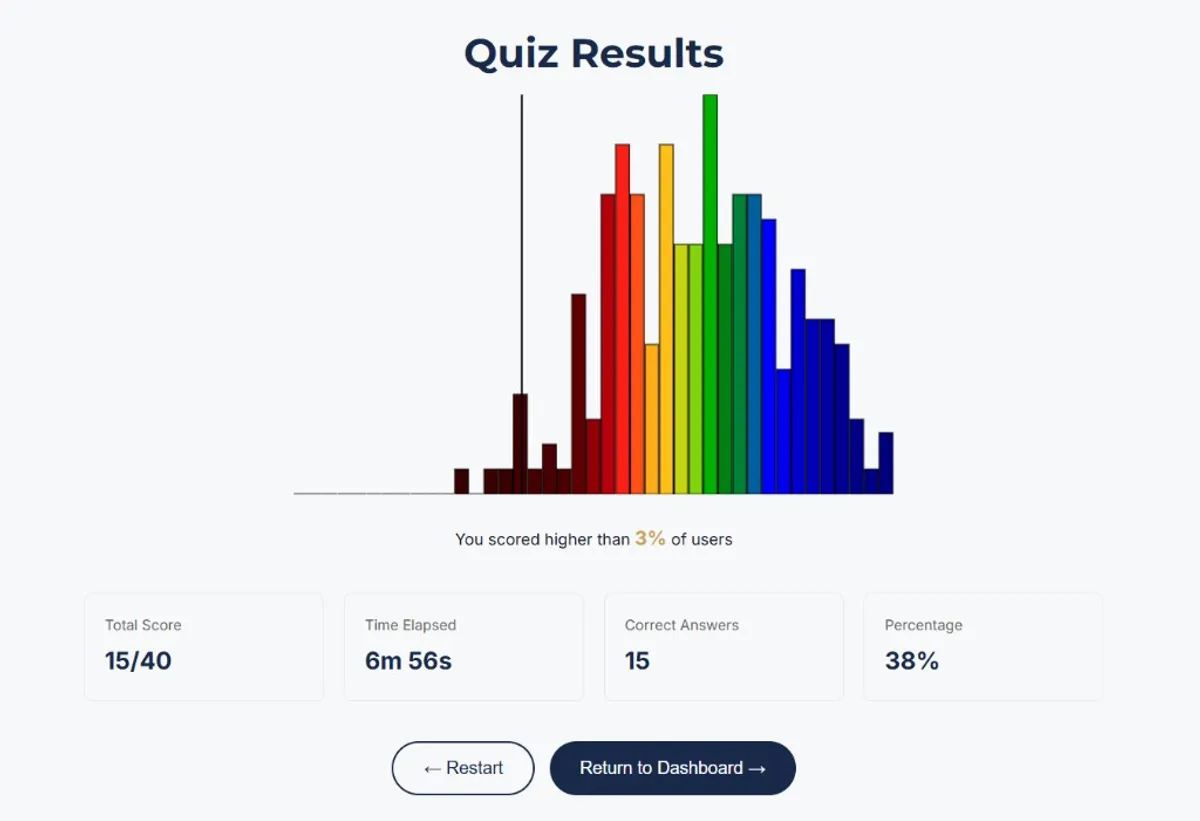
The moment you finish, your result drops onto the score distribution — percentile, total score, and time, read at a glance.
Ready to continue?
Open a timed Army aviation knowledge set, then review your score and explanations question by question.
Five habits that move an Army Aviation Information score
Candidates report that the free FAA handbook covers most of what they saw. One chapter a day, six weeks out.
Cyclic, collective, pedals, swashplate, rotor systems. Control-to-effect pairs come up often in what candidates report.
Autorotation, settling with power, retreating blade stall, dynamic rollover. Know the cause and the recovery for each.
45 seconds a question is comfortable only when recall is instant. Timed sets expose the facts you only half-know.
It is a section where studying pays off. Secure it first, then spend the remaining weeks on the perceptual tests.
Start with six weeks of handbook reading, then move to flashcards and daily timed sets in weeks three and four. Spend the final two weeks on full-battery simulations only.
Next SIFT subtests to master
Army Aviation Information, quick answers
Can I really study for this subtest?
Yes. The FAA Helicopter Flying Handbook covers most of what candidates report seeing: rotor aerodynamics, flight controls, and the Army's own aircraft. Disciplined study pays off here.
Do I need flight experience?
No. Every concept tested can be learned from books and diagrams. Flight hours help intuition, but candidates with zero cockpit time score well here.
Are the questions about helicopters or airplanes?
Mostly rotary-wing. The subtest is centered on helicopter flight: aerodynamics, flight controls, systems, and maneuvers. Our practice bank also covers the Army's current fleet. That includes helicopters, fixed-wing aircraft, and drones such as the C-12, the RC-12, and the MQ-1C Gray Eagle.
How does it affect my SIFT score?
The SIFT reports a single score from 20 to 80 (minimum 40 to qualify), and the retake rules are strict. Pass once and that score is permanent: you can never retest to improve it. Score below 40 and you get exactly one retest, no sooner than the 46th day after your first attempt. A strong showing here lifts the whole number.
Build your test-day method
- Exam-aligned drills under deliberate time pressure
- Instant explanations after every item
- Your score estimate, tracked drill after drill