
Math Knowledge
Algebra, geometry, and number theory with time to work — one of the four subtests that decide your Pilot composite.
- Questions
- 25
- Time limit
- 22 min
- Pace
- ~53 s per item
- Counts toward
- 5 composites
See what the test looks like
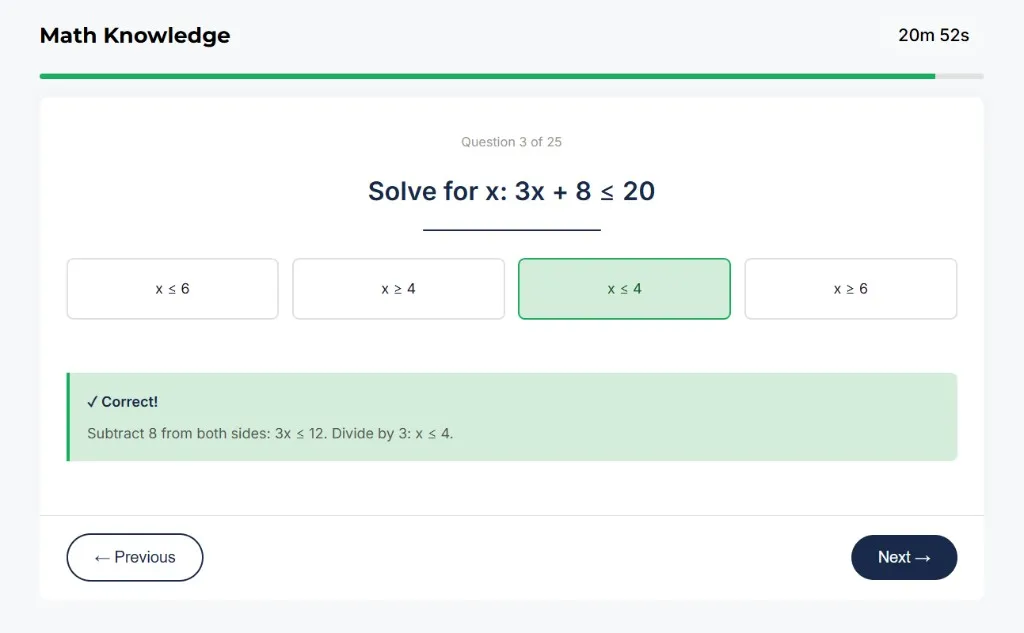
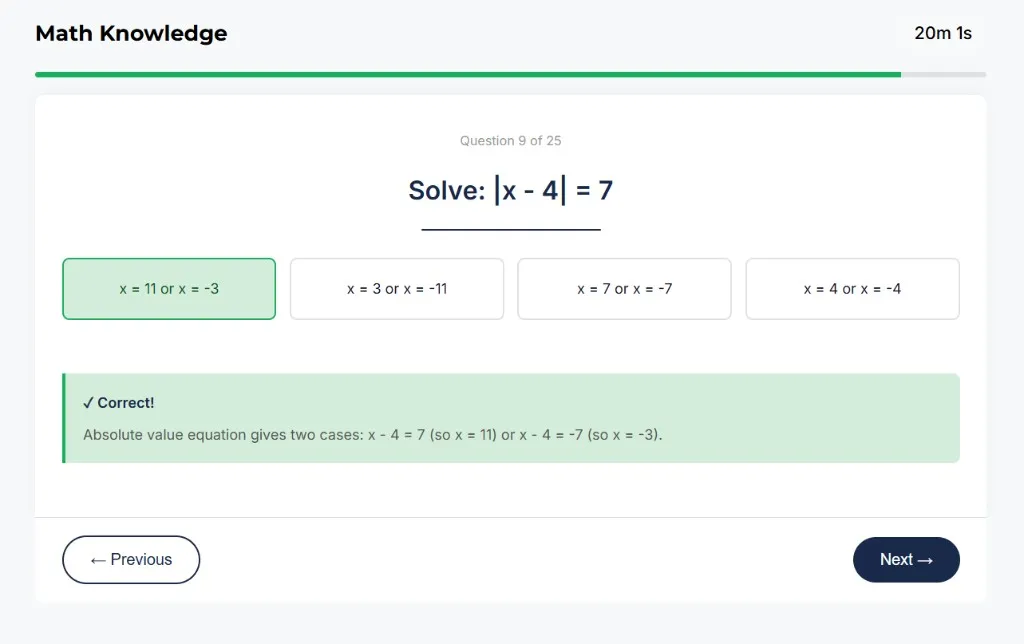
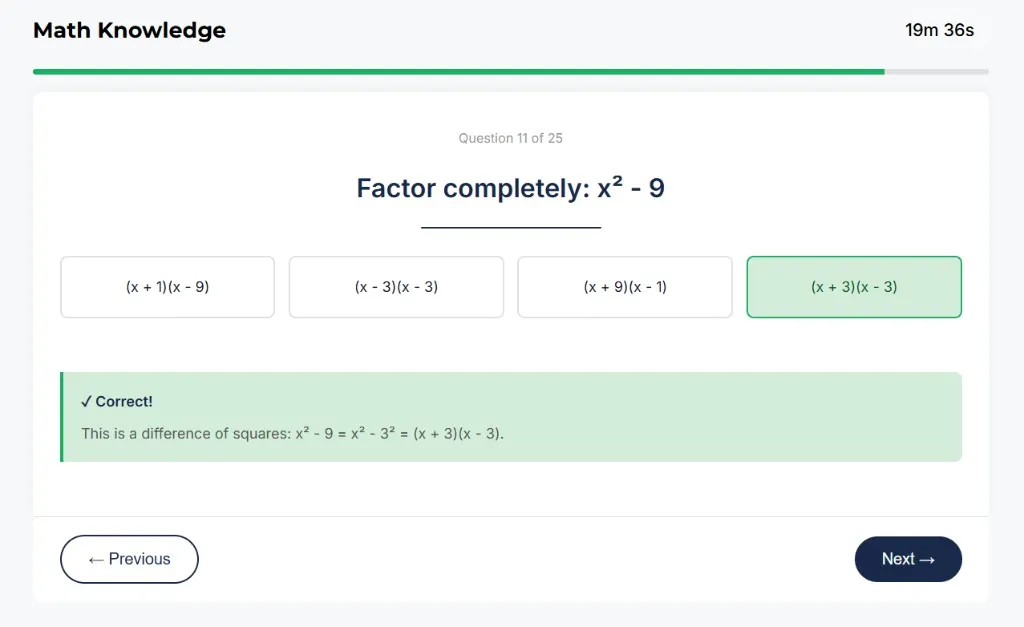
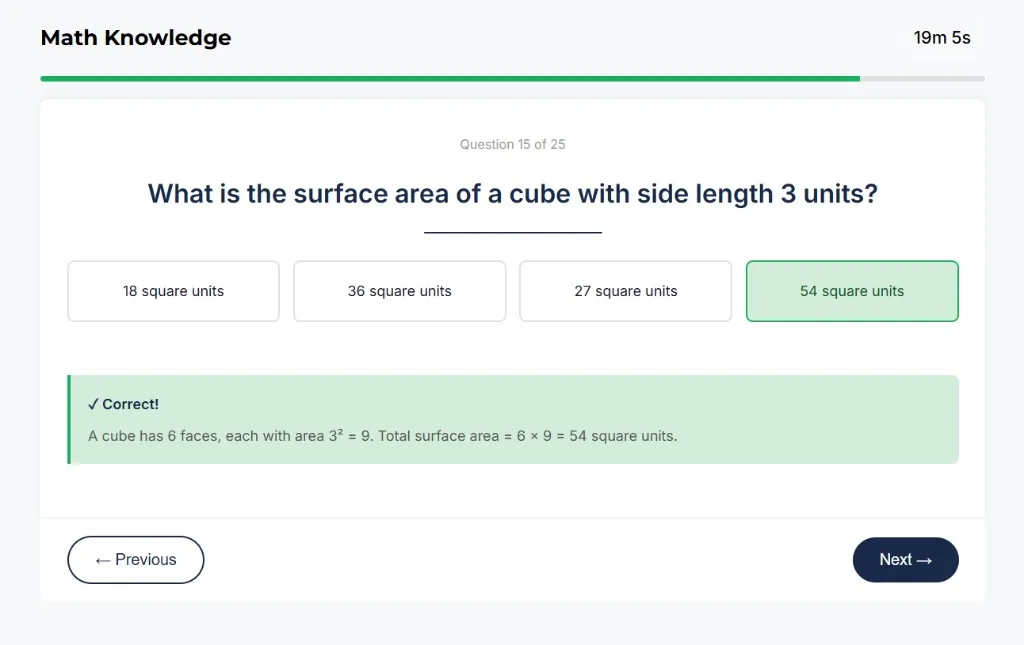
Sample questions from our AFOQT Math Knowledge practice tests. Each question comes with a detailed explanation so you understand the reasoning, not just the answer.
What is the Math Knowledge subtest?
Math Knowledge tests your understanding of mathematical concepts, principles, and formulas. Questions are presented as straightforward math problems rather than real-world word problems. You’ll solve equations, calculate geometric properties, and apply number theory.
The difficulty ranges from basic algebra to intermediate topics. You need to recall formulas from memory since no reference sheet is provided. The test rewards candidates who have a solid foundation in high school math.
This subtest is especially important because it contributes to four composites, including the Pilot composite, the CSO composite, the Quantitative composite, and the Academic Aptitude composite.
What the questions are made of
The AFOQT Math Knowledge subtest covers these core areas.
Algebra
Solving linear and quadratic equations, inequalities, systems of equations, exponent rules, radicals, factoring polynomials, and functions.
Geometry
Area, perimeter, and volume of shapes. Angle relationships, parallel lines, triangles (including Pythagorean theorem), circles, and coordinate geometry.
Number theory
Factors, multiples, prime numbers, greatest common factor (GCF), least common multiple (LCM), order of operations, and absolute value.
Fractions & decimals
Operations with fractions, converting between fractions/decimals/percentages, comparing fractions, and mixed numbers.
Probability & statistics
Basic probability calculations, permutations, combinations, mean/median/mode, and interpreting data sets.
Sequences & series
Arithmetic and geometric sequences, finding the nth term, and recognizing number patterns.
Which composite scores?
Pilot composite: Math Knowledge + Table Reading + Instrument Comprehension + Aviation Information
CSO composite: Math Knowledge + Table Reading + Block Counting + Word Knowledge
Quantitative composite: Arithmetic Reasoning + Math Knowledge
Academic Aptitude composite: Verbal Analogies + Arithmetic Reasoning + Word Knowledge + Math Knowledge + Reading Comprehension + Physical Science
ABM composite: Verbal Analogies + Math Knowledge + Table Reading + Instrument Comprehension + Block Counting + Aviation Information
Math Knowledge is one of the most impactful subtests on the AFOQT. See the full composite breakdown on the AFOQT guide.
Tips & strategy
No formula sheet is provided. Commit area, volume, Pythagorean theorem, quadratic formula, and common conversions to memory before test day.
Plug answer choices back into the equation to see which one works. This is often faster than solving complex equations from scratch, especially with quadratics.
Exponent questions appear frequently. Master rules like x^a × x^b = x^(a+b), (x^a)^b = x^(ab), and x^0 = 1. Same for square root simplification.
Sketch the shape described in the question. Label the given measurements. Visual representation makes it much easier to identify the right formula and solve.
At 53 seconds per question, many problems are designed to be solved in under a minute. If you find yourself doing extensive multi-step work, reconsider your approach.
Related AFOQT subtests
Math Knowledge, quick answers
What is AFOQT Math Knowledge?
Math Knowledge is one of 12 AFOQT subtests. You have 25 questions and 22 minutes to solve math concept problems covering algebra, geometry, number theory, and probability. It contributes to five composite scores: Quantitative, Pilot, CSO, ABM, and Academic Aptitude — more than any other subtest.
How much time do I have per question?
With 25 questions in 22 minutes, you have approximately 53 seconds per question. The questions are more direct than Arithmetic Reasoning word problems, but you still need to work efficiently without a calculator.
Does Math Knowledge count toward the Pilot composite?
Yes. Math Knowledge is one of the four subtests in the Pilot composite, along with Table Reading, Instrument Comprehension, and Aviation Information. It also contributes to the Quantitative, CSO, ABM, and Academic Aptitude composites.
How should I prepare for Math Knowledge?
Review high school algebra (equations, inequalities, exponents) and geometry (area, volume, angles, Pythagorean theorem). Memorize key formulas since no reference sheet is provided. Practice solving problems without a calculator.
Build your test-day method
- Exam-aligned drills under deliberate time pressure
- Instant explanations after every item
- Your score estimate, tracked drill after drill