Simple Drawings
One hundred identification items in two minutes — the fastest section on any military aptitude test. No knowledge, no tricks: pure processing speed.
- Questions
- 100
- Time limit
- 2 min
- Pace
- ~1.2 s per item
- Counts toward
- SIFT score
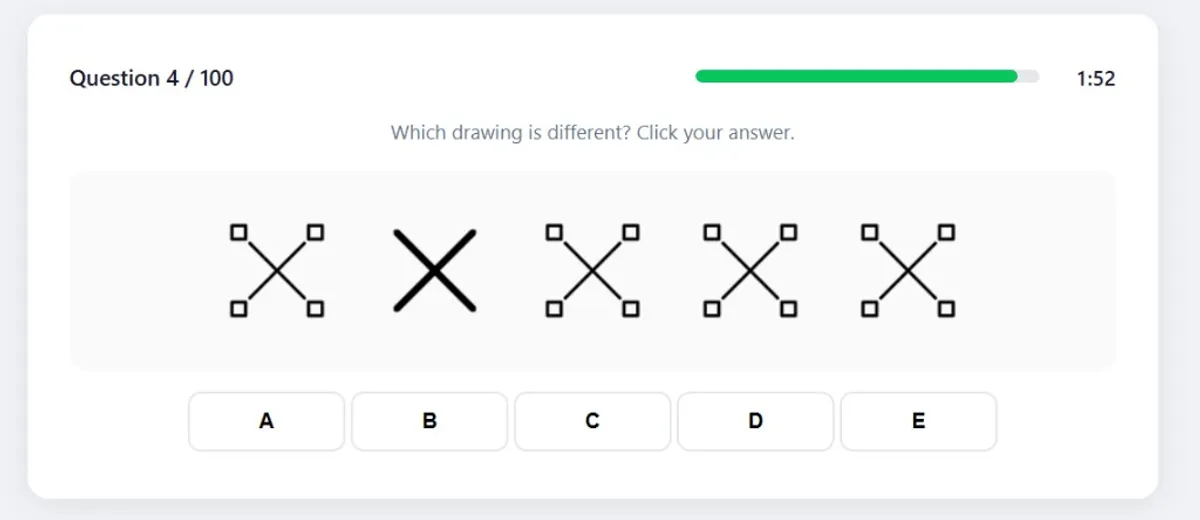
Training test screenshot
Real preview from the training test interface.
How the SIFT Simple Drawings test works
Simple Drawings is a pure speed section. You get 100 questions in 2 minutes, which means around 1.2 seconds per item. The difficulty is not complicated geometry; the difficulty is processing visual information quickly and committing to an answer immediately.
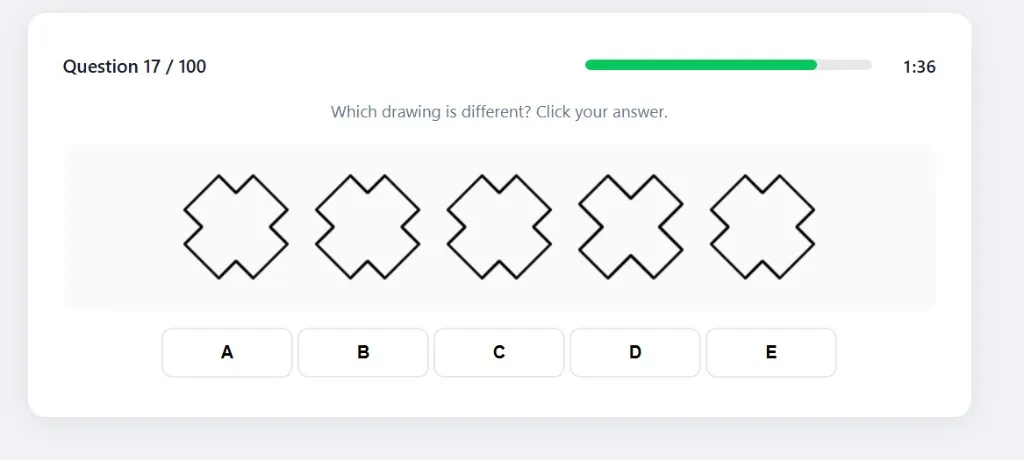
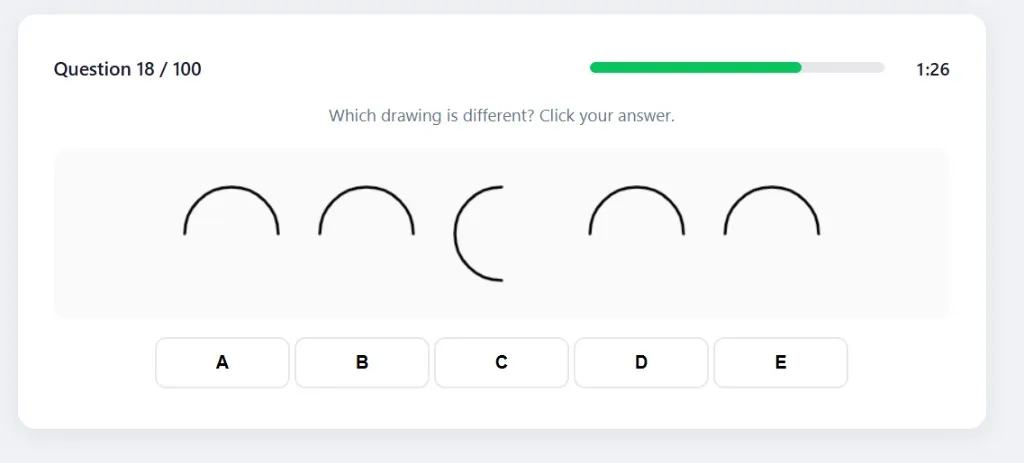
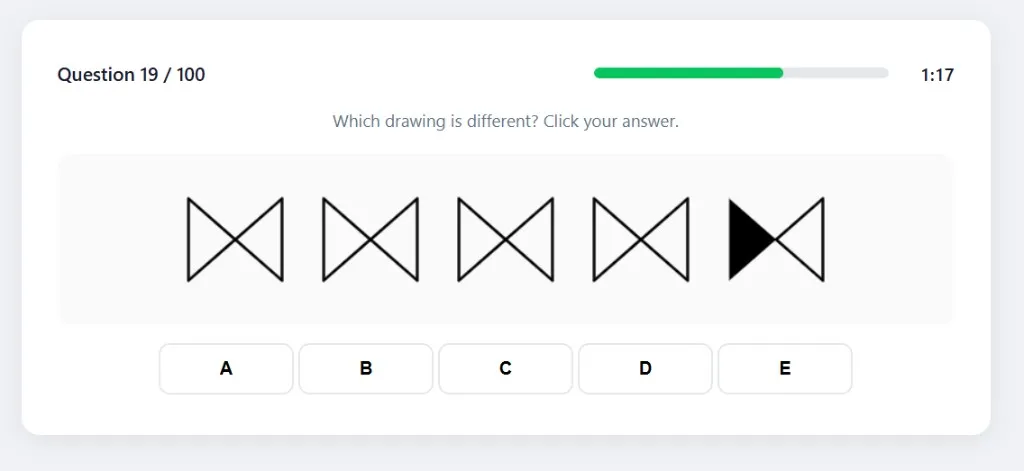
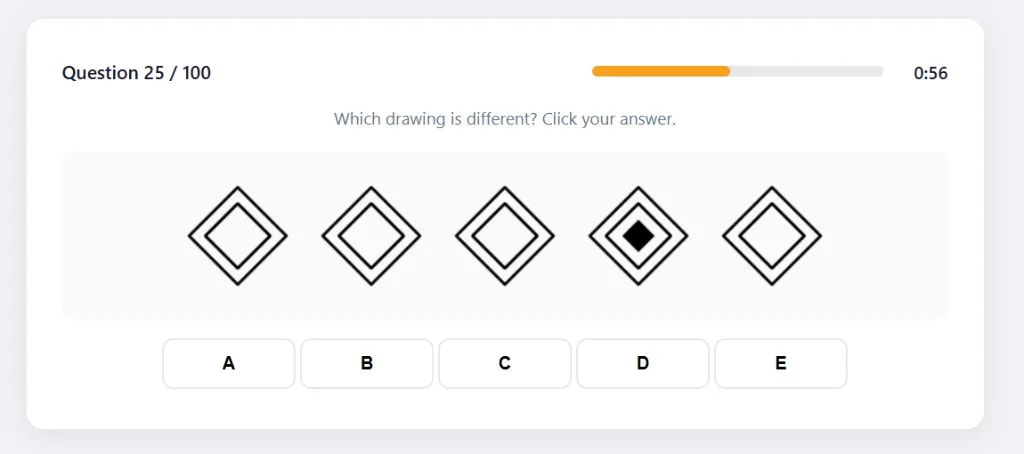
Each question shows five shapes. In the standard format, four are the same and one is different. Your job is to identify the different one as fast as possible. Differences are usually small: orientation, line direction, missing segment, or mirrored layout.
Scoring is based on how many correct answers you get inside the time limit. You are not expected to finish all 100. High performers usually keep a fast, steady rhythm rather than pausing to over-check every item.
Two items, solved the test-day way
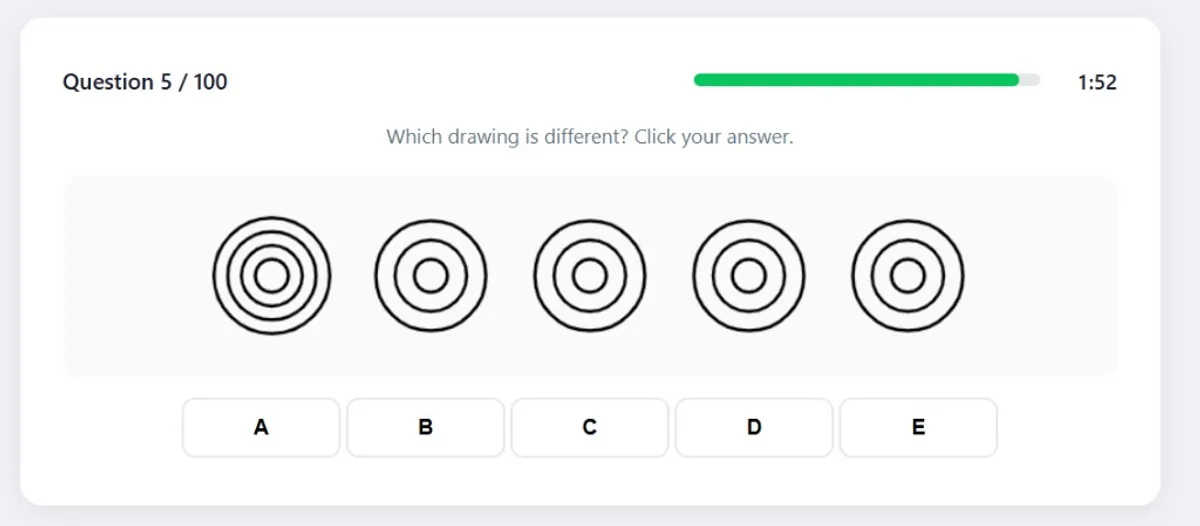
Use these examples to train the exact scan pattern you will use on test day.
Example 1: Rotation Trap
Four arrows point northeast, one arrow points northwest. The fastest way to solve this is to compare tip direction first, not the whole shape. If one tip breaks the direction pattern, answer and move on.
Example 2: Missing Segment
All five options look like squares, but one has a tiny gap on one side. Train your eyes to check corners and line continuity quickly. Broken continuity usually reveals the odd shape in less than a second.
Fast Read Pattern to Use Every Time. First, scan all five options in one sweep. Second, look for a single feature that should match across all shapes (orientation, closed/open lines, or symmetry). Third, click as soon as one option violates the pattern. Your speed comes from consistency, not from rethinking.
Common mistakes
Overchecking Every Item
Spending 3-4 seconds to be certain on one question usually costs you several easy points later. Make your best fast read and keep moving.
Looking at One Shape Too Long
If you stare at option A first, you lose pattern context. Compare all five quickly, then identify what breaks the group.
Ignoring Small Visual Features
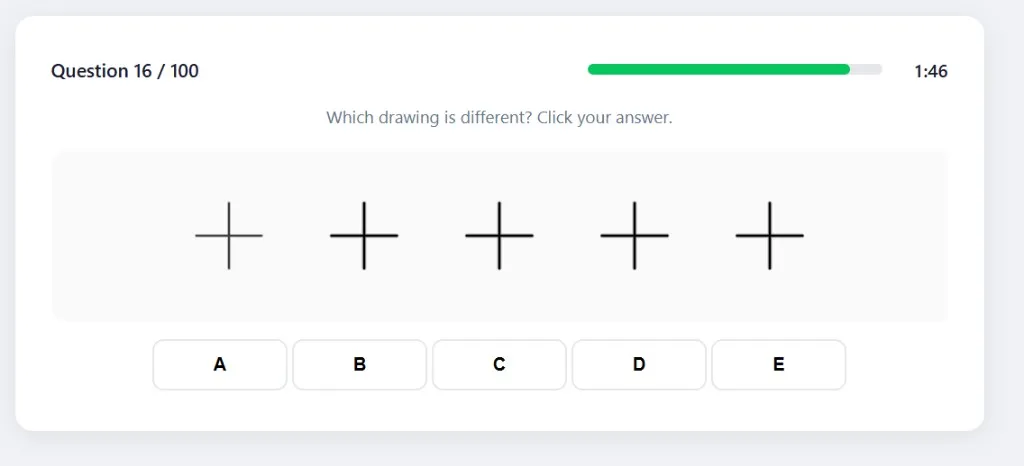
Most wrong answers come from tiny differences: one missing line, one mirrored branch, one rotated angle. Train detail spotting under speed.
Panic in the Last Minute
When stress spikes, accuracy crashes. Keep the same rhythm from start to finish and avoid sudden frantic guessing.
Simple Drawings, quick answers
Is Simple Drawings mostly a speed test or a difficulty test?
It is mostly a speed test. The shapes are intentionally simple, but the time pressure is extreme. Your score depends on how many accurate decisions you can make quickly in 2 minutes.
Do I need to finish all 100 questions to get a good score?
No. Most candidates do not finish all 100. A strong score comes from keeping a high correct-answer rate at speed, not from forcing every item.
What differences should I look for first?
Start with orientation, missing or extra line segments, and mirror reversals. These are the fastest high-signal checks and usually reveal the odd shape immediately.
What is the best way to practice for this section?
Practice short, timed sets daily. Focus on decision rhythm: scan, identify the mismatch feature, click, move. Repetition under a timer builds the reflexes this subtest rewards.
Build your test-day method
- Exam-aligned drills under deliberate time pressure
- Instant explanations after every item
- Your score estimate, tracked drill after drill