
Assembling Objects
Mental rotation under time — pieces, connections, and the shapes they become.
- Questions
- 15 (CAT)
- Time limit
- 18 min
- Pace
- ~72 s per item
- Counts toward
- Select Navy ratings
See what the test looks like
Here are sample questions from our Assembling Objects practice tests. Each question comes with a clear explanation of the correct answer.
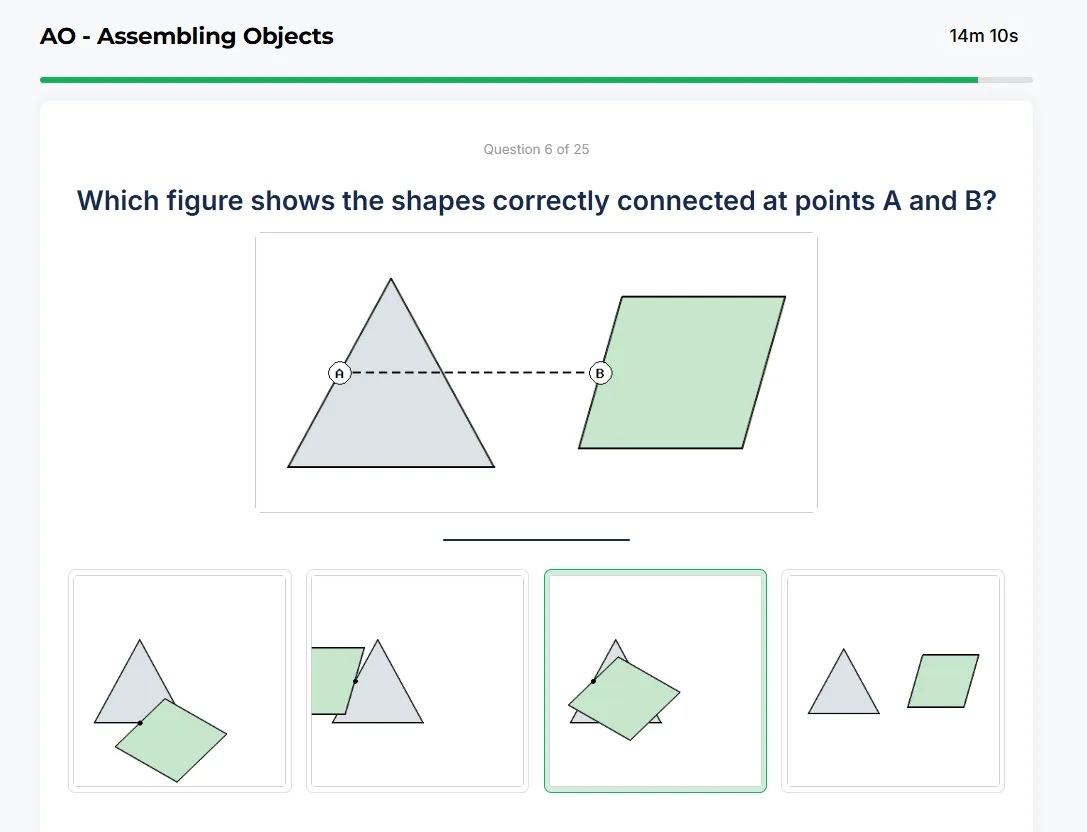
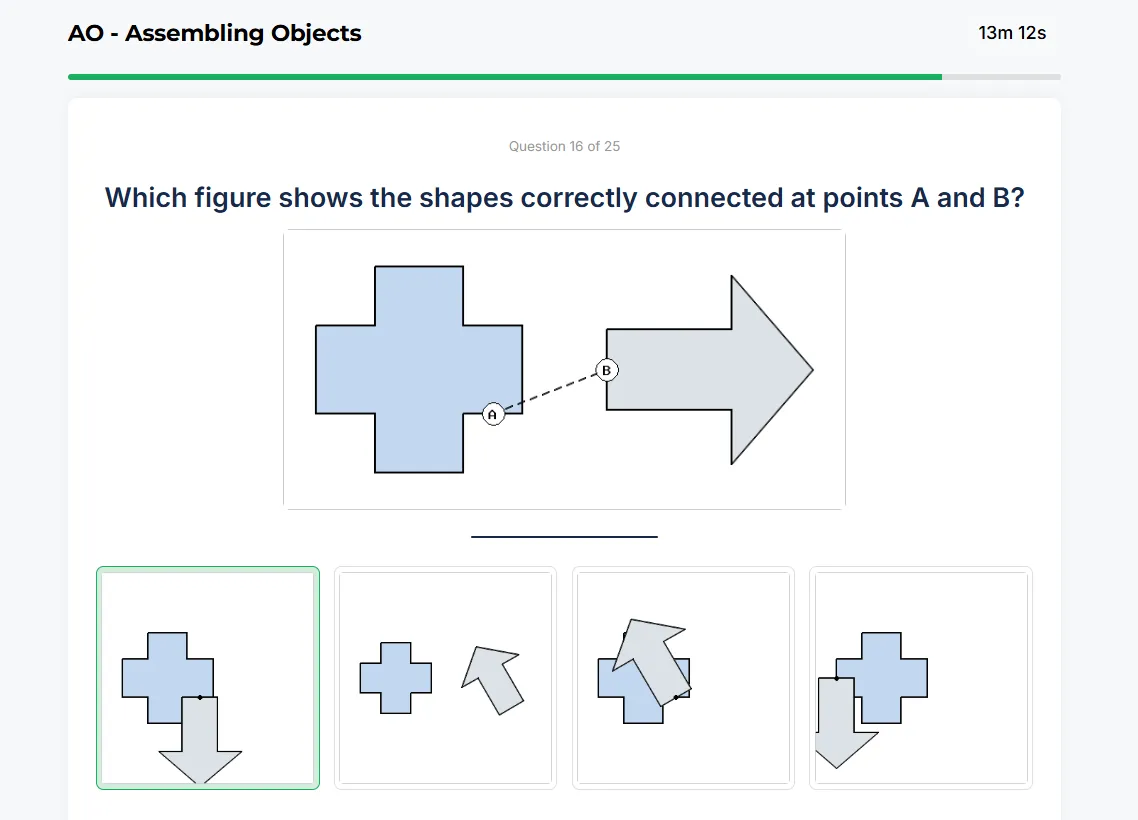
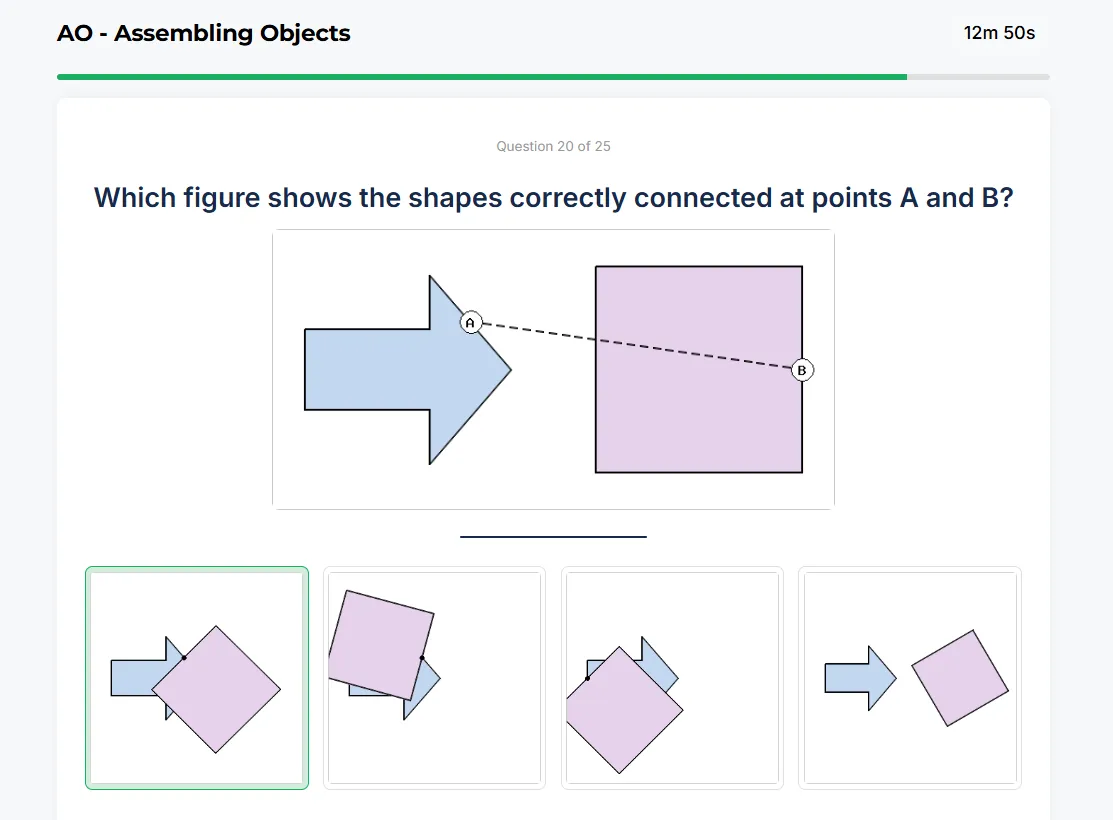
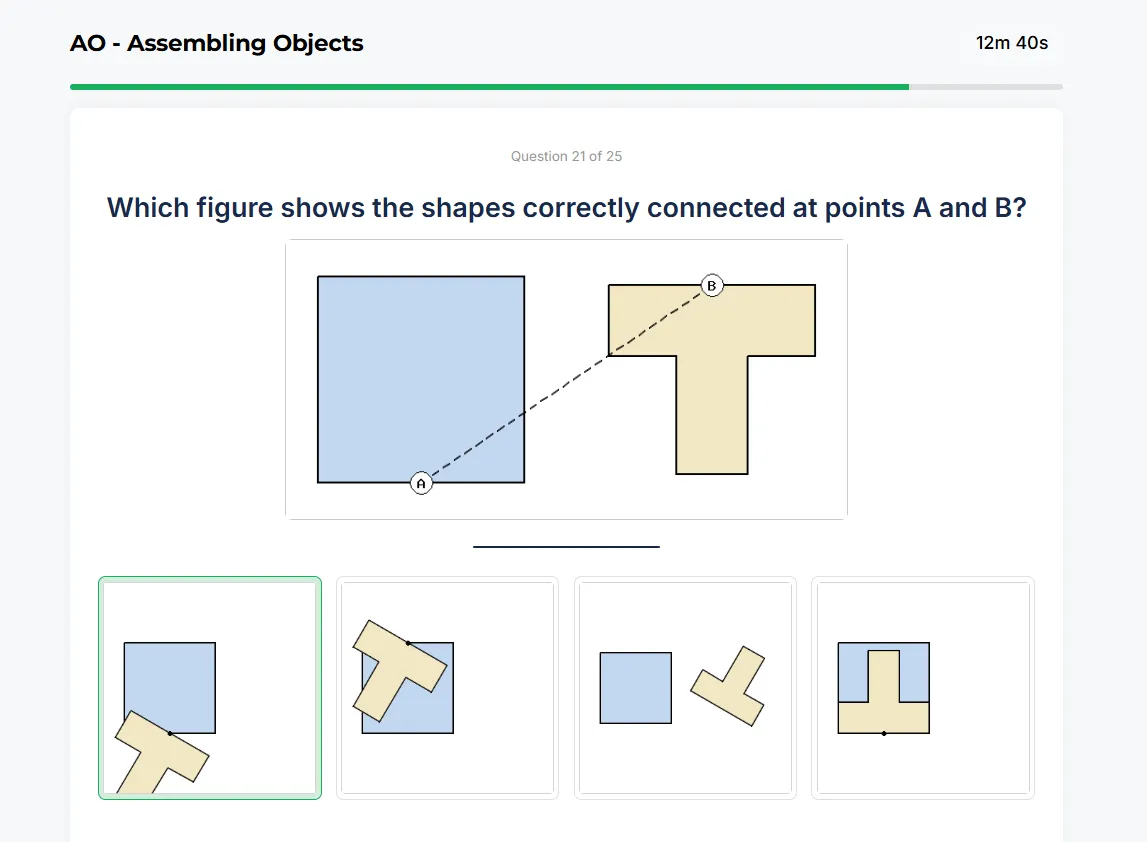
Inside the Assembling Objects subtest
Two formats, one skill. Connection items show two shapes with labeled points and ask which answer joins them correctly; puzzle items show scattered pieces and ask which assembled figure they form. Both are pure mental rotation.
The test’s one iron rule is your best weapon: pieces may be rotated, never flipped. Scan the answers for mirrored pieces first — every mirrored option is an instant elimination, often two per question.
In an Assembling Objects item, the pieces may be rotated but never:
Reflection is the forbidden move. Any answer that requires flipping a piece over is wrong — that is the test’s core trap.
Coach's tip. Practice with real puzzle apps in short daily sessions, then switch to timed AO sets. Rotation speed is trainable — it just needs reps, not theory.
How the subtest is delivered
Two versions of the same subtest, and they are not the same sitting. Which one you take depends on where you test.
CAT-ASVAB
Computer, at a MEPS — what most enlistees take
- Questions
- 15 scored
- Time limit
- 18 min
- With tryout items
- up to 38 min
Adaptive: the difficulty follows your answers, and you cannot skip or go back. Up to 15 unscored tryout items may be added, which is what raises the limit to 38 minutes — you are never told which ones they are, so treat every question as scored.
Paper & Pencil
Booklet and answer sheet, at a MET site
- Questions
- 25
- Time limit
- 15 min
- Pace
- ~36 s per question
Fixed difficulty — everyone sits the same items in the same order. You may skip and come back, but unanswered questions are scored as wrong, so leave nothing blank.
AO question types: what you'll actually see
Every AO question falls into one of two patterns. Learn to recognize them instantly.
Connector / Attachment Logic
You'll see shapes with lettered points (A, B, etc.) and must determine how the parts connect at those points. Match the labeled connection points between shapes · Visualize rotation and positioning at contact · Eliminate answers where points don't align · Pay close attention to which letter is on which shape
Fit-Together Visualization
You'll see separated pieces and must identify which answer choice shows them correctly assembled. Mentally rotate each piece — never flip it · Compare size and proportions of individual parts · Check that all pieces are accounted for in the answer · Use process of elimination: rule out impossible shapes first
Assembling Objects, quick answers
What is Assembling Objects on the ASVAB?
Assembling Objects (AO) is a visual-spatial subtest on the ASVAB. It measures your ability to determine how an object will look when its parts are put together. You'll see disassembled shapes and must identify the correct assembled version, or match lettered connection points to figure out how parts attach. No math, no reading. Just pattern recognition under time pressure.
Is AO part of the AFQT score?
No. The AFQT is calculated from only four subtests: AR, MK, WK, and PC. AO does not contribute to your AFQT percentile. However, AO feeds into certain line scores used by specific branches (notably the Navy) to determine eligibility for technical and spatial-reasoning-heavy MOS options.
Is Assembling Objects hard?
AO is unusual because it doesn't test knowledge. It tests a skill. Some people find spatial visualization naturally easy; others find it challenging at first. The good news: spatial reasoning is highly trainable. Practicing with puzzles, tangrams, and AO-style questions for even 1–2 weeks can produce noticeable improvement. It's one of the most improvable subtests.
Can I improve my AO score quickly?
Yes. Unlike knowledge-based subtests, AO improves with repetitive visual practice. Spend 15–20 minutes daily on AO-style questions, tangrams, or jigsaw puzzles. Focus on recognizing connection point patterns and mentally rotating shapes. Most people see measurable improvement within 1–2 weeks of consistent practice.
Can I use a calculator on the ASVAB?
No. Calculators are not allowed on any ASVAB section. For AO, this is completely irrelevant. The subtest is entirely visual. There are no calculations involved. You just need your eyes and your spatial reasoning ability.
Are 'real AO leaked questions' trustworthy?
No. Any site claiming to offer 'leaked' or 'real' ASVAB questions is either misleading or violating federal testing rules. Official ASVAB content is secured and not publicly released. Use reputable practice materials that follow official question formats (like the sample questions provided by the DoD) rather than trusting dubious sources.
Build your test-day method
- Exam-aligned drills under deliberate time pressure
- Instant explanations after every item
- Your score estimate, tracked drill after drill