
Paragraph Comprehension
Short passages, precise questions — the reading half of your AFQT verbal score.
- Questions
- 10 (CAT)
- Time limit
- 27 min
- Pace
- ~2.7 min per item
- Counts toward
- AFQT (Verbal Expression)
See what the test looks like
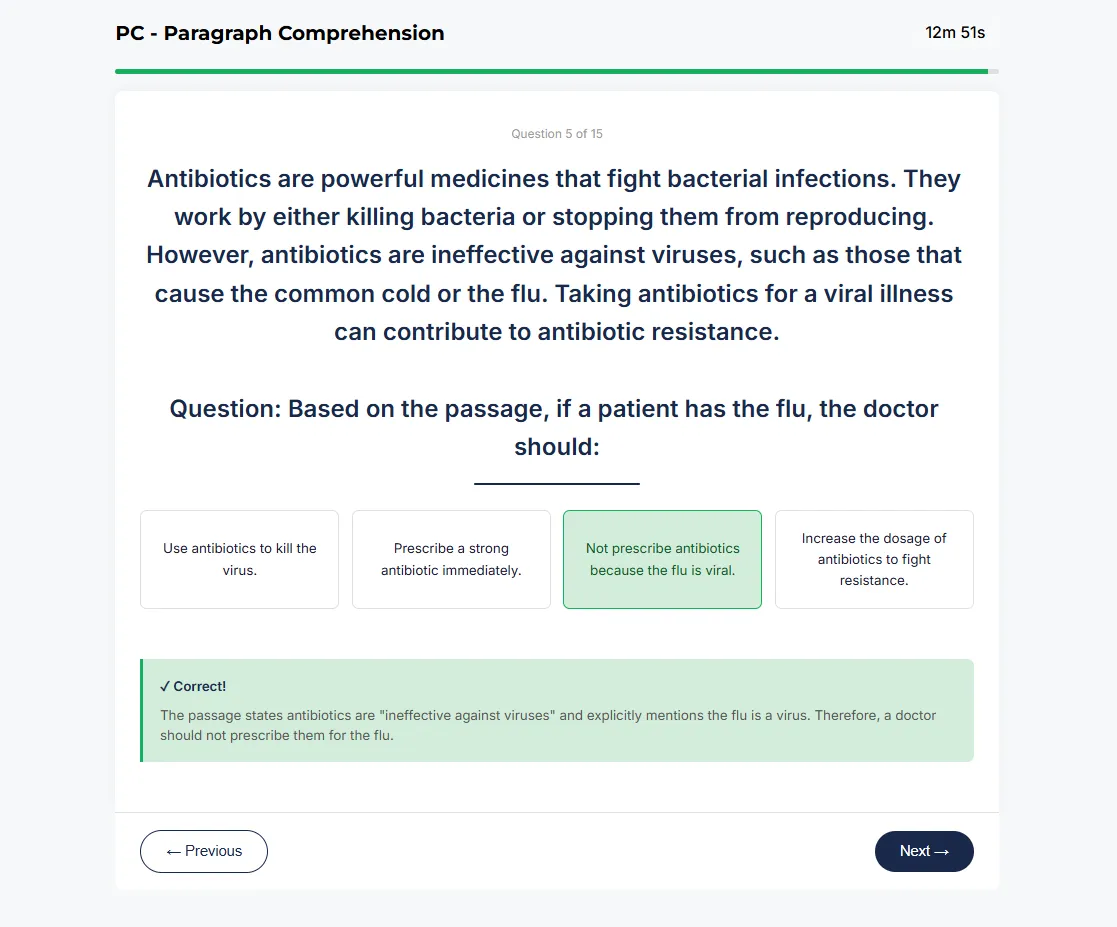
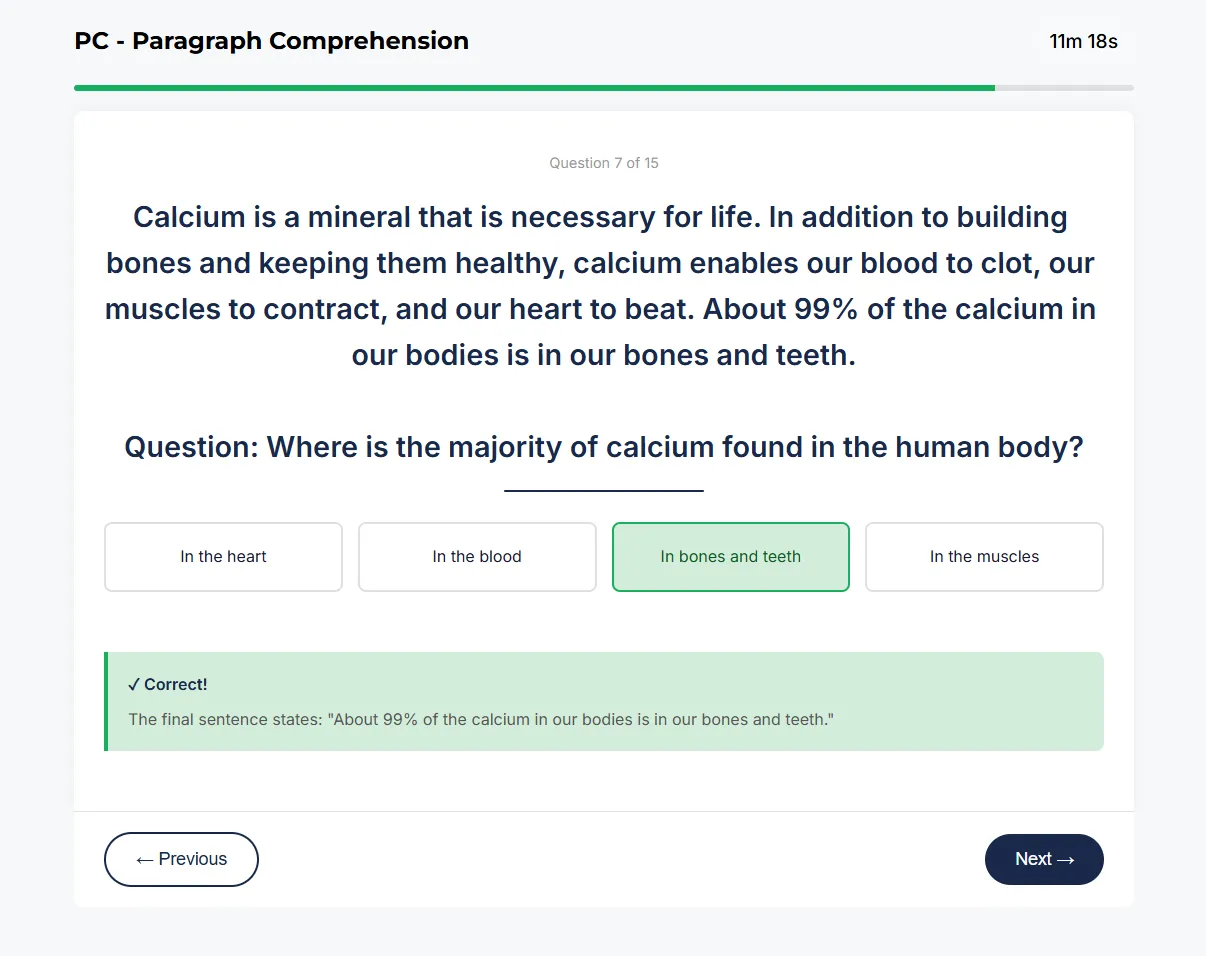
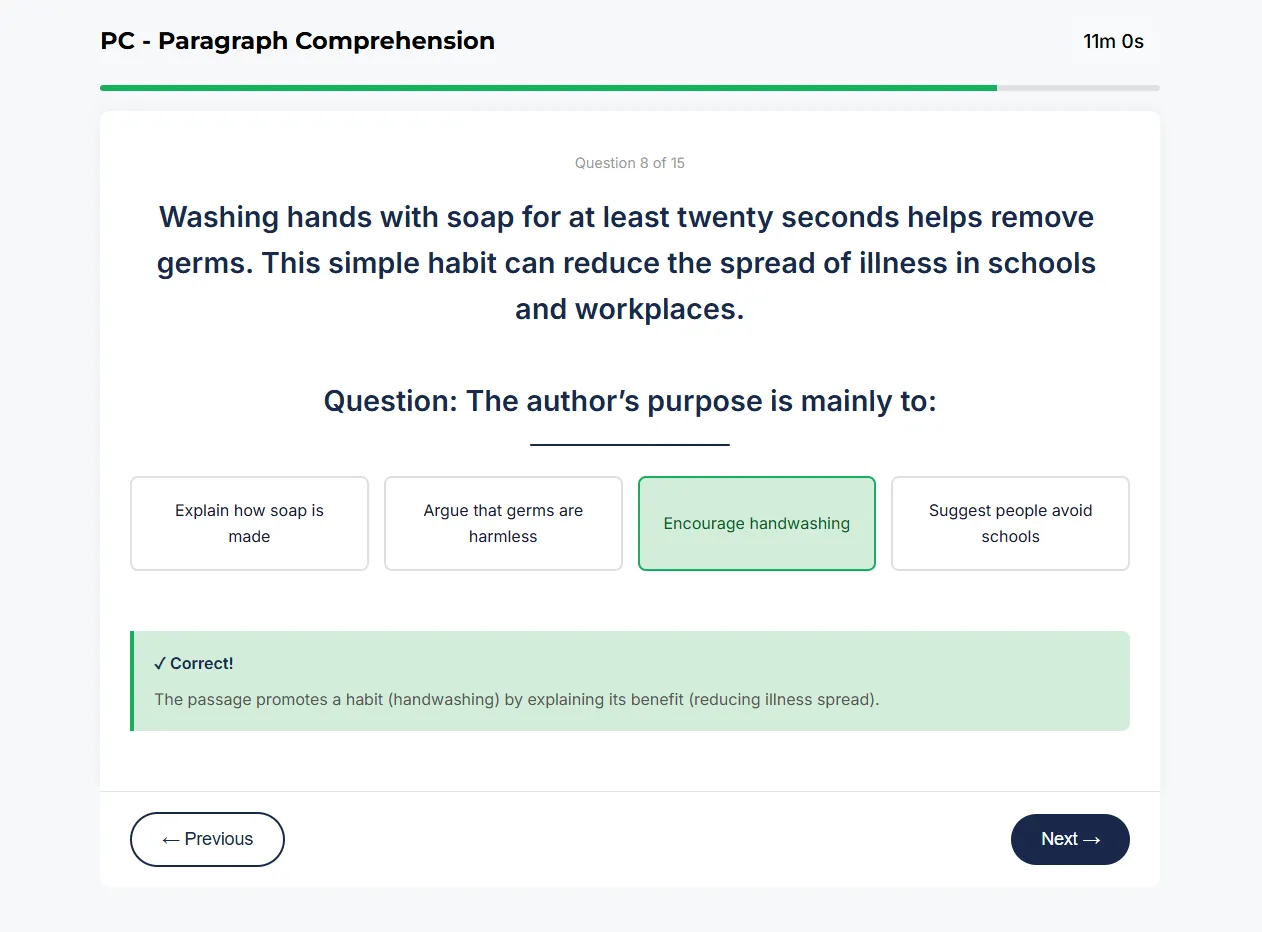
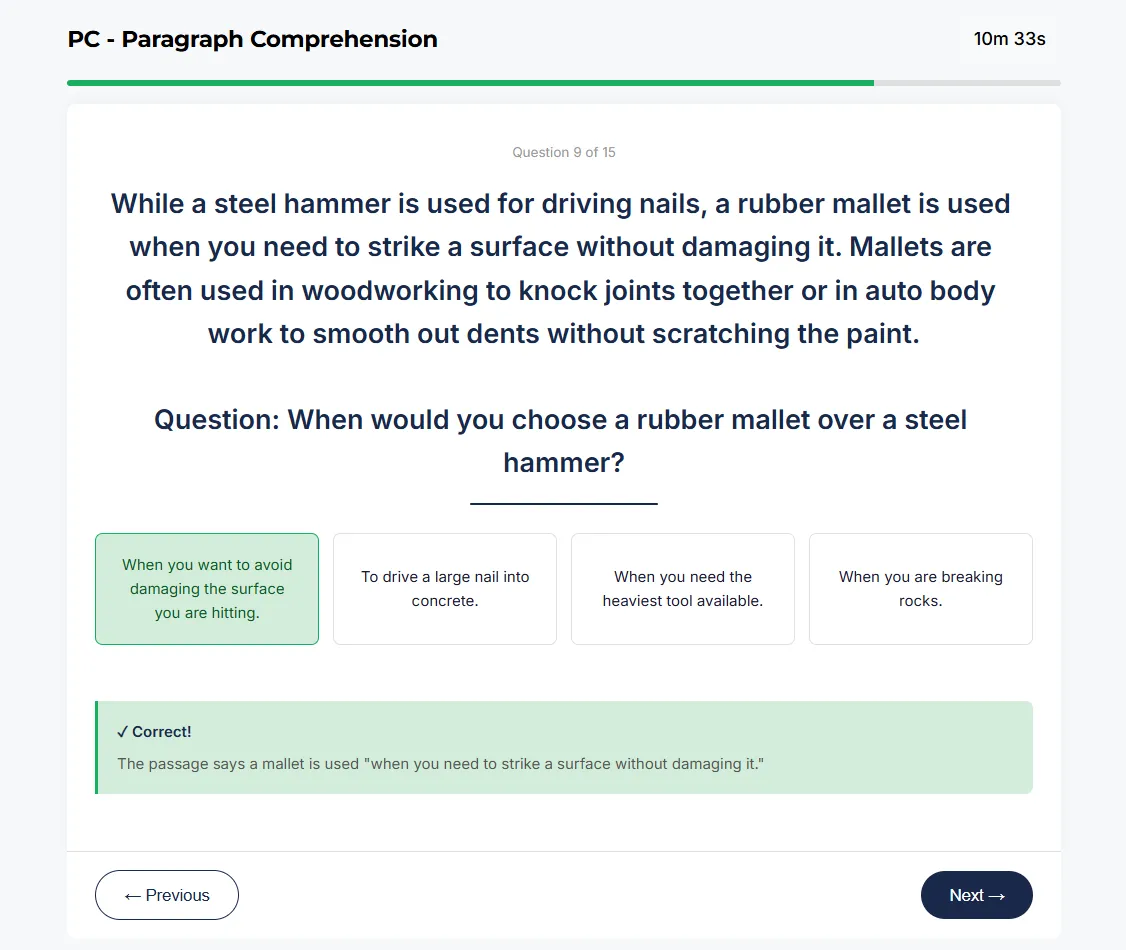
Here are real sample questions from our Paragraph Comprehension practice tests. Each question comes with a clear explanation of the correct answer and the reasoning behind it.
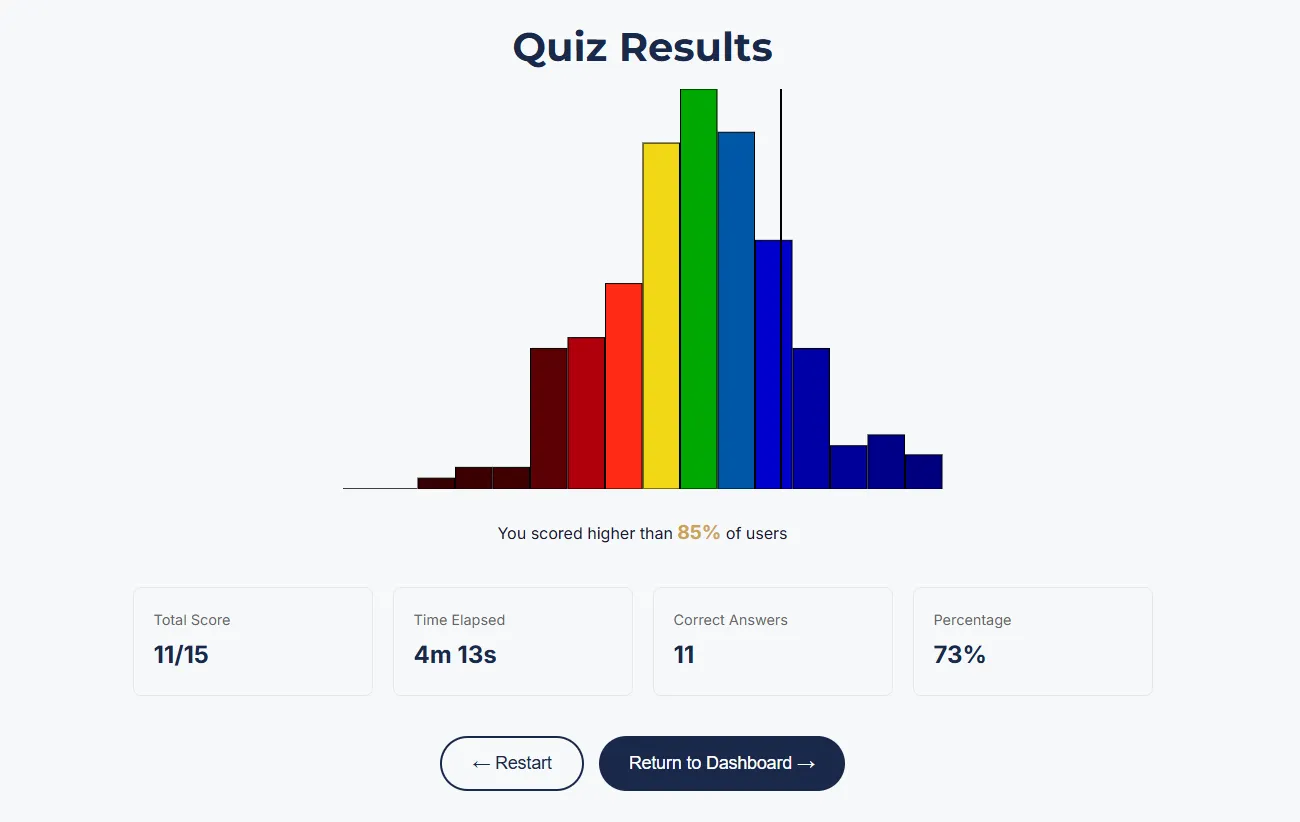
Inside the Paragraph Comprehension subtest
Each item gives you a short passage — a few sentences to a paragraph — and asks for the main idea, a stated detail, an inference, or the meaning of a word in context. Nothing outside the passage is ever required, or allowed.
The classic trap is the answer that is true in real life but never stated in the text. Treat it like evidence handling: if you cannot point to the sentence that proves your choice, it is not your choice.
"The squad postponed the patrol because fog reduced visibility to fifty meters." Why was the patrol postponed?
Stated directly in the passage. The other options are plausible war-movie reasons — and appear nowhere in the text.
Coach's tip. Read the question before the passage, then hunt. On a timed test, reading with a target doubles your speed at no cost in accuracy.
How the subtest is delivered
Two versions of the same subtest, and they are not the same sitting. Which one you take depends on where you test.
CAT-ASVAB
Computer, at a MEPS — what most enlistees take
- Questions
- 10 scored
- Time limit
- 27 min
- With tryout items
- up to 75 min
Adaptive: the difficulty follows your answers, and you cannot skip or go back. Up to 15 unscored tryout items may be added, which is what raises the limit to 75 minutes — you are never told which ones they are, so treat every question as scored.
Paper & Pencil
Booklet and answer sheet, at a MET site
- Questions
- 15
- Time limit
- 13 min
- Pace
- ~52 s per question
Fixed difficulty — everyone sits the same items in the same order. You may skip and come back, but unanswered questions are scored as wrong, so leave nothing blank.
What PC questions actually look like
PC questions follow recurring patterns. Recognizing these stem types helps you know what to look for before you even start reading.
"According to the passage..."
Detail / Fact questions: the most common type: The answer is stated directly in the text · Look for specific facts, numbers, or names · Don't add your own interpretation: stick to what's written
"The author implies..."
Inference questions: read between the lines: The answer isn't stated directly but is strongly suggested · Look for clues in tone, word choice, and cause-effect · Avoid answers that go too far beyond what the text supports
"The word/idea refers to..."
Reference / Vocabulary-in-context questions: A word or phrase is highlighted in the passage · You determine its meaning based on the surrounding context · Re-read the sentence with each answer choice substituted in
"Which choice is best supported..."
Evidence-based questions: prove it with the text: Asks which answer the passage most directly supports · Eliminate answers that are true in general but not backed by this passage · The best answer can always be pointed to in the text
Next AFQT subtests to master
Paragraph Comprehension, quick answers
Is ASVAB Paragraph Comprehension hard?
PC is considered one of the more approachable ASVAB subtests because every answer is somewhere in the passage. You don't need to memorize anything beforehand. The challenge is time pressure: you must read carefully and answer quickly. With practice, you learn to spot key information faster and avoid common traps like over-interpreting the text.
Is PC part of the AFQT score?
Yes. Paragraph Comprehension is one of four subtests that make up the AFQT — the score that determines enlistment eligibility. PC and Word Knowledge (WK) are combined into a Verbal Expression (VE) composite, which accounts for half the AFQT calculation alongside Arithmetic Reasoning (AR) and Mathematics Knowledge (MK).
What is a good PC score?
PC is scored as part of your overall ASVAB standard scores and contributes to your AFQT percentile. There's no standalone 'PC score' you'll see on your results — it feeds into the Verbal Expression (VE) composite. Aim to answer at least 80% of PC questions correctly during practice to ensure a strong contribution to your AFQT.
Can I use a calculator on PC?
No. Calculators are not allowed on any ASVAB section. However, PC doesn't involve math. It's purely reading comprehension. You read short passages and answer questions about what you just read. No calculations, no formulas; just careful reading and reasoning.
How long should I study for PC?
Most people improve noticeably with 2–3 weeks of daily reading practice, spending 20–30 minutes per day. Focus on timed practice passages, learn to identify question types (main idea, inference, detail, vocabulary in context), and practice the 'read the question first' technique. Daily reading of news articles or short essays also builds comprehension speed naturally.
Can I improve PC quickly in 2–4 weeks?
Yes. Unlike vocabulary (which takes time to memorize), reading comprehension is a skill you can sharpen quickly with the right technique. Practice identifying main ideas, learn to distinguish stated facts from inferences, and do timed drills daily. Most test-takers see meaningful improvement within 2 weeks of consistent practice.
Build your test-day method
- Exam-aligned drills under deliberate time pressure
- Instant explanations after every item
- Your score estimate, tracked drill after drill