
Aviation Information
Aerodynamics, aircraft components, and flight fundamentals — the Pilot-composite subtest you can simply study for.
- Questions
- 20
- Time limit
- 8 min
- Pace
- 24 s per item
- Counts toward
- Pilot · ABM
See what the test looks like
Sample questions from our AFOQT Aviation Information practice tests. Each question comes with a detailed explanation so you understand the reasoning, not just the answer.
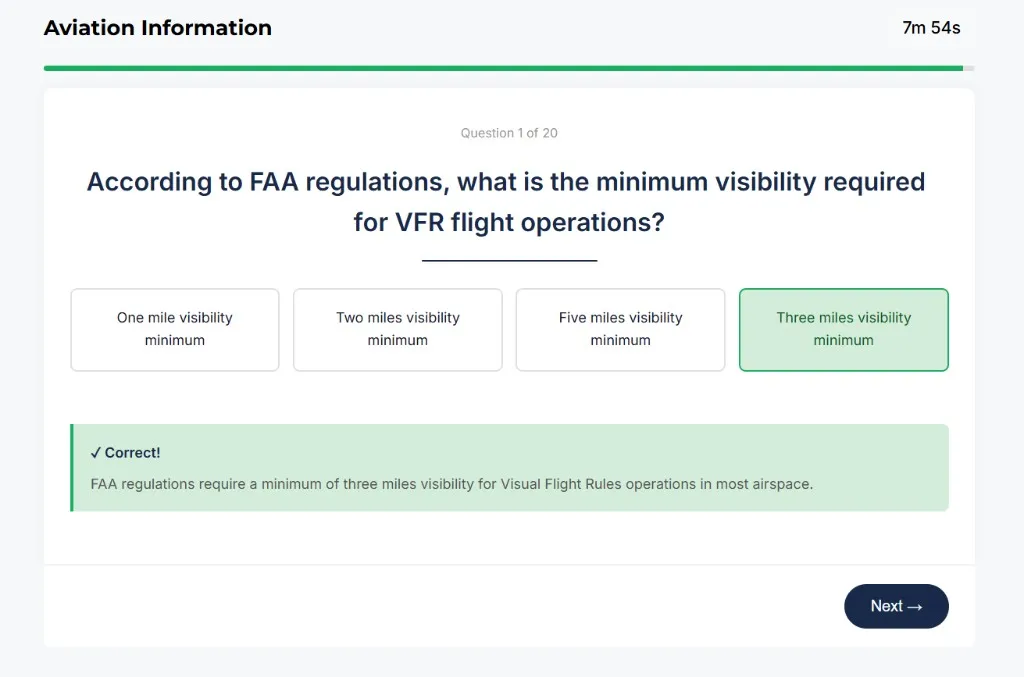
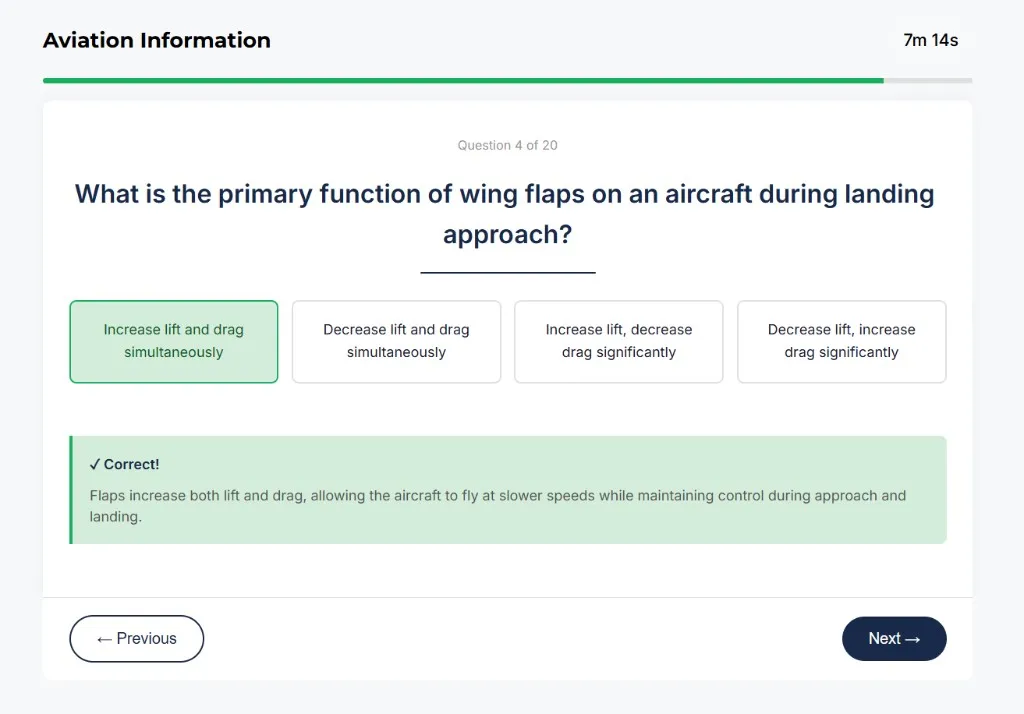
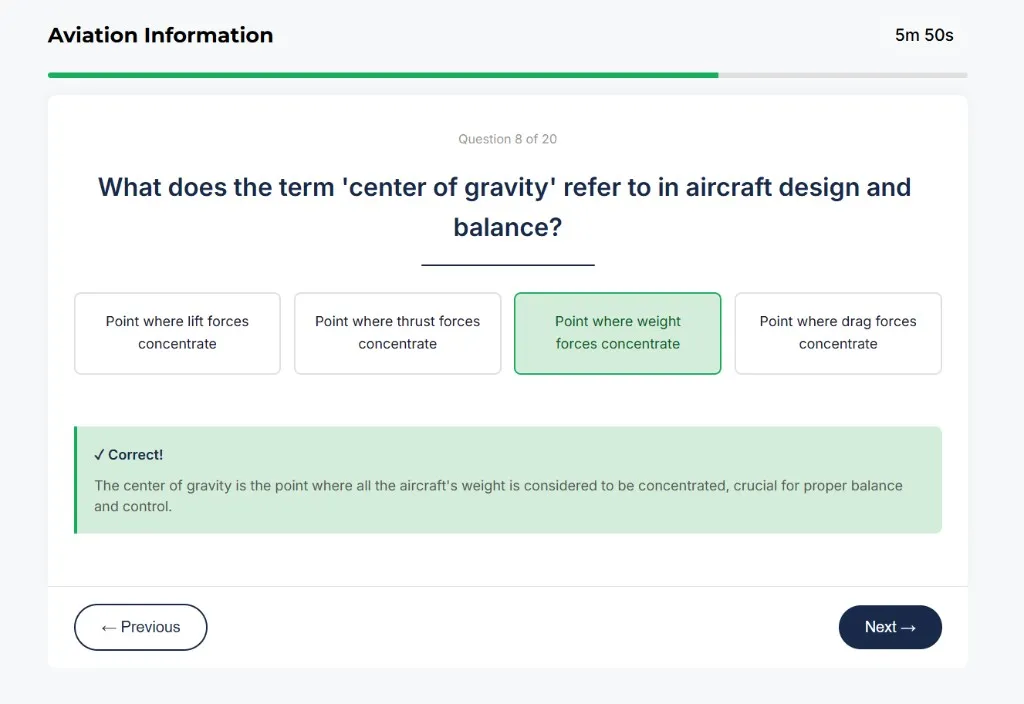
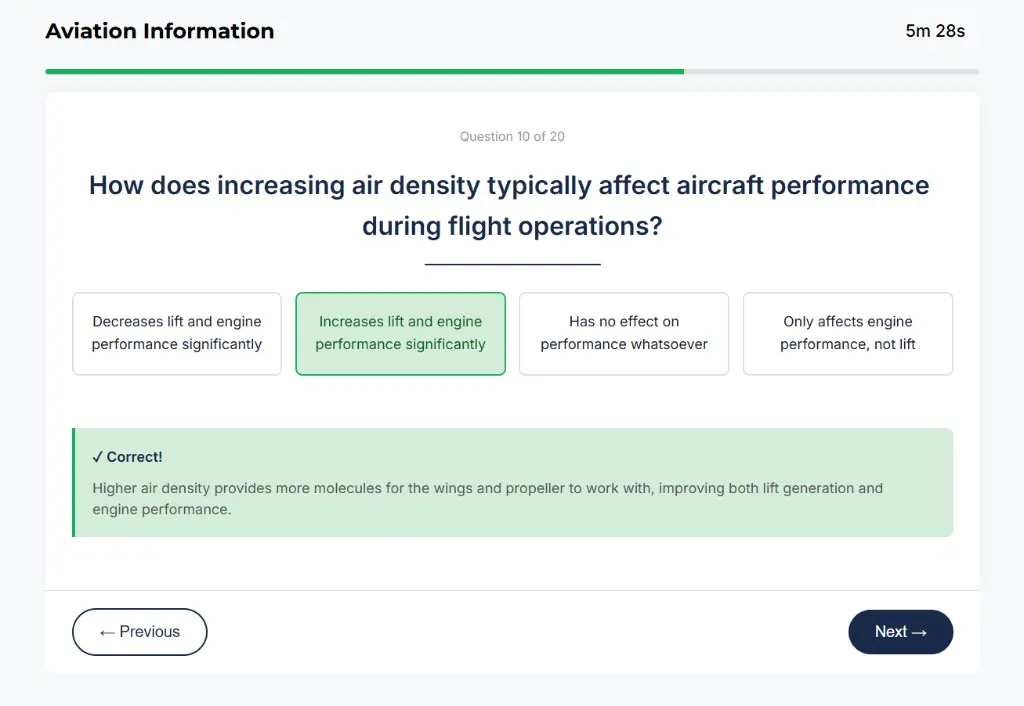
What is the Aviation Information subtest?
Aviation Information tests your knowledge of aeronautics, flight principles, aircraft systems, and aviation operations. Unlike many AFOQT subtests that measure reasoning ability, this is a pure knowledge test — you either know the answer or you don’t.
Questions cover topics like the four forces of flight, aircraft control surfaces, flight instruments, airport operations, weather effects, and basic aerodynamic principles. The test assumes no prior flight experience, but candidates with aviation background have a clear advantage.
Critical for pilot candidates: This subtest is one of four that make up the Pilot composite, along with Math Knowledge, Table Reading, and Instrument Comprehension. Your Pilot composite score directly impacts your competitiveness for pilot training slots.
What the questions are made of
Aviation Information covers fundamental aeronautics knowledge expected of Air Force officer candidates.
Four forces of flight
Lift, weight (gravity), thrust, and drag. Understand how each force acts on an aircraft and how pilots manipulate them to control flight.
Aircraft control surfaces
Ailerons (roll), elevator (pitch), and rudder (yaw). Know which control surface affects which axis and how pilots use them.
Airport operations & procedures
Runway markings, traffic patterns, airport lighting, and basic air traffic control procedures. Know standard patterns and right-of-way rules.
Flight instruments & navigation
Basic flight instruments: altimeter, airspeed indicator, attitude indicator, heading indicator, turn coordinator. Understand what each shows.
Weather effects on flight
How wind, visibility, clouds, and precipitation affect flight operations. Basic weather minimums and safety considerations.
Aircraft types & components
Basic aircraft types (fixed-wing, rotary-wing), major components (fuselage, wings, empennage), and their functions.
FAA regulations basics
Fundamental aviation regulations, airspace classifications, and basic flight rules. Know VFR vs. IFR basics.
Aerodynamic principles
Bernoulli’s principle, angle of attack, stall characteristics, and how lift is generated. Understand basic aerodynamic concepts.
The Pilot composite
Pilot composite = Aviation Information + Math Knowledge + Table Reading + Instrument Comprehension
Aviation Information is critical for pilot candidates. It is one of four subtests that make up the Pilot composite — the score that directly impacts your competitiveness for pilot training slots.
ABM composite: Verbal Analogies + Math Knowledge + Table Reading + Instrument Comprehension + Block Counting + Aviation Information
See the full composite breakdown on the AFOQT guide.
Tips & strategy
Get a private pilot ground school textbook or study guide. These cover all the fundamentals you need: four forces, control surfaces, instruments, regulations, and aerodynamics. This is the most efficient way to prepare.
Memorize: ailerons control roll (banking), elevator controls pitch (nose up/down), rudder controls yaw (left/right). Know which way the aircraft moves when each control is deflected.
Lift (upward), weight/gravity (downward), thrust (forward), drag (backward). Understand how pilots manipulate these forces to control the aircraft. This is fundamental aviation knowledge.
Create flashcards for control surfaces, instruments, forces of flight, and key terms. Review them daily. Spaced repetition helps retain aviation terminology and concepts.
If possible, take a discovery flight or introductory lesson. Seeing the controls and instruments firsthand helps cement the knowledge. Many flight schools offer affordable introductory flights.
This free PDF from the FAA covers everything you need. Download it from faa.gov and study chapters on aerodynamics, flight controls, instruments, and flight operations. It’s comprehensive and authoritative.
Related AFOQT subtests
Aviation Information, quick answers
What is the AFOQT Aviation Information subtest?
Aviation Information is one of 12 AFOQT subtests and one of four subtests that make up the Pilot composite. You have 20 questions in 8 minutes covering aeronautics, flight principles, aircraft systems, and aviation knowledge. This is a knowledge-based test — you either know the answer or you don't.
Do I need prior aviation experience for Aviation Information?
No, but it helps. Many successful candidates study from private pilot ground school materials and the FAA Pilot's Handbook of Aeronautical Knowledge (free PDF). Focus on the four forces of flight, control surfaces, instruments, and basic aerodynamics.
Does Aviation Information count toward the Pilot composite?
Yes! Aviation Information is one of four subtests that make up the Pilot composite, along with Math Knowledge, Table Reading, and Instrument Comprehension. This is critical for pilot candidates.
What topics are highest yield for Aviation Information?
Focus on: the four forces of flight (lift, weight, thrust, drag), aircraft control surfaces (ailerons, elevator, rudder) and their effects, basic flight instruments, airport operations, weather effects on flight, and aerodynamic principles like Bernoulli's principle and angle of attack.
Build your test-day method
- Exam-aligned drills under deliberate time pressure
- Instant explanations after every item
- Your score estimate, tracked drill after drill