
Mathematics Knowledge
Algebra, geometry, and math theory — straight math, no word problems, and one of the four AFQT subtests.
- Questions
- 15 (CAT)
- Time limit
- 31 min
- Pace
- ~2.1 min per item
- Calculator
- Not allowed
- Counts toward
- AFQT + line scores
See what the test looks like
Here are sample questions from our Mathematics Knowledge practice tests. Each question comes with a step-by-step explanation so you understand the method, not just the answer.
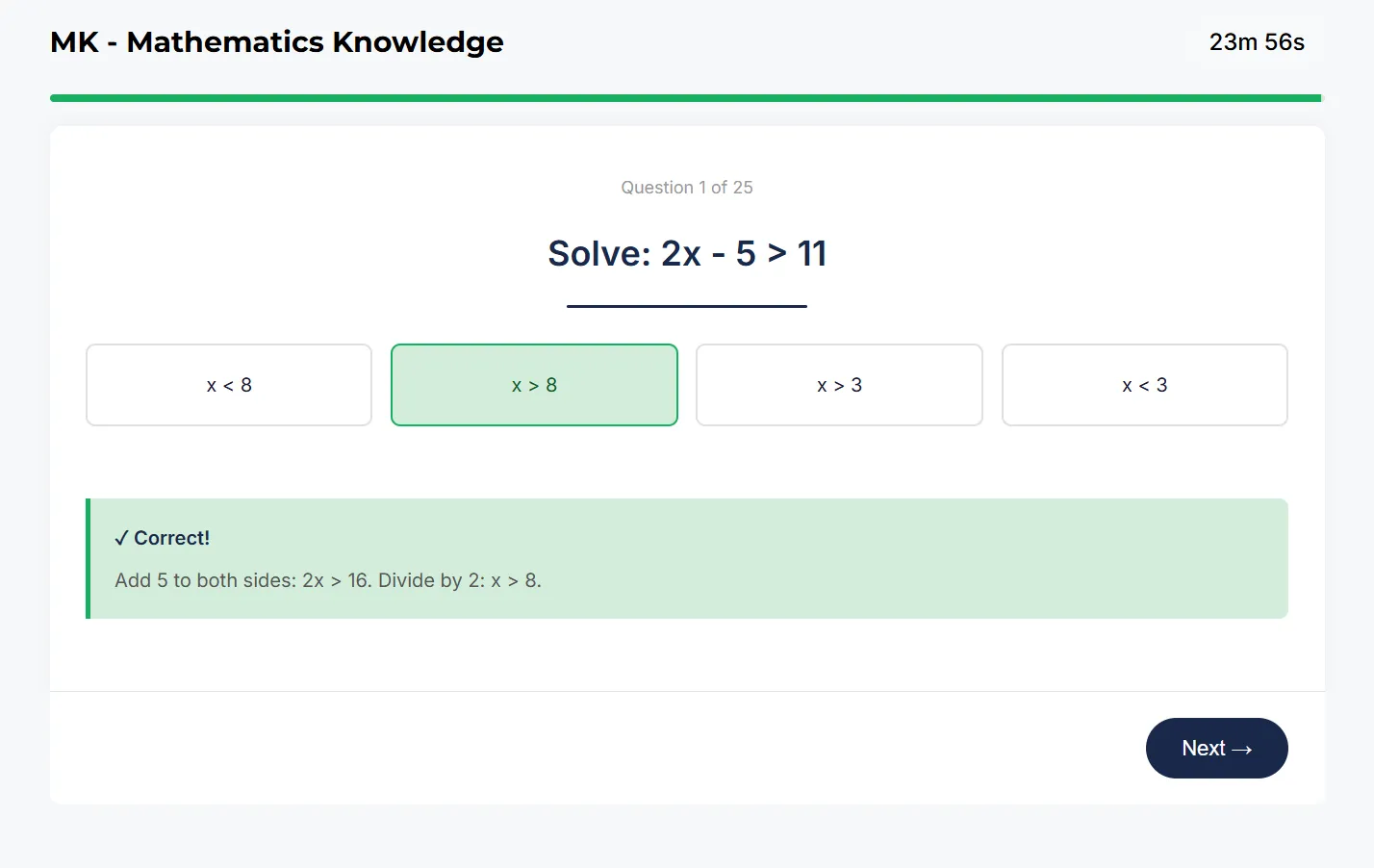
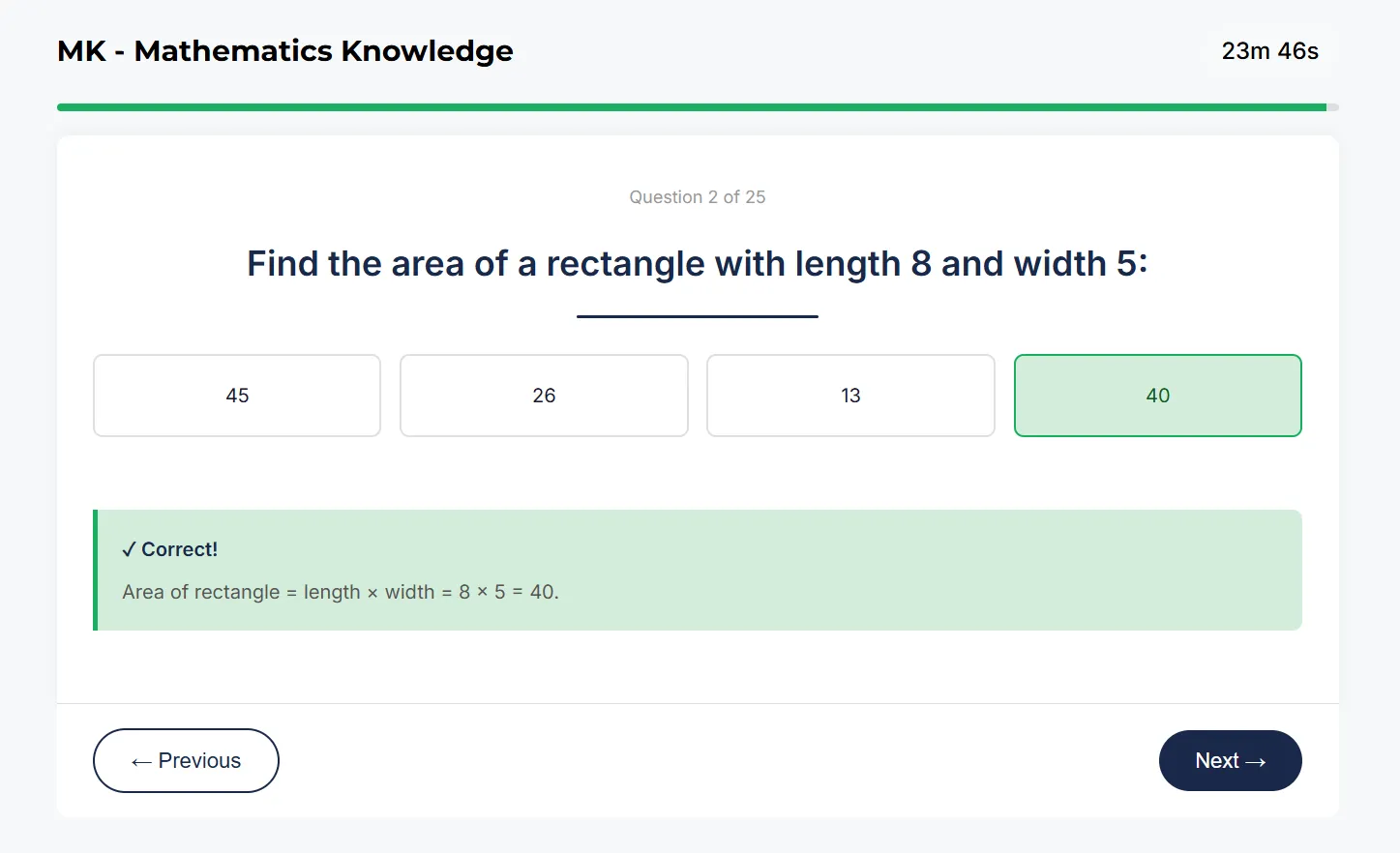
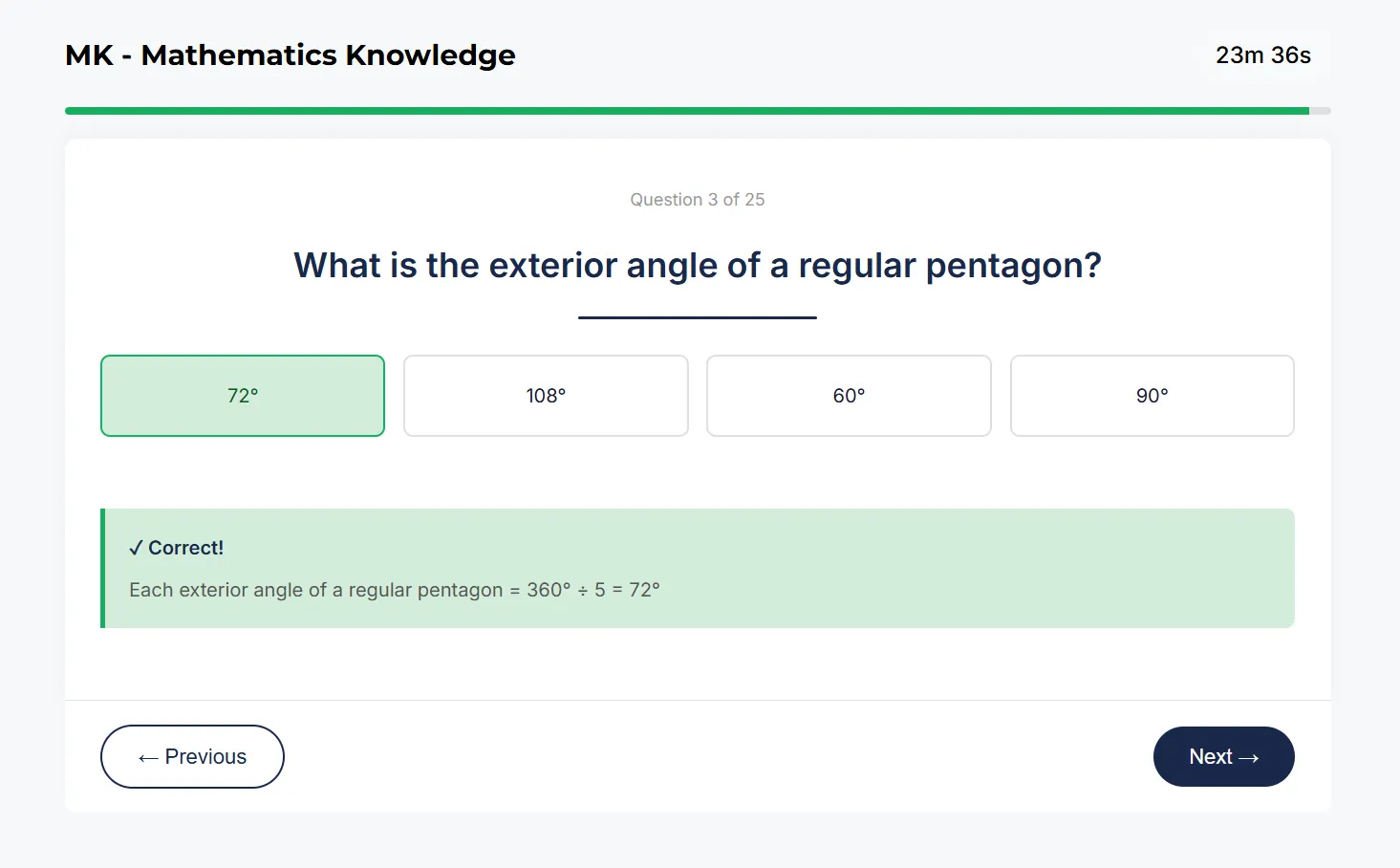
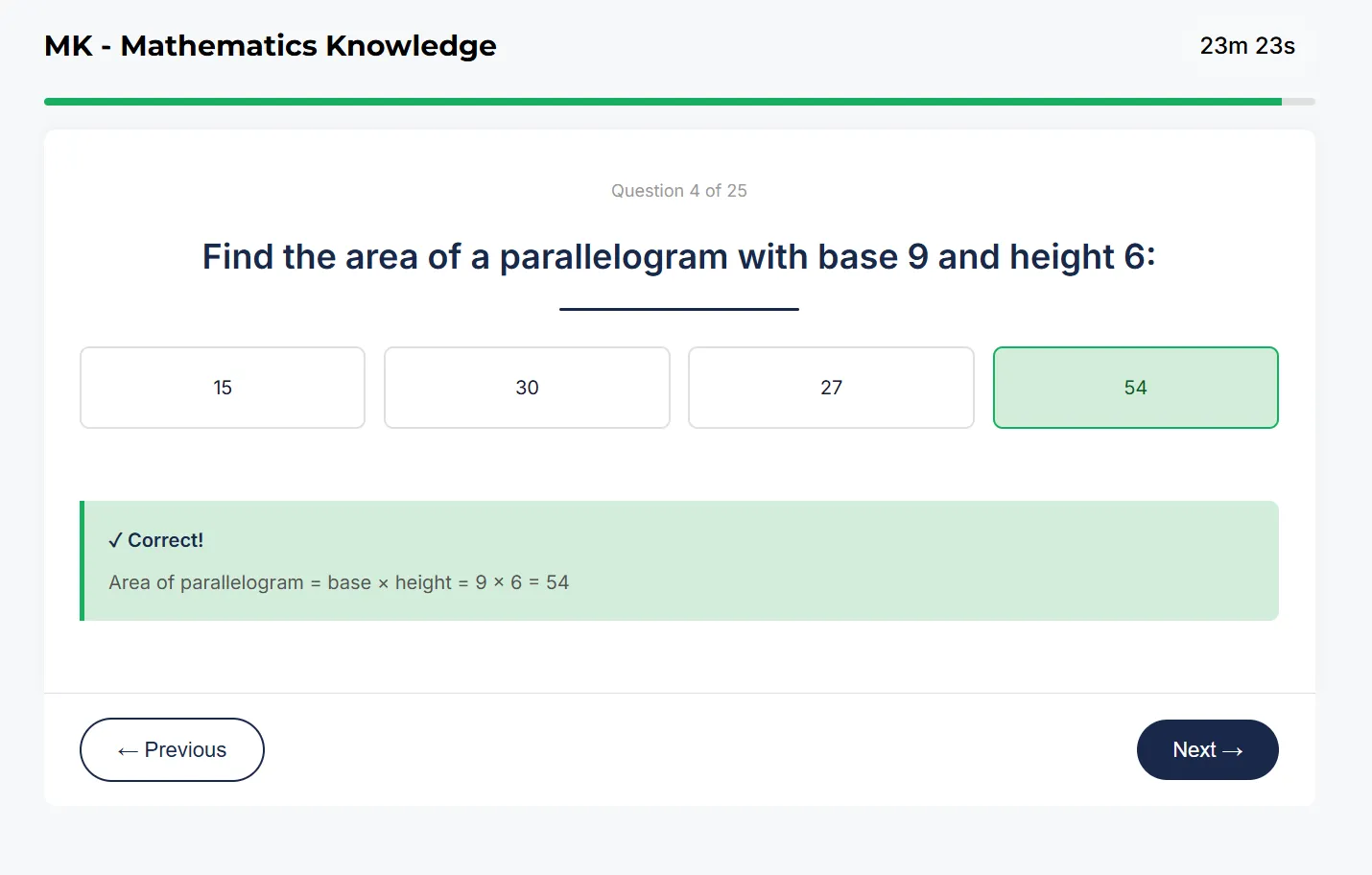
Inside the Mathematics Knowledge subtest
MK is the schoolbook counterpart to Arithmetic Reasoning: equations, exponents, factoring, angles, perimeter and area — asked directly, with no story around them. If you know the rule, the question takes twenty seconds.
That makes MK the most improvable AFQT subtest: there are only about twenty-five formulas and identities in play. Drill them until recall is automatic, because the adaptive format makes your early answers count double.
If 3x − 7 = 14, then x =
Add 7 to both sides (3x = 21), divide by 3. Distractor D is the classic "stopped one step early" answer.
Coach's tip. Write your formula sheet from memory every morning — perimeter, area, exponent rules, factoring patterns. When the sheet is perfect three days running, you are ready.
How the subtest is delivered
Two versions of the same subtest, and they are not the same sitting. Which one you take depends on where you test.
CAT-ASVAB
Computer, at a MEPS — what most enlistees take
- Questions
- 15 scored
- Time limit
- 31 min
- With tryout items
- up to 65 min
Adaptive: the difficulty follows your answers, and you cannot skip or go back. Up to 15 unscored tryout items may be added, which is what raises the limit to 65 minutes — you are never told which ones they are, so treat every question as scored.
Paper & Pencil
Booklet and answer sheet, at a MET site
- Questions
- 25
- Time limit
- 24 min
- Pace
- ~58 s per question
Fixed difficulty — everyone sits the same items in the same order. You may skip and come back, but unanswered questions are scored as wrong, so leave nothing blank.
What you need to master for MK
Focus your study on these five areas. They cover everything you'll see on the test.
Number Sense & Core Operations
The foundation everything else builds on: Fractions, decimals, and percentages · Ratios and proportions · Order of operations (PEMDAS)
Algebra Foundations
The highest-yield MK topic area: Solving linear equations and inequalities · Exponents and roots (square roots, cube roots) · Factoring basics and simplifying expressions
Geometry Essentials
Know the formulas and how to apply them: Area, perimeter, and circumference · Volume of common solids (cubes, cylinders, cones) · Angles, triangles, and basic coordinate reasoning
Data & Patterns
Less frequent but still tested: Simple data interpretation · Proportionality and scaling · Sequence and pattern logic
Mental Math & Estimation
Critical for no-calculator test conditions: Fast approximation techniques · Eliminating wrong answers by estimation · Shortcut multiplication and division
Next AFQT subtests to master
Mathematics Knowledge, quick answers
Is ASVAB Mathematics Knowledge hard?
MK covers high-school-level math: algebra, geometry, and number operations. It feels harder than AR because questions are abstract (no real-world context), but the math itself doesn't go beyond what you'd see in a typical 10th-grade class. If you struggle with formulas or haven't done math in a while, focused review for 3–4 weeks usually brings significant improvement.
Is MK part of the AFQT score?
Yes. MK is one of four subtests that make up the AFQT, the score that determines enlistment eligibility. The AFQT combines Mathematics Knowledge (MK) and Arithmetic Reasoning (AR) for the math component, plus Word Knowledge (WK) and Paragraph Comprehension (PC) for the verbal component. A strong MK score directly boosts your AFQT.
Can I use a calculator on MK?
No. Calculators are not allowed on any section of the ASVAB, including Mathematics Knowledge. You'll need to solve algebra, geometry, and arithmetic problems by hand. Practice mental math shortcuts (like squaring numbers, simplifying fractions, and estimating square roots) so you can work quickly on test day.
What math topics matter most for MK?
Algebra (solving equations, exponents, factoring) and geometry (area, perimeter, volume, angles) make up the majority of MK questions. Number operations (fractions, decimals, order of operations) and basic data interpretation also appear. Focus your study on algebra and geometry first. They're the highest-yield topics for score improvement.
How long should I study to improve my MK score?
Plan for 3–4 weeks of focused study, spending 30–45 minutes per day. Start with a diagnostic test to identify weak areas, then drill the fundamentals: solving equations, geometry formulas, and exponent rules. Practice without a calculator from day one. Timed practice tests in the final week help build test-day speed and confidence.
Should I retake the ASVAB if MK is low but AFQT is passable?
It depends on your MOS goals. If your AFQT is above the minimum but your MK pulls down line scores needed for technical jobs (like electronics or mechanical roles), retaking may open more options. Remember: you can retake after 1 month, then 1 month, then every 6 months, and your most recent score replaces the old one.
Is the CAT-ASVAB harder than the paper ASVAB?
Not inherently. The CAT-ASVAB is adaptive: it adjusts difficulty based on your answers, so strong test-takers see harder questions. But you also get more time per question and fewer total questions. The paper version has fixed difficulty for everyone. Most enlistees take the CAT at MEPS; the paper version is typically used at MET sites.
Build your test-day method
- Exam-aligned drills under deliberate time pressure
- Instant explanations after every item
- Your score estimate, tracked drill after drill