
Physical Science
Twenty questions across physics and chemistry fundamentals. Breadth of recall wins — no derivations required.
- Questions
- 20
- Time limit
- 10 min
- Pace
- 30 s per item
- Counts toward
- No composite
See what the test looks like
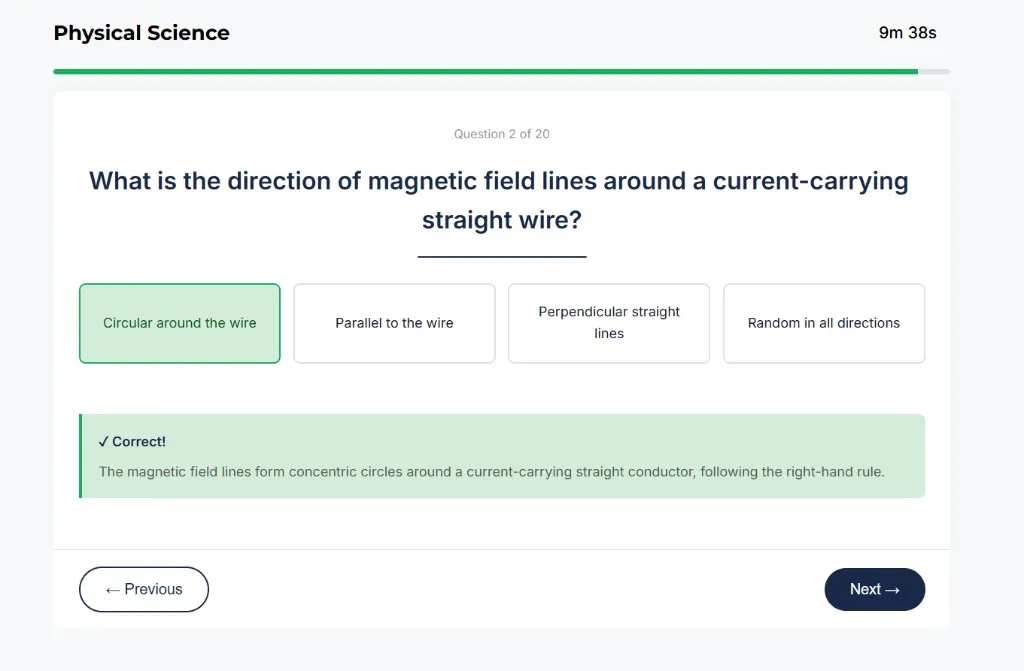
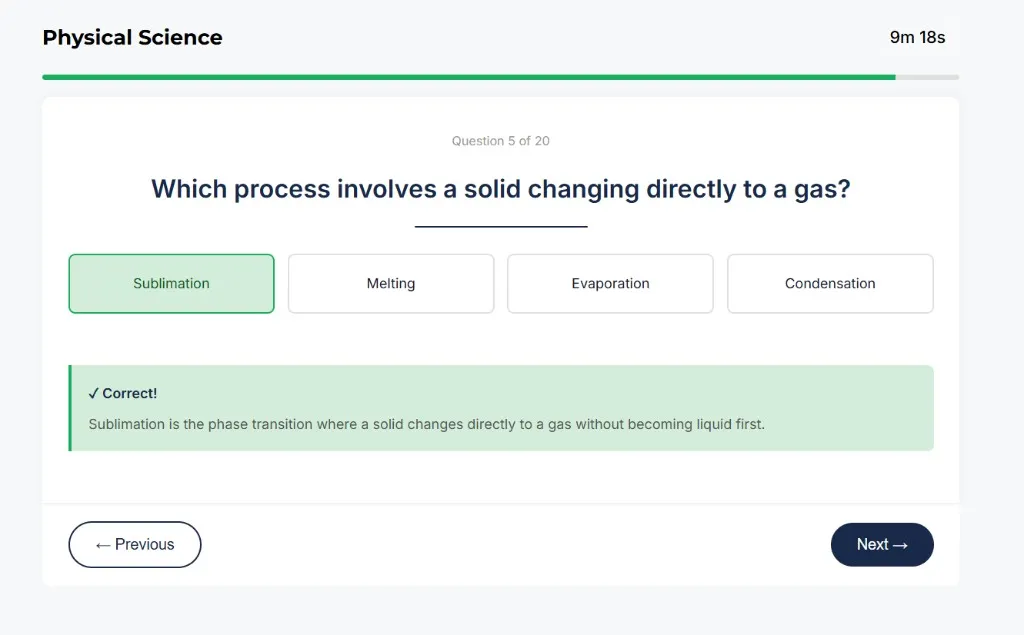
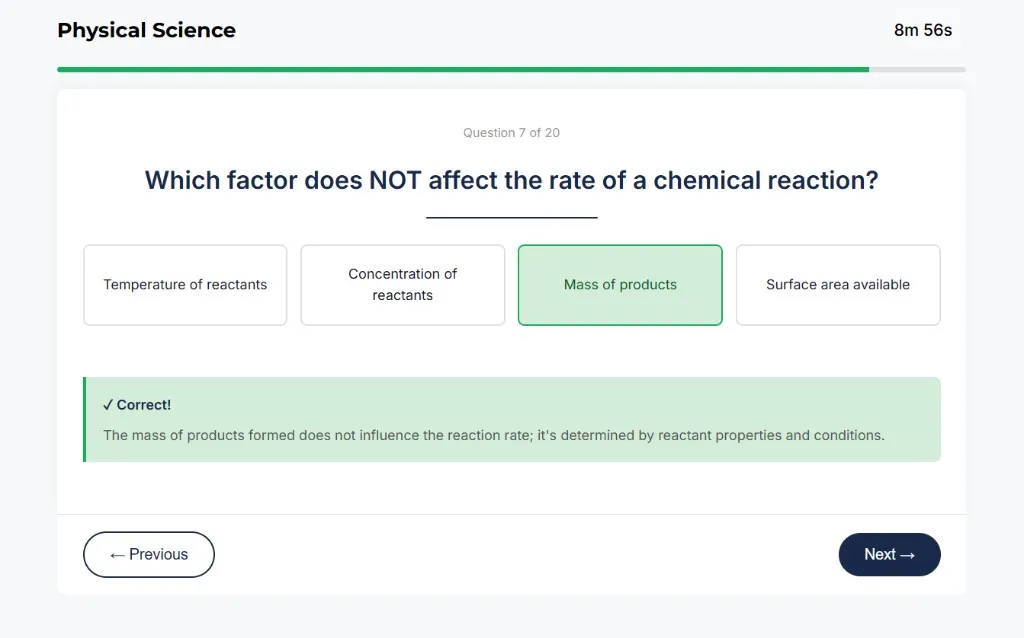
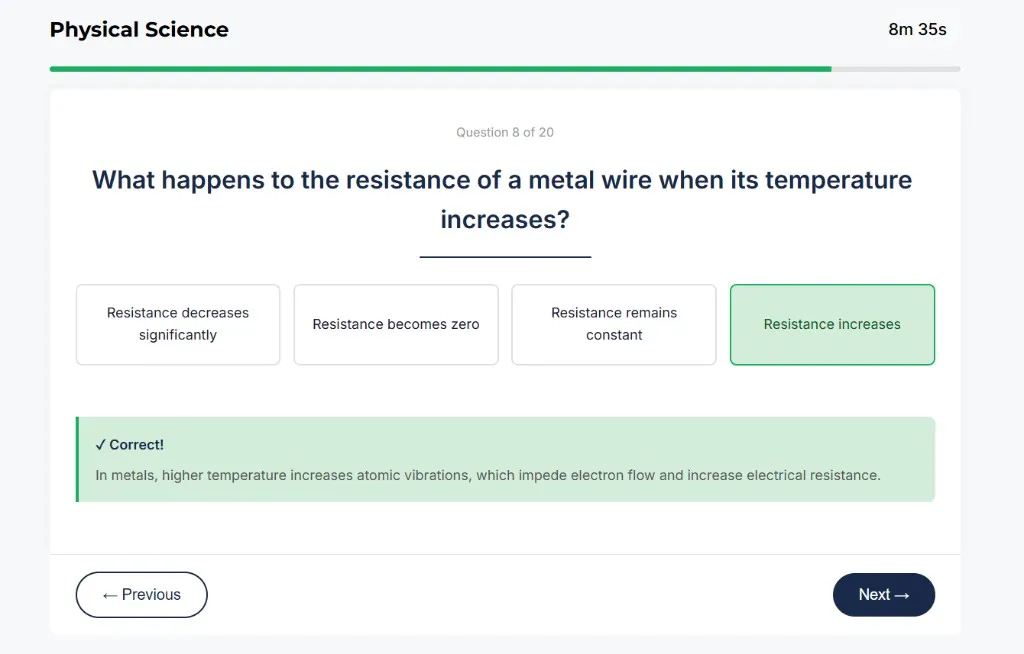
Sample questions from our AFOQT Physical Science practice tests. Each question comes with a detailed explanation so you understand the reasoning, not just the answer.
What is the Physical Science subtest?
Physical Science tests your knowledge of fundamental physics and chemistry concepts. Unlike the math subtests, this section focuses on scientific principles rather than computation. Questions ask you to understand how the physical world works.
The content covers the same material taught in high school physics and chemistry courses. At 30 seconds per question, the test is designed to measure what you already know rather than your ability to work through complex problems under pressure.
Physical Science sits outside the operational composites: your answers are scored and recorded, but they do not move a Pilot, CSO, ABM, Academic Aptitude, Verbal or Quantitative number. Treat it as a section to clear cleanly, not one to sink weeks into.
What the questions are made of
The Physical Science subtest spans two major domains: physics and chemistry.
Mechanics
Newton’s laws of motion, force, mass, acceleration, gravity, friction, momentum, and projectile motion. Understanding cause-and-effect relationships between forces and motion.
Energy & work
Kinetic and potential energy, conservation of energy, work and power calculations, simple machines, and mechanical advantage.
Waves & optics
Properties of waves (frequency, wavelength, amplitude), sound waves, light (reflection, refraction, diffraction), electromagnetic spectrum, and color theory.
Electricity & magnetism
Electric charge, current, voltage, resistance, Ohm’s law, circuits (series/parallel), magnets, electromagnetic fields, and conductors vs. insulators.
Atomic structure & periodic table
Protons, neutrons, electrons, atomic number, mass number, isotopes, periodic table organization, periodic trends (electronegativity, ionization energy, atomic radius).
Chemical reactions & bonding
Types of chemical bonds (ionic, covalent, metallic), balancing equations, acids and bases, pH scale, states of matter, and phase changes.
Which composite scores?
None. Physical Science, the Situational Judgment Test and the Self-Description Inventory are the three AFOQT subtests that feed no operational composite.
The six operational composites — Pilot, CSO, ABM, Academic Aptitude, Verbal and Quantitative — are built from the other nine subtests. Physical Science is still administered and still scored, and boards see the result; it simply is not one of the numbers a selection board scores you on. See the full composite breakdown on the AFOQT guide.
Tips & strategy
At 30 seconds per question, most problems test understanding rather than computation. Know why things happen (why objects float, why circuits fail) rather than memorizing complex formulas.
Know the organization: metals vs. nonmetals, groups and periods, trends (atomic radius increases down a group, electronegativity increases up and to the right). You don’t need to memorize every element.
Physics questions lean heavily on mechanics. Be able to apply all three laws in different scenarios: objects at rest, objects accelerating, and action-reaction pairs.
Understand the difference between kinetic and potential energy, how energy transforms (potential to kinetic and back), and that energy is conserved in closed systems.
With only 30 seconds per question, guessing and moving on is better than spending a minute on one question. Mark your best guess and return if time allows.
Related AFOQT subtests
Physical Science, quick answers
What is AFOQT Physical Science?
Physical Science is one of 12 AFOQT subtests. You have 20 questions and 10 minutes to answer questions on physics and chemistry. Topics range from mechanics and optics to atomic structure and chemical reactions. It is scored, but the Air Force does not currently fold it into any of the operational composites.
How much time do I have per question?
With 20 questions in 10 minutes, you have approximately 30 seconds per question. This is one of the fastest AFOQT subtests, so questions test recall and conceptual understanding rather than multi-step calculations.
Does Physical Science count toward the Pilot composite?
No — and not to any other composite either. Physical Science, Situational Judgment and the Self-Description Inventory sit outside all of the operational composites (Pilot, CSO, ABM, Academic Aptitude, Verbal, Quantitative). Your answers are still recorded and seen by selection boards; they simply do not move a composite number.
How should I prepare for Physical Science?
Review high school physics (Newton's laws, energy, waves, electricity) and chemistry (atomic structure, periodic table trends, chemical bonding, states of matter). Focus on conceptual understanding over memorization.
Build your test-day method
- Exam-aligned drills under deliberate time pressure
- Instant explanations after every item
- Your score estimate, tracked drill after drill