
General Science
Life science, earth science, and physical science fundamentals — the broadest subtest on the battery.
- Questions
- 15 (CAT)
- Time limit
- 12 min
- Pace
- ~48 s per item
- Counts toward
- Technical line scores
See what the test looks like
Here are real sample questions from our General Science practice tests. Each question comes with a detailed explanation so you understand the reasoning, not just the answer.
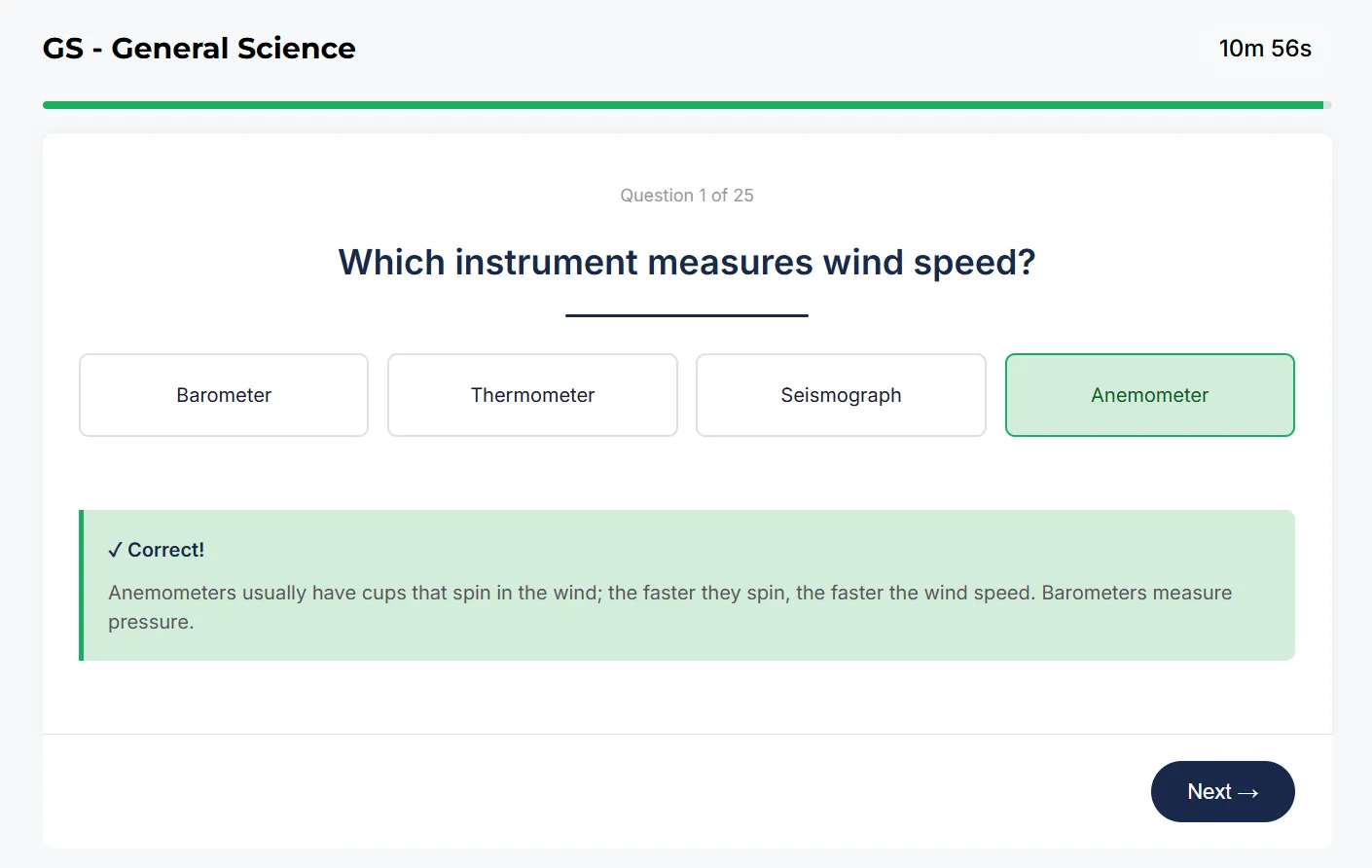
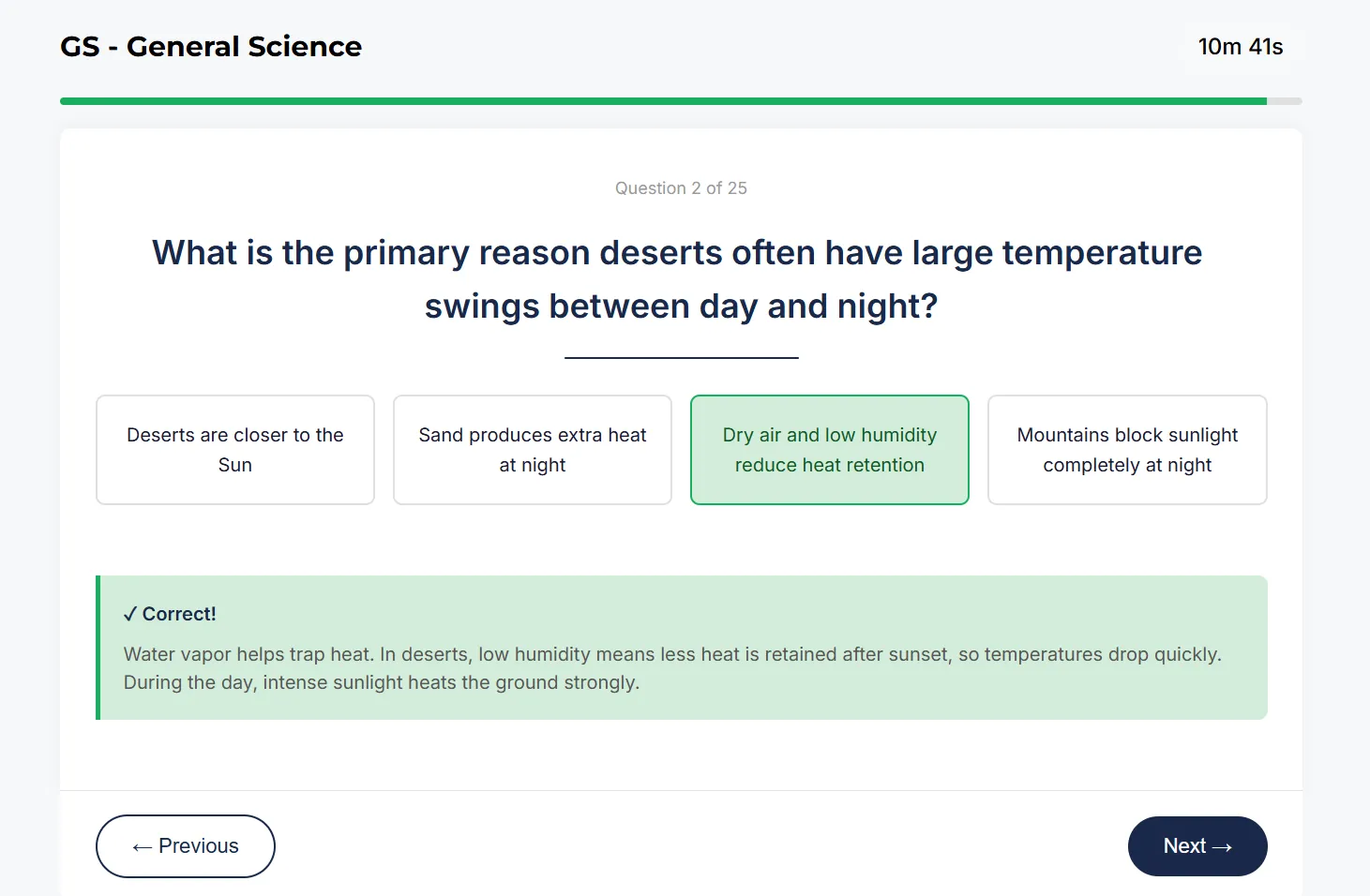
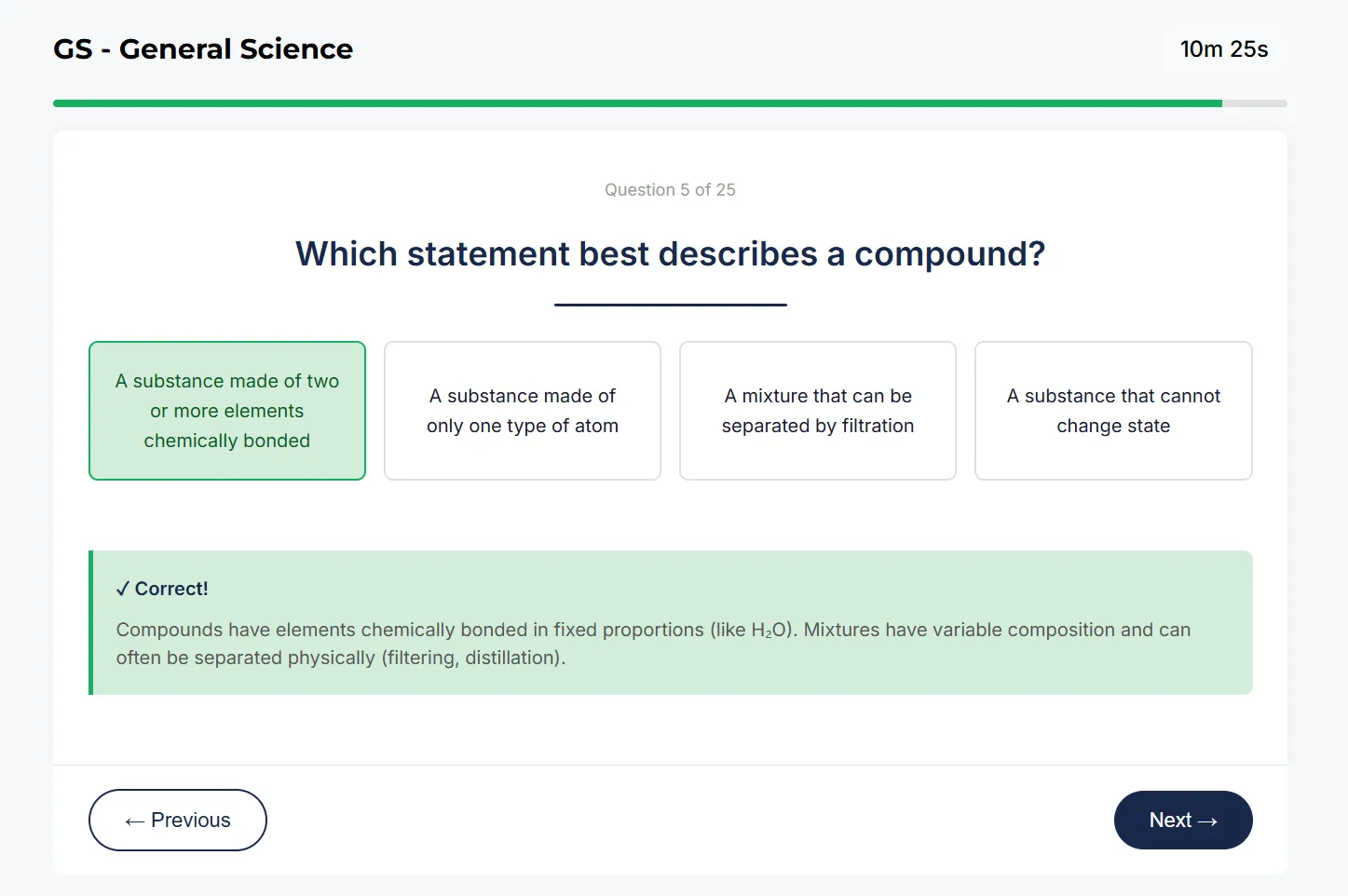
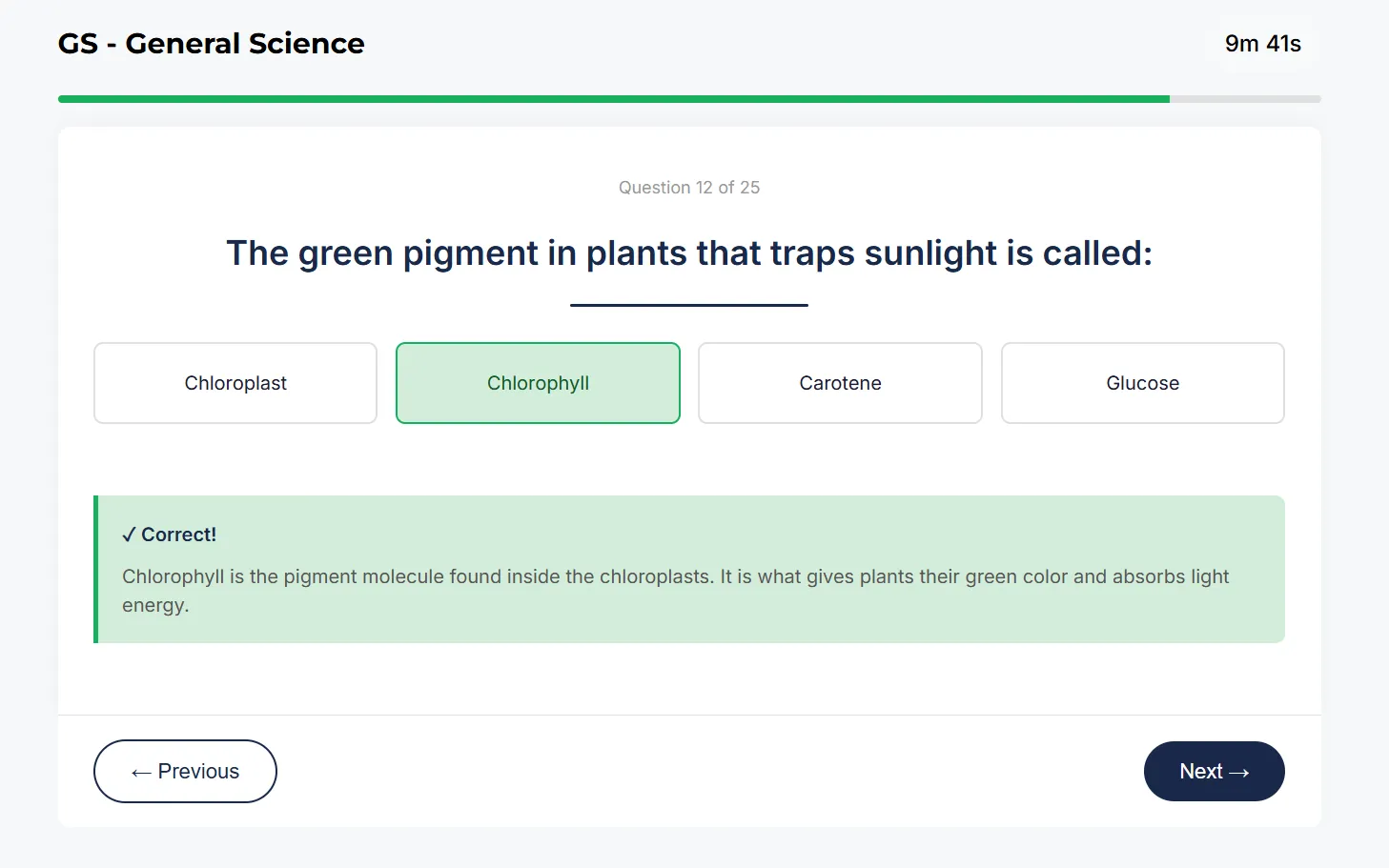
Inside the General Science subtest
General Science sweeps across everything a good high-school program covers: biology and human anatomy, ecology, chemistry, physics, astronomy, and meteorology. No single topic goes deep — most appear for exactly one question — so breadth beats depth when you study.
Review structured outlines rather than textbooks: the water cycle, cell parts, Newton’s laws, the planets, common chemical symbols. Life science historically carries the most questions, so if time is short, start there.
At sea level, water boils at:
212° is the Fahrenheit value — the test loves unit traps. Read the unit before you answer.
Coach's tip. Make one flashcard per fact, not per topic — GS rewards recognizing 300 small facts, not mastering 10 big ideas.
How the subtest is delivered
Two versions of the same subtest, and they are not the same sitting. Which one you take depends on where you test.
CAT-ASVAB
Computer, at a MEPS — what most enlistees take
- Questions
- 15 scored
- Time limit
- 12 min
- With tryout items
- up to 25 min
Adaptive: the difficulty follows your answers, and you cannot skip or go back. Up to 15 unscored tryout items may be added, which is what raises the limit to 25 minutes — you are never told which ones they are, so treat every question as scored.
Paper & Pencil
Booklet and answer sheet, at a MET site
- Questions
- 25
- Time limit
- 11 min
- Pace
- ~26 s per question
Fixed difficulty — everyone sits the same items in the same order. You may skip and come back, but unanswered questions are scored as wrong, so leave nothing blank.
What topics you must master for GS
The official description says "physical and biological sciences." Here's a practical breakdown of what that actually means for your study plan.
Life Science
The largest topic area on GS. Focus on: Cell structure and function · Human body systems (circulatory, respiratory, digestive, nervous) · Genetics and heredity basics · Ecology: food chains, ecosystems, trophic levels · Classification of organisms
Physical Science
Chemistry and physics fundamentals: Atoms, elements, and the periodic table · Chemical reactions and states of matter · pH scale (acids and bases) · Force, motion, and Newton's laws · Energy, electricity, and heat transfer
Earth & Space Foundations
Less frequent but still tested: Earth's layers and plate tectonics · Rock cycle and mineral types · Weather patterns and climate basics · Solar system and astronomy fundamentals
Scientific Method & Measurement
Process and reasoning skills: Variables: independent, dependent, control · Control groups and experimental design · Unit conversions (metric/imperial) · Reading graphs and interpreting data
Related ASVAB subtests
General Science, quick answers
Is ASVAB General Science hard?
GS covers a broad range of topics, but none go deeper than high-school level. The challenge is breadth, not depth. You need to recall facts from biology, chemistry, physics, and earth science. With focused review using flashcards and practice tests, most people improve their GS score within 2–4 weeks.
Is GS part of the AFQT score?
No. The AFQT is calculated from only four subtests: Arithmetic Reasoning (AR), Mathematics Knowledge (MK), Word Knowledge (WK), and Paragraph Comprehension (PC). However, GS contributes to several line scores (composite scores) that determine which military jobs (MOS) you qualify for.
Can I use a calculator on the GS section?
No. Calculators are not allowed on any section of the ASVAB, including General Science. The math involved in GS questions is minimal. Most questions test your recall of scientific facts and concepts, not your ability to calculate.
What science topics matter most for GS?
Life science (biology, human body systems, ecology) and physical science (basic chemistry and physics) make up the majority of GS questions. Earth and space science appears less frequently but is still tested. Focus your study time on biology and chemistry first for the highest return.
How long should I study for GS?
Most people see meaningful improvement with 2–4 weeks of focused study, spending 30–45 minutes per day. Start with a diagnostic test to identify weak areas, then focus on high-yield topics like body systems, basic chemistry, and ecology. Use flashcards for vocabulary and practice tests to build speed.
Build your test-day method
- Exam-aligned drills under deliberate time pressure
- Instant explanations after every item
- Your score estimate, tracked drill after drill