
Verbal Analogies
A is to B as C is to…? Twenty-five relationships in eight minutes — where vocabulary meets logic, and naming the pattern beats knowing the word.
- Questions
- 25
- Time limit
- 8 min
- Pace
- ~19 s per item
- Counts toward
- Verbal · Academic · ABM
See what the test looks like
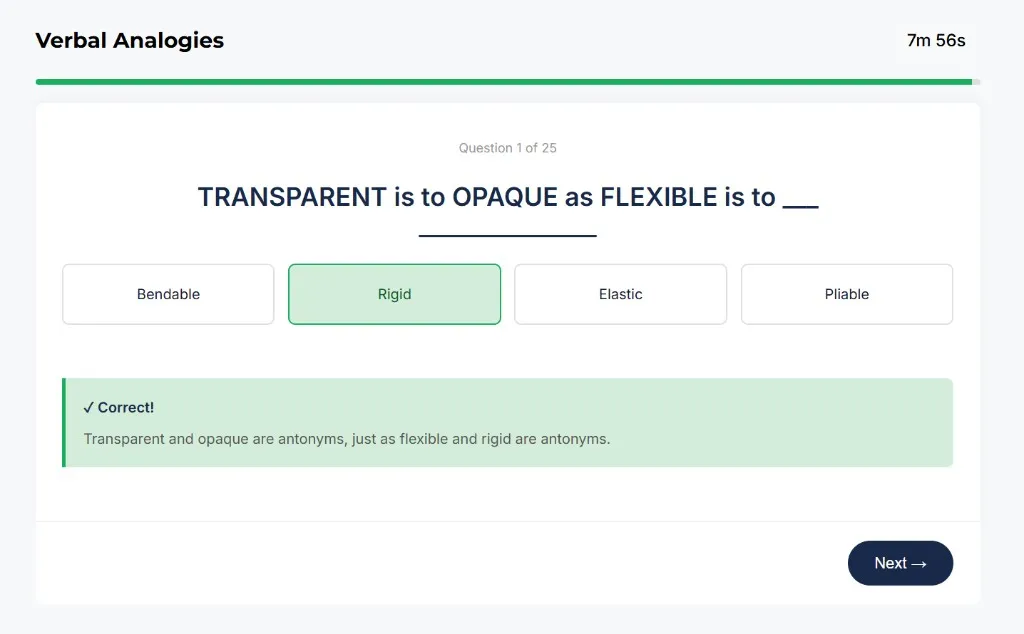
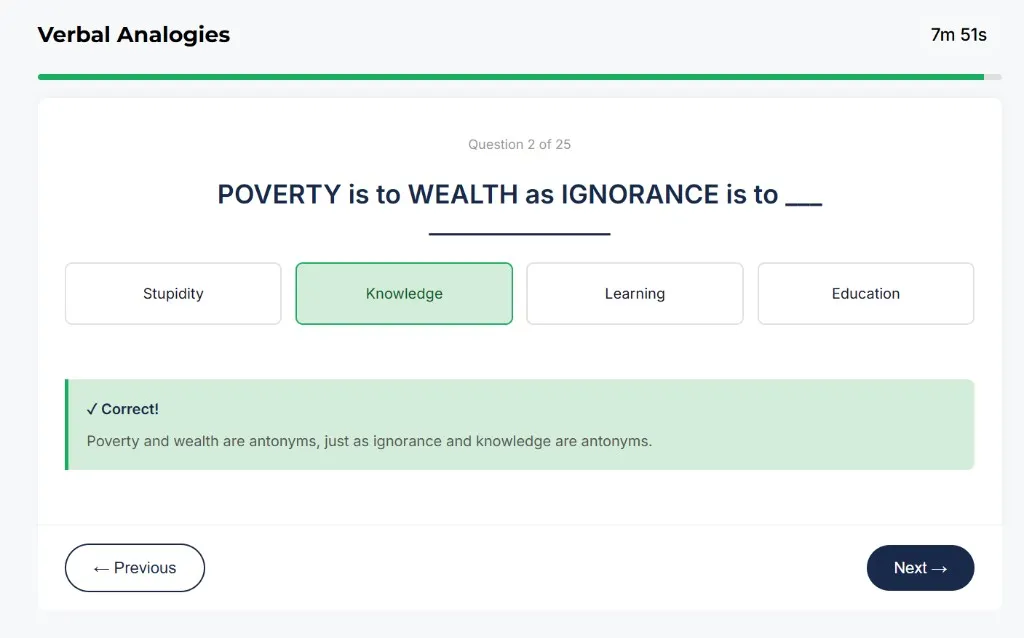
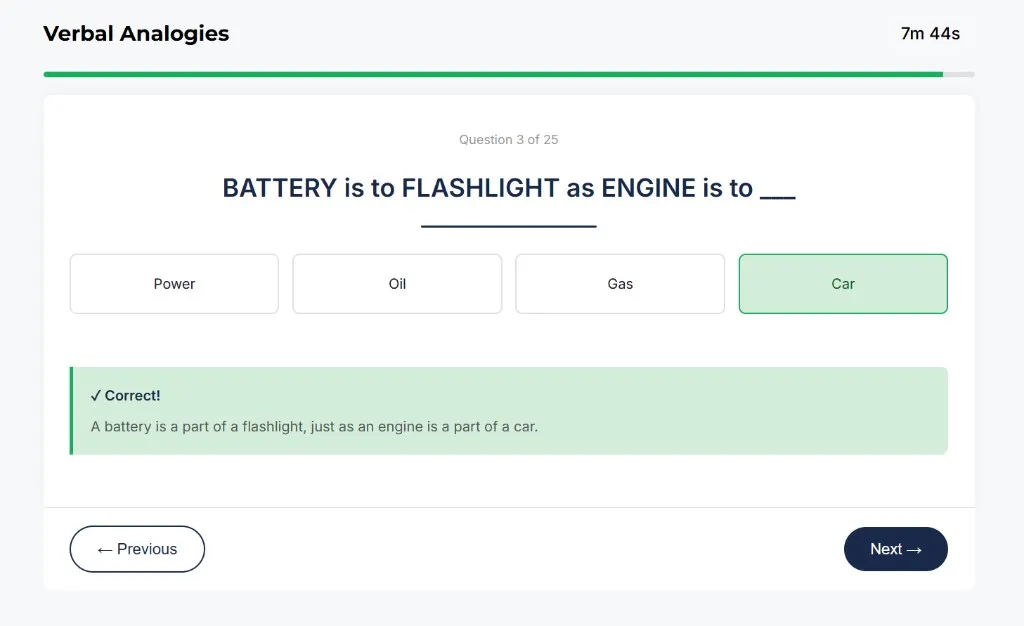
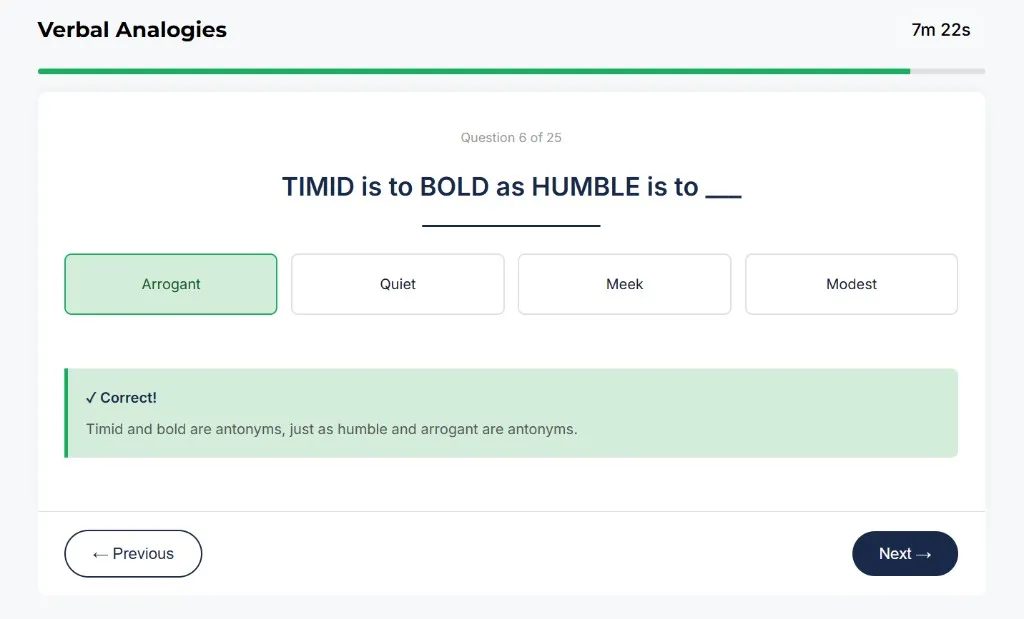
Sample questions from our AFOQT Verbal Analogies practice tests. Each question comes with a detailed explanation so you understand the reasoning, not just the answer.
What is the Verbal Analogies subtest?
Verbal Analogies measures your ability to reason with words by recognizing relationships between word pairs. Each question gives you a stem pair (e.g., BIRD : NEST) and asks you to choose the answer pair that mirrors the same relationship (e.g., BEE : HIVE).
The subtest doesn’t test obscure vocabulary. Instead, it focuses on your ability to identify the type of relationship quickly and match it accurately. The time pressure is the real challenge: at just 19 seconds per question, hesitation costs points.
This subtest contributes to the Verbal composite and the Academic Aptitude composite.
What the questions are made of
Most AFOQT verbal analogies fall into these common relationship categories.
Synonyms & antonyms
Words with similar or opposite meanings. Example: HAPPY : JOYFUL (synonym) or HOT : COLD (antonym).
Part to whole
One word is a component of the other. Example: WHEEL : CAR or CHAPTER : BOOK.
Cause & effect
One word leads to or produces the other. Example: FIRE : SMOKE or STUDY : KNOWLEDGE.
Function / purpose
One word describes what the other does or is used for. Example: KNIFE : CUT or PEN : WRITE.
Degree / intensity
Words represent different intensities of the same concept. Example: WARM : SCALDING or ANNOYED : FURIOUS.
Category / type
One word is a specific example of the other. Example: EAGLE : BIRD or VIOLIN : INSTRUMENT.
Which composite scores?
Verbal composite: Verbal Analogies + Word Knowledge + Reading Comprehension
Academic Aptitude composite: Verbal Analogies + Arithmetic Reasoning + Word Knowledge + Math Knowledge + Reading Comprehension + Physical Science
ABM composite: Verbal Analogies + Math Knowledge + Table Reading + Instrument Comprehension + Block Counting + Aviation Information
Verbal Analogies does not contribute to the Pilot, CSO, or Quantitative composites. See the full composite breakdown on the AFOQT guide.
Tips & strategy
Before looking at answer choices, define the relationship in the stem pair. Say it in your head: “A is a type of B” or “A causes B.” Then find the answer pair that fits the same sentence.
Analogies depend on knowing what words mean. Use flashcards or vocabulary apps to study common GRE/SAT-level words. Focus on words with multiple meanings.
Memorize the six common analogy types above. When you see a question, classify the relationship type instantly. This shortcut saves critical seconds.
If two answers seem close, eliminate the clearly wrong ones first. Pick the best remaining option and move on. At 19 seconds per question, guessing beats stalling.
Do timed analogy drills. Set a timer for 8 minutes and try 25 analogies. Build the habit of working fast without sacrificing accuracy.
Related AFOQT subtests
Verbal Analogies, quick answers
What are AFOQT Verbal Analogies?
Verbal Analogies is one of 12 AFOQT subtests. You have 25 questions and 8 minutes to identify word relationships. Each question presents a pair of words and asks you to find another pair with the same relationship. It contributes to the Verbal and Academic Aptitude composite scores.
How much time do I have per question?
With 25 questions in 8 minutes, you have approximately 19 seconds per question. This is one of the fastest-paced AFOQT subtests, so quick pattern recognition is essential.
Does Verbal Analogies count toward the Pilot composite?
No. Verbal Analogies feeds the Verbal, Academic Aptitude and ABM composites, but not the Pilot composite. The Pilot composite uses Math Knowledge, Table Reading, Instrument Comprehension, and Aviation Information.
How should I prepare for Verbal Analogies?
Build your vocabulary using flashcards and learn the common analogy relationship types: synonyms, antonyms, part-to-whole, cause-and-effect, degree, and function. Practice with timed drills to build speed and pattern recognition.
Build your test-day method
- Exam-aligned drills under deliberate time pressure
- Instant explanations after every item
- Your score estimate, tracked drill after drill