
Arithmetic Reasoning
Math word problems under the clock — one of the four subtests that determine your AFQT score, with representative practice in our trainer.
- Questions
- 15 (CAT)
- Time limit
- 55 min
- Pace
- ~3.7 min per item
- Calculator
- Not allowed
- Counts toward
- AFQT + line scores
Representative questions on the real clock
Representative word problems from the trainer, with four choices and the same 55-minute, 15-question clock as the official CAT-ASVAB. Flip through a few.
Inside the Arithmetic Reasoning subtest
Arithmetic Reasoning is applied math: every question is a short story — fuel, pay, distances, work crews — that hides one simple calculation. The math itself rarely goes past ratios and percentages; the skill being tested is translation, turning three sentences into one equation. It is one of the four subtests that make up your AFQT, the score that decides whether you can enlist at all.
Unit rates, ratios, scaling recipes and work problems
Discounts, interest, tax, pay and commission
Speed problems, converging convoys, combined work rates
How the 55 minutes unfold
15 questions, one at a time, no going back. The CAT weighs early answers heavily — a strong start raises your ceiling.
You should be near question 6. Time is unusually generous here — over three and a half minutes a question — so read carefully rather than fast.
Ten minutes left — estimate, eliminate, and commit on anything still open.
The CAT penalizes an unfinished test — pace yourself to answer all 15, even if the last few are educated guesses.
The wrong setup produces an answer that IS among the choices. Divide 12 by 180 instead of 180 by 12 and a plausible option is waiting. Write the equation before you compute — every time.
How the subtest is delivered
Two versions of the same subtest, and they are not the same sitting. Which one you take depends on where you test.
CAT-ASVAB
Computer, at a MEPS — what most enlistees take
- Questions
- 15 scored
- Time limit
- 55 min
- With tryout items
- up to 113 min
Adaptive: the difficulty follows your answers, and you cannot skip or go back. Up to 15 unscored tryout items may be added, which is what raises the limit to 113 minutes — you are never told which ones they are, so treat every question as scored.
Paper & Pencil
Booklet and answer sheet, at a MET site
- Questions
- 30
- Time limit
- 36 min
- Pace
- ~72 s per question
Fixed difficulty — everyone sits the same items in the same order. You may skip and come back, but unanswered questions are scored as wrong, so leave nothing blank.
Three questions, solved the test-day way
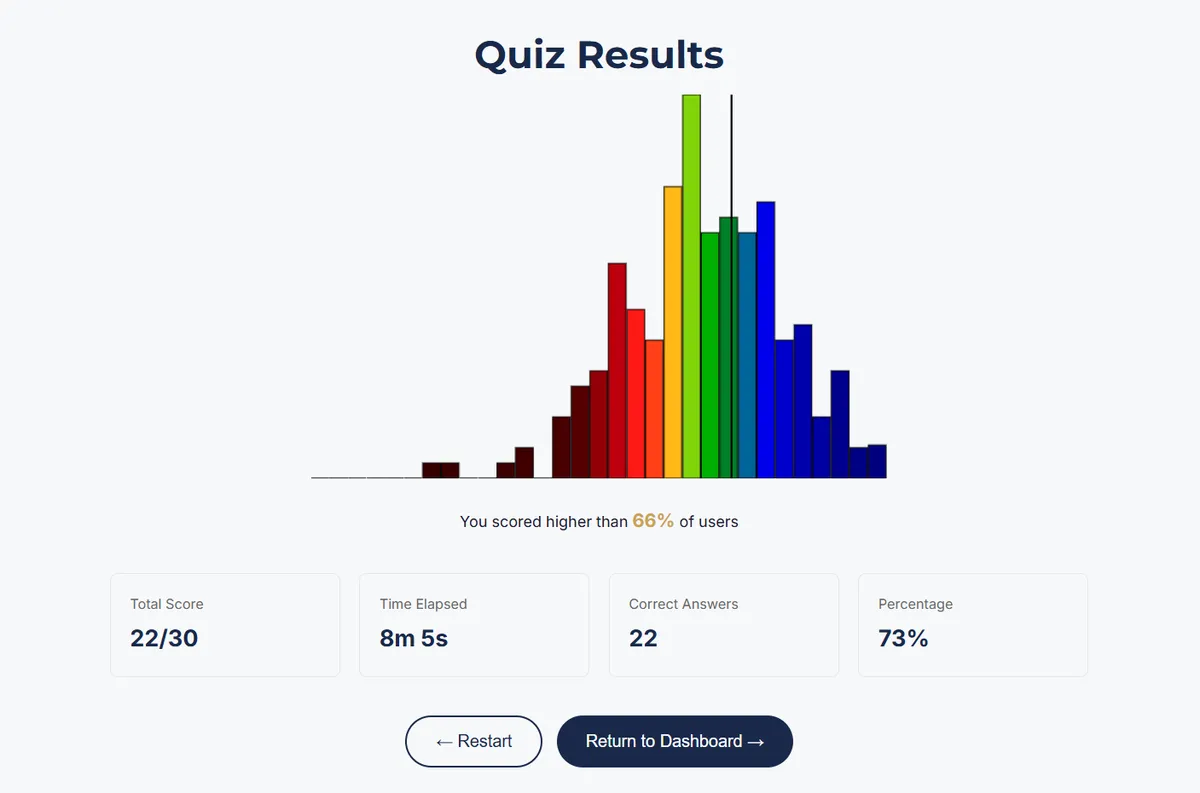
Every set is scored against every other candidate
The moment you finish, your result drops onto the score distribution — percentile, total score, and time, read at a glance.
Got all three? Run the full set
Try a free 15-question quick drill, one minute per item, then review your score and explanations question by question.
Five habits that move an Arithmetic Reasoning score
Underline what is asked, write the equation, then do the arithmetic. Most misses are setup errors, not math errors.
No calculator — times tables, percent shortcuts, and fraction–decimal conversions must be automatic.
Minutes vs. hours, feet vs. yards, per-item vs. per-dozen — half the distractors are unit traps.
"How many are present" is not "how many are on leave" — re-read the question after you compute, before you commit.
The CAT penalizes an unfinished test. Over three and a half minutes a question is generous — bank time early on the easy ones.
Six weeks out: arithmetic fundamentals. Weeks 3–4: daily word-problem sets, timed. Final two weeks: full AFQT simulations only.
Next AFQT subtests to master
Arithmetic Reasoning, quick answers
Can I use a calculator?
No. No calculator is allowed anywhere on the ASVAB — you get scratch paper and a pencil, which is why mental arithmetic is the first skill to rebuild.
How much does it count toward my AFQT?
Arithmetic Reasoning is one of the four AFQT subtests, alongside Mathematics Knowledge and the two verbal tests. Together they decide whether you qualify to enlist — few subtests carry more weight.
Do the early questions count for more on the CAT?
In effect, yes. The adaptive engine uses your first answers to decide how hard the rest of the set gets, so an early run of mistakes lowers the ceiling of what you can still be shown — and your score reflects the difficulty you sustained, not just the count. Slow down at the start; the clock is generous enough to allow it.
Is there a penalty for guessing?
No per-question penalty — but the CAT does penalize an unfinished test. Pace yourself to answer every question, even if the last few are educated guesses.
Build your test-day method
- Exam-aligned drills under deliberate time pressure
- Instant explanations after every item
- Your score estimate, tracked drill after drill