
Word Knowledge
Vocabulary, synonyms, and word meanings in context — one of the four subtests that decide your AFQT score.
- Questions
- 15 (CAT)
- Time limit
- 9 min
- Pace
- ~36 s per item
- Counts toward
- AFQT + line scores
See what the test looks like
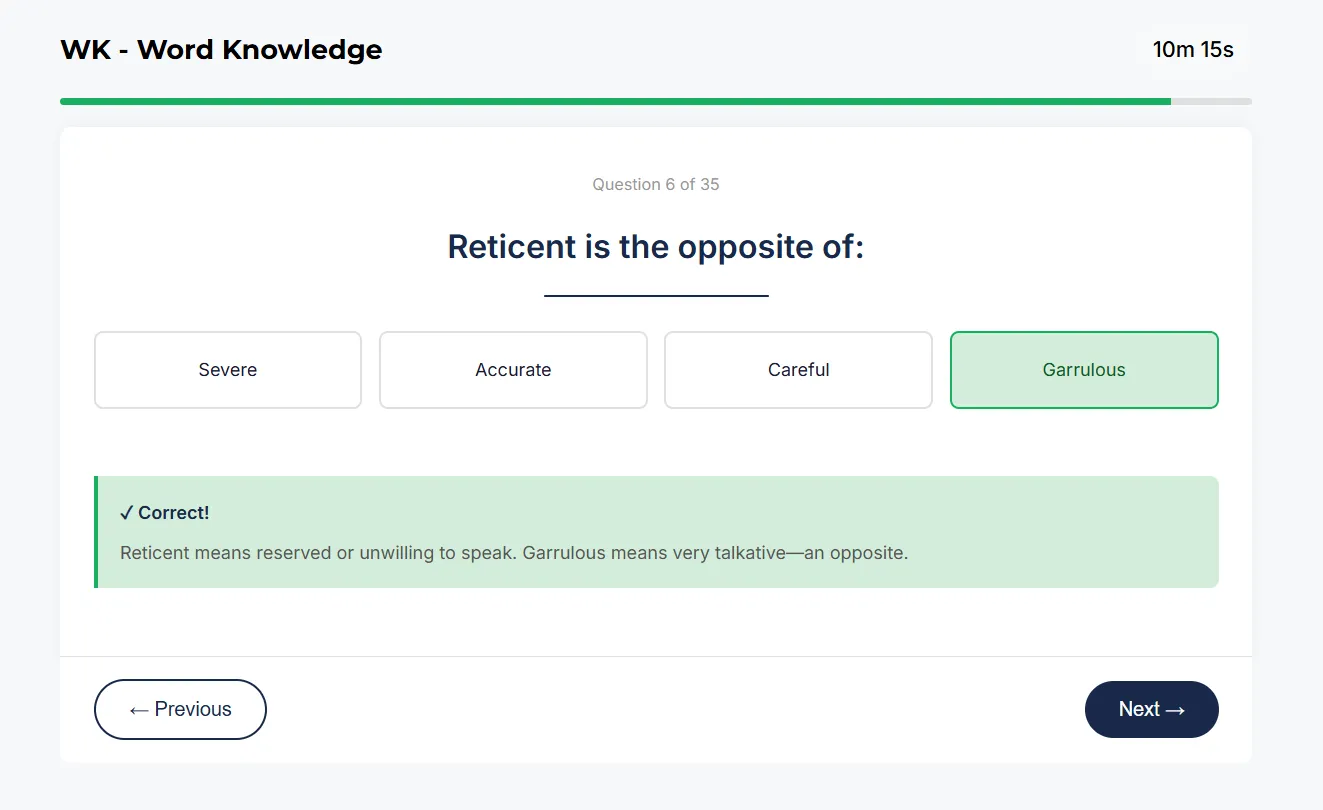
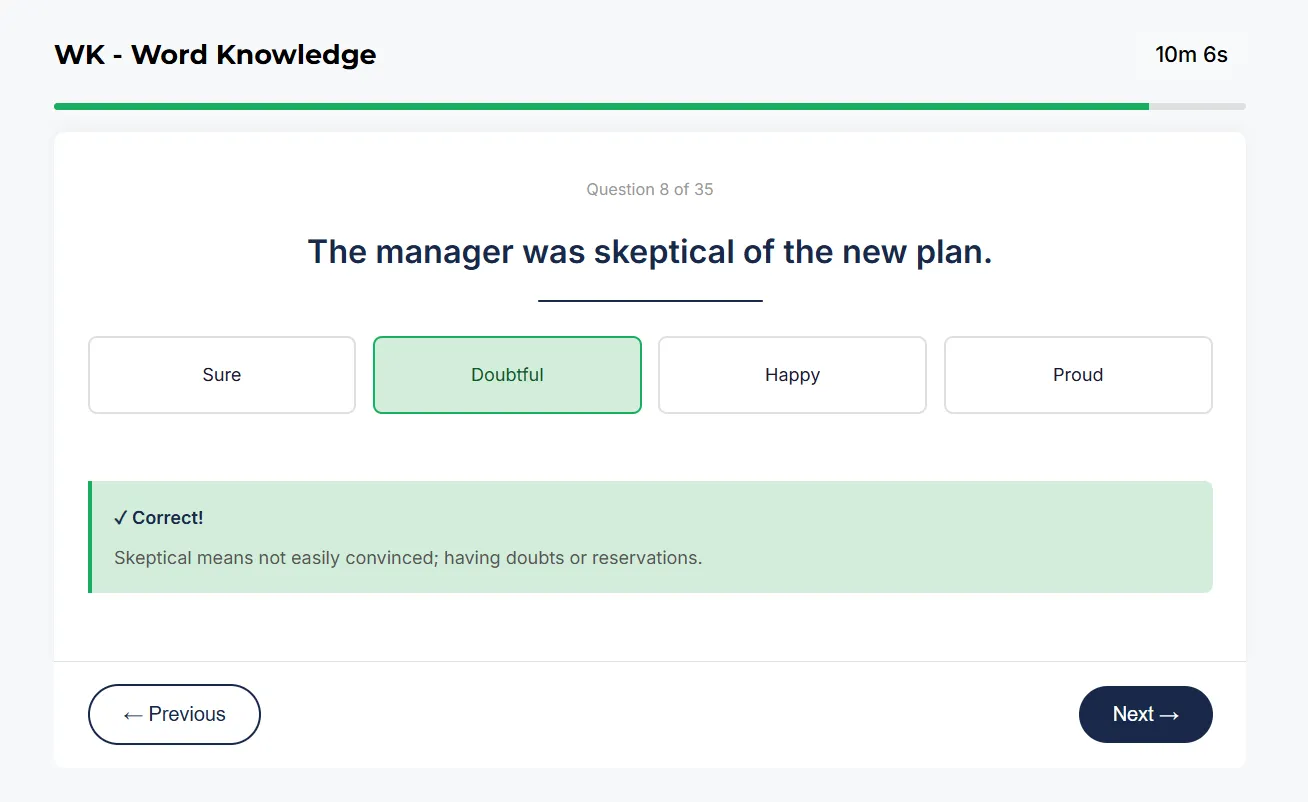
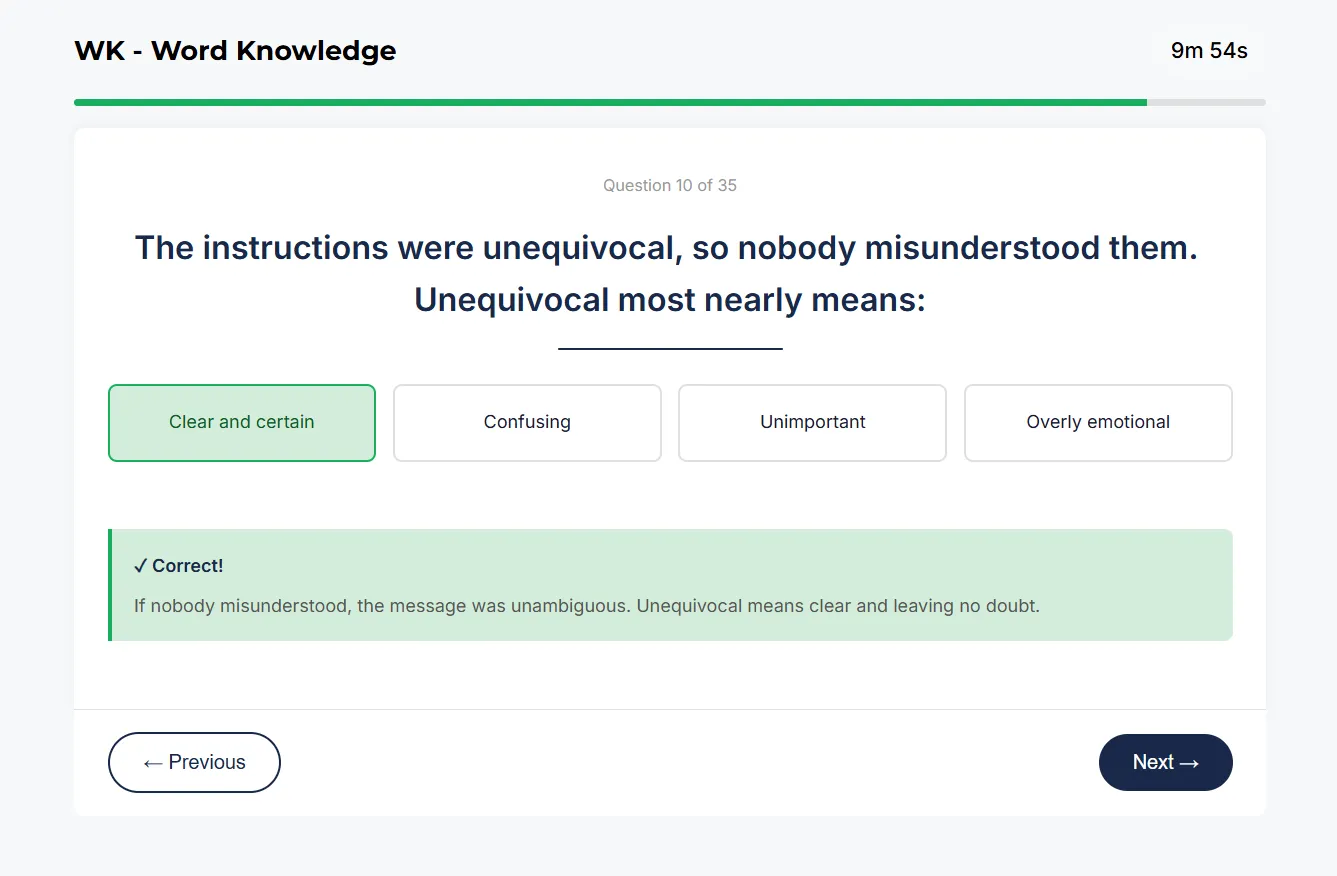
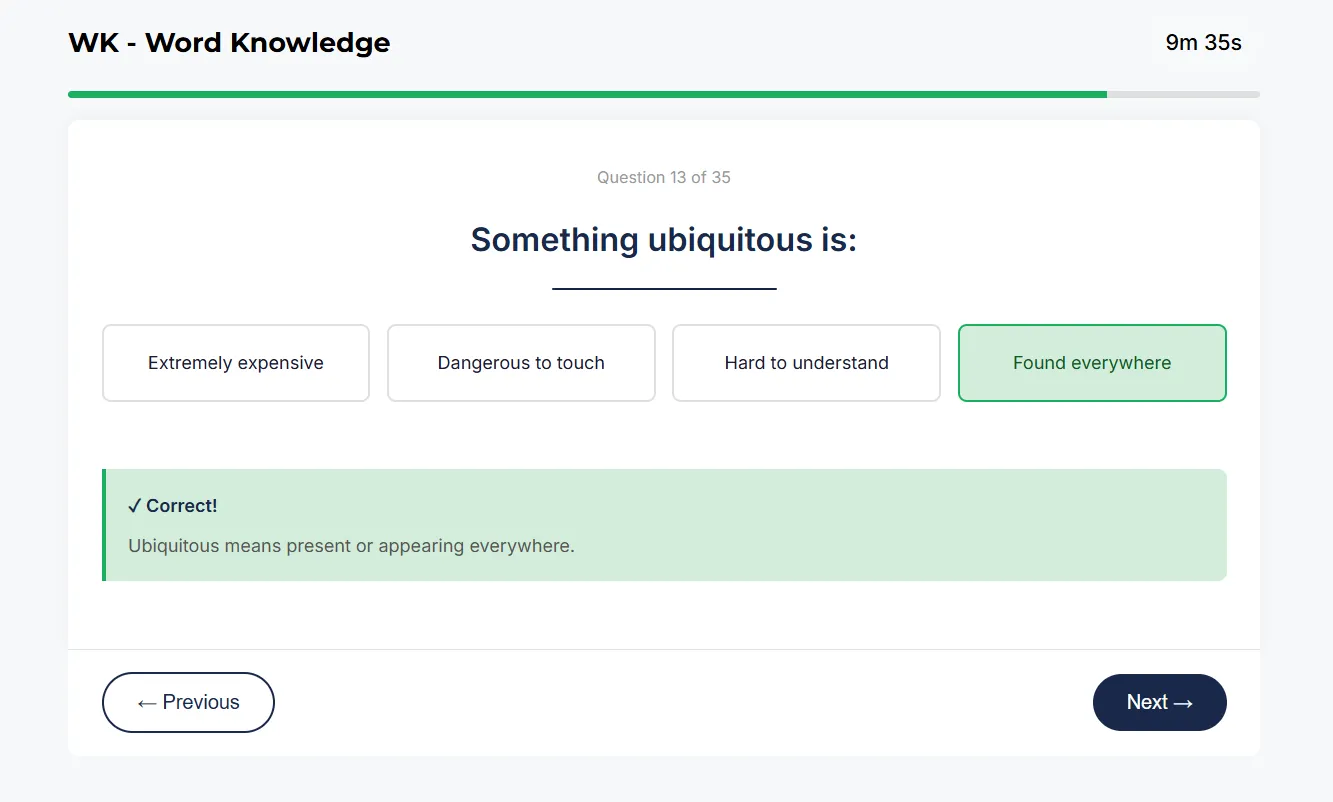
Here are real sample questions from our Word Knowledge practice tests. Each question comes with a clear explanation so you understand why the correct answer is right.
Inside the Word Knowledge subtest
Word Knowledge asks you to pick the answer closest in meaning to an underlined word — sometimes alone, sometimes in a short sentence. It is pure vocabulary: no grammar rules, no reading passages. Because the CAT version adapts to your answers, early questions weigh heavily; a strong start raises the ceiling of your score.
Most misses come from confusing a word with a similar-looking one, not from never having seen it. Slow down on look-alike roots, and when you truly don't know a word, eliminate choices by tone — positive or negative — before guessing.
"Candid" most nearly means:
Candid shares its root with "candor" — openness. The distractors play on sound (candy) and opposites (hidden).
Coach's tip. Ten minutes of word-list drills a day beats a weekend cram: vocabulary is the slowest ASVAB skill to build and the most stable once built. Start six weeks out.
How the subtest is delivered
Two versions of the same subtest, and they are not the same sitting. Which one you take depends on where you test.
CAT-ASVAB
Computer, at a MEPS — what most enlistees take
- Questions
- 15 scored
- Time limit
- 9 min
- With tryout items
- up to 18 min
Adaptive: the difficulty follows your answers, and you cannot skip or go back. Up to 15 unscored tryout items may be added, which is what raises the limit to 18 minutes — you are never told which ones they are, so treat every question as scored.
Paper & Pencil
Booklet and answer sheet, at a MET site
- Questions
- 35
- Time limit
- 11 min
- Pace
- ~19 s per question
Fixed difficulty — everyone sits the same items in the same order. You may skip and come back, but unanswered questions are scored as wrong, so leave nothing blank.
WK question types you must master
WK questions fall into distinct categories. Knowing what to expect helps you study smarter and react faster on test day.
Synonym Questions
The most common WK format: pure vocabulary recall: A word is given in isolation (e.g., "Belligerent most nearly means:") · You pick the answer closest in meaning from four options · No context clues: you either know it or you don't
Context-Meaning Questions
The word appears inside a sentence: A sentence uses the target word in context · You deduce the meaning from how the word is used · Easier if you don't know the word: context gives clues
Trap Patterns
Common tricks the test uses to mislead you: False friends: words that look similar but mean different things · Connotation traps: positive vs. negative tone · Register confusion: formal vs. casual word meanings
High-Frequency Word Families
Learn roots, prefixes, and suffixes to decode unknown words: bene- (good): benevolent, beneficial, benediction · mal- (bad): malicious, malfunction, malevolent · -logy (study of): biology, psychology, geology · Knowing 30–40 common roots unlocks hundreds of words
Next AFQT subtests to master
Word Knowledge, quick answers
Is WK part of the AFQT score?
Yes. Word Knowledge is one of four subtests that make up the AFQT, the score that determines whether you can enlist. The AFQT combines WK and Paragraph Comprehension into a Verbal Expression (VE) score, then adds Arithmetic Reasoning (AR) and Mathematics Knowledge (MK). A strong WK score directly boosts your AFQT.
What is the fastest way to improve WK?
Flashcards with spaced repetition are the fastest method. Focus on high-frequency ASVAB words first, then learn common prefixes, suffixes, and roots (like bene-, mal-, -ology) to decode unfamiliar words on test day. Pair this with daily practice tests to build speed. Most people see measurable improvement in 2–3 weeks with 30 minutes per day.
Is WK harder than Paragraph Comprehension?
They test different skills. WK is pure vocabulary recall: you either know the word or you don't. Paragraph Comprehension gives you context to work with, so you can often reason your way to the answer. Most test-takers find WK harder because it requires memorization, while PC rewards careful reading. Both count equally toward your AFQT verbal score.
Can I retake the ASVAB if my verbal score is low?
Yes. You can retake the ASVAB after 1 month, then again after another month, and every 6 months after that. There's no lifetime limit. However, your most recent score replaces your previous one, so only retake if you're confident you'll improve. Focus your study time on WK vocabulary and PC reading skills before retesting.
Build your test-day method
- Exam-aligned drills under deliberate time pressure
- Instant explanations after every item
- Your score estimate, tracked drill after drill