
Math Skills
Computer-adaptive algebra and geometry. Every answer changes the next question, early accuracy sets your ceiling — and there is no going back.
- Questions
- Adaptive
- Time limit
- 40 min
- Format
- No going back
- Counts toward
- SIFT score
See what the test looks like
Here are sample questions from our SIFT Math Skills practice tests. Each question comes with a detailed explanation so you understand the reasoning, not just the answer.
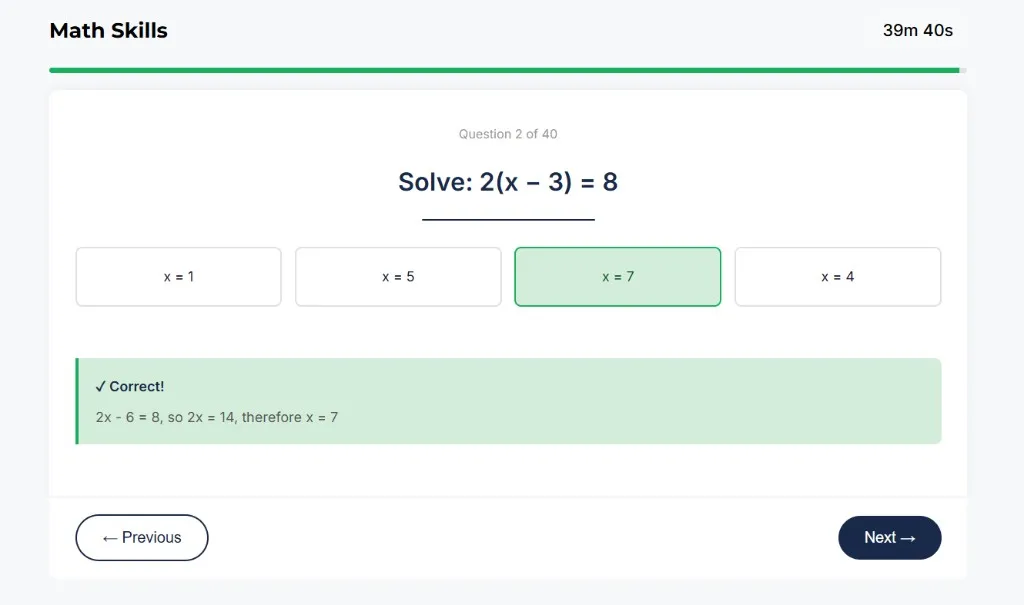
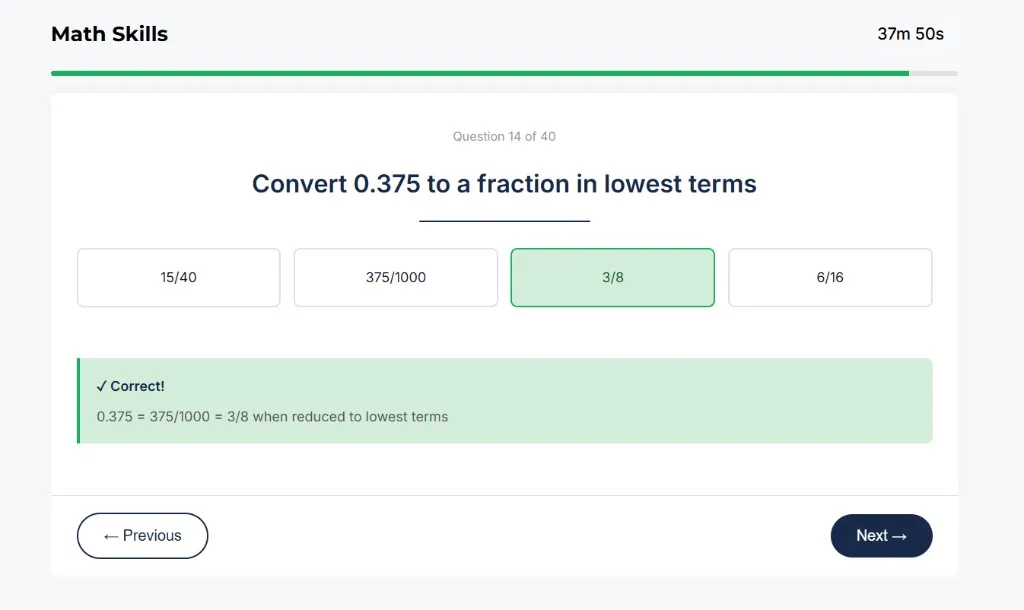
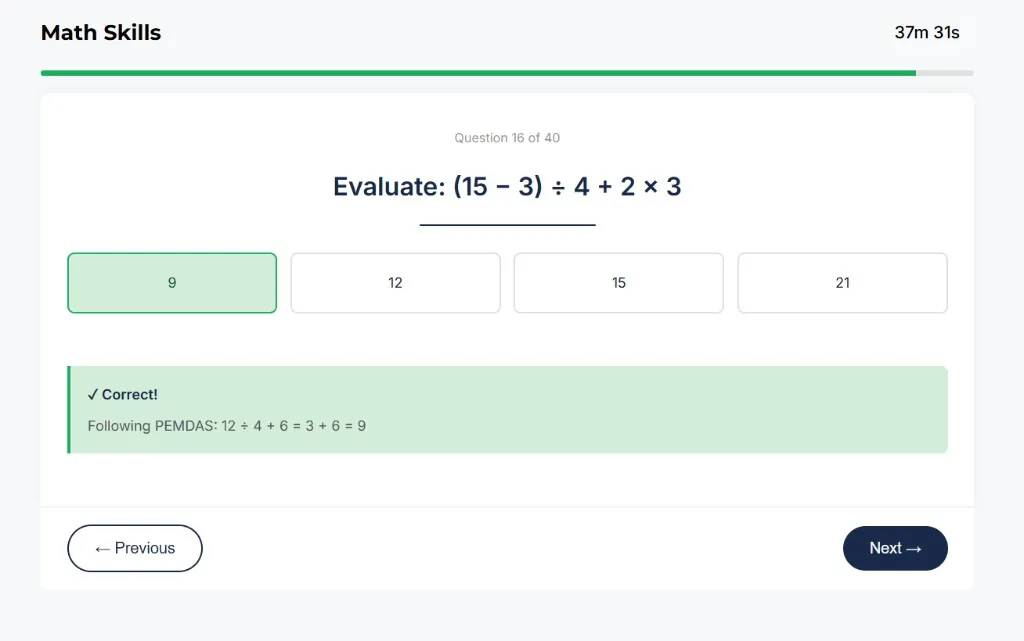
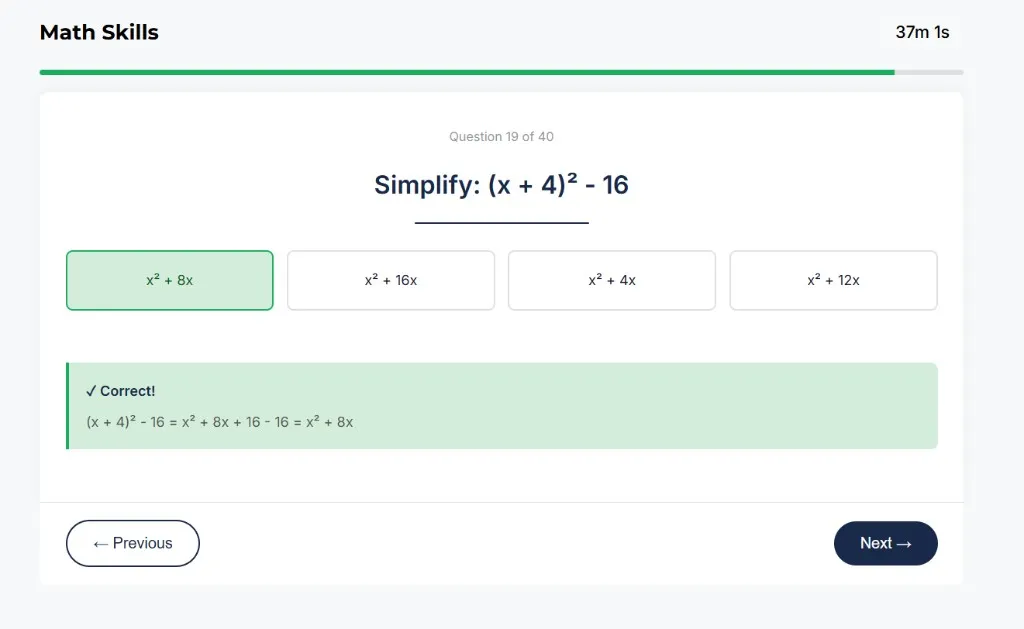
What is the Math Skills subtest?
Math Skills (MST) is a Computer Adaptive Test (CAT) that adjusts question difficulty based on your performance. Answer correctly and the next question gets harder; answer incorrectly and it gets easier. The test continues until it has accurately determined your math ability level.
Because it's adaptive, the number of questions varies — typically 25–35 questions, but it could be more or fewer depending on how consistently you answer. The total time is approximately 40 minutes, but individual question timing varies. Early questions have more influence on your score since they establish your baseline difficulty level.
Math Skills covers arithmetic, algebra, geometry, probability, statistics, and introductory trigonometry. Strong math students will see college-level questions; those struggling will see more basic material. Your score reflects the difficulty level you sustained, not just the number correct.
Math Skills is one of seven subtests that collectively produce your SIFT score (scored 20–80). The SIFT is a computerized test required for all U.S. Army aviation candidates.
What the questions are made of
Math Skills assesses mathematical reasoning from basic arithmetic through introductory college-level topics.
Arithmetic & Number Operations
Fractions, decimals, percentages, ratios, proportions, order of operations. The foundation for every other math concept on the test.
Algebra
Solving equations and inequalities, working with variables and expressions, word problem translation, systems of equations, and basic functions.
Geometry
Area, perimeter, volume of standard shapes, angle relationships, coordinate geometry basics, the Pythagorean theorem, and properties of triangles and circles.
Advanced Topics
Probability, combinations, permutations, introductory statistics, sequences, and basic trigonometry. These appear at higher adaptive levels if you're performing well.
Tips & strategy
On a CAT test, getting hard questions right matters more than answering many easy questions correctly. Each correct answer raises difficulty; each wrong answer lowers it. Your score reflects the difficulty level you sustained.
The first several questions establish your baseline. Take extra care on early questions since they have outsized influence on where the algorithm places you on the difficulty scale.
Because the test adapts, spending too long on a question you can't solve is worse than making your best guess and moving on. The algorithm will adjust and give you a more appropriate question.
Memorize key formulas: area of circles (πr²), Pythagorean theorem (a² + b² = c²), slope formula, quadratic formula, and basic probability (favorable/total outcomes). These appear frequently.
When stuck, plug answer choices back into the problem. This is faster than solving forward on many algebra and word problems, and it's especially useful under time pressure.
Math Skills, quick answers
What is the SIFT Math Skills subtest?
Math Skills (MST) is a computer-adaptive test covering arithmetic through introductory college-level math. The number of questions varies because the test adapts to your performance — harder questions if you answer correctly, easier ones if you don't. The clock does not vary: the time limit is a fixed 40 minutes.
How is a CAT test different from a regular test?
On a CAT (Computer Adaptive Test), question difficulty changes based on your answers. You can't skip or go back. Your score depends on the difficulty level you sustain, not just the number correct. Getting a hard question right is worth more than getting an easy one right.
What level of math should I study for MST?
Study from basic arithmetic through algebra II and geometry. If you're comfortable with those, review basic probability, statistics, and introductory trigonometry. The adaptive format means the test will find your level — strong math students will see harder questions.
Can I use a calculator on the SIFT Math Skills test?
No. The SIFT is taken on a computer but no calculator is provided. Practice mental math and estimation. Many questions can be solved more quickly with mental shortcuts than with formal computation.
Build your test-day method
- Exam-aligned drills under deliberate time pressure
- Instant explanations after every item
- Your score estimate, tracked drill after drill